Times of Israel
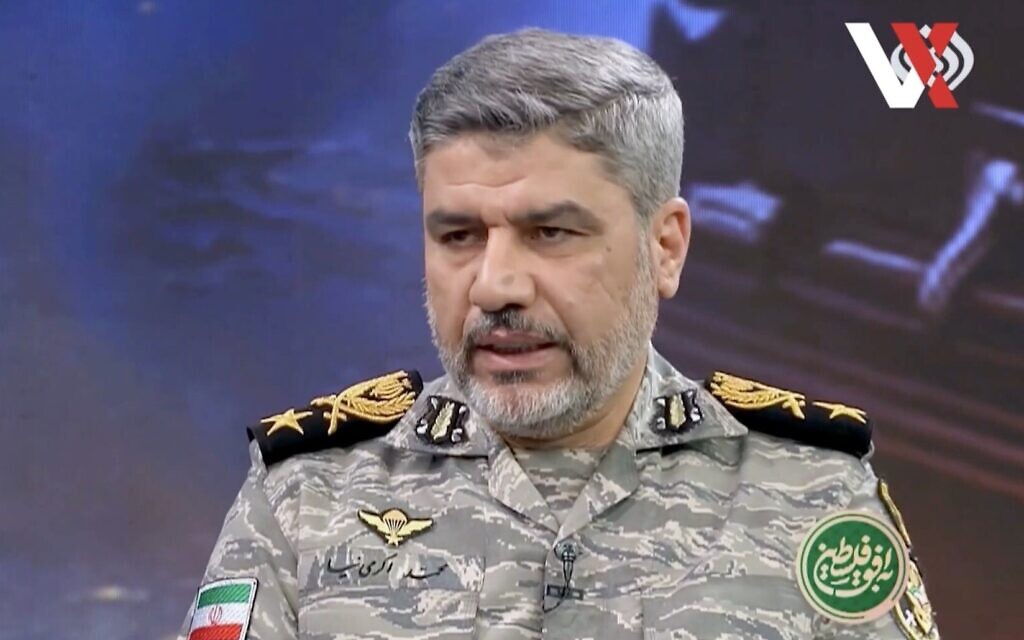
Iran warns Strait of Hormuz is a ‘red line’ and vows to resist until the end
The Times of Israel is liveblogging Thursday’s events as they unfold.
IDF’s West Bank chief says illegal farming settler outposts ‘greatly strengthen security’
The Israeli army general responsible for the West Bank says recently established illegal farming outposts “greatly strengthen security” in the territory.
Speaking at a conference yesterday organized by the so-called Farm Union, Central Command chief Maj. Gen. Avi Bluth says that the settlement farms “align well with the security concept. It does not contradict it.”
“It integrates with it, provided that this is also reflected in operational conduct, as well as ethical conduct, and in accordance with the law,” he says.
“All of this greatly strengthens security,” Bluth says.
“I have great faith in the people here. I look each and every one of you straight in the eye. I love you, I appreciate you, and I appreciate what you do,” he adds.
The left-wing Peace Now organization, which campaigns against Israeli settlements in the West Bank, says that some 120 illegal farming outposts have been established in the three-plus years since the government came to power.
Some of these farming outposts have become hotbeds for settler violence that terrorizes nearby Palestinian communities, as far-right activists use the agricultural communes to expand Israel’s grip over West Bank territory.
The outposts are frequently established on what is defined as state land but without cabinet authorization, meaning they are illegal under Israeli law.
However, government ministries have directly funded the farming outposts, providing them with security equipment and subsidies for raising livestock.
The government has been seeking to legalize the farming outposts.
Ministers said to approve lifetime security detail for Sara Netanyahu, five-year extension for sons
The Ministerial Committee on Shin Bet Affairs has approved a request to extend the security detail for Prime Minister Benjamin Netanyahu’s wife, Sara Netanyahu, for life, and to extend security protection for the couple’s two sons for five years, regardless of the outcome of future elections, according to Hebrew media reports.
The committee is said to have unanimously adopted the move on the recommendation of Shin Bet chief David Zini, who, according to earlier Hebrew media reports, submitted the request after pressure from Netanyahu and his wife, who had argued that the war with Iran and other security developments justified the extended protection.
Netanyahu, who is himself guaranteed protection for the next 20 years, was reportedly seeking the extension to go into effect immediately, regardless of the results of the upcoming elections.
However, officials in the National Security Council and the Shin Bet were said to be hesitant about the move, with sources saying that while they recognize the seriousness of potential threats, they saw no reason to decide now on security arrangements for the next five years.
The Prime Minister’s Office denied initial reports on the request, while the NSC and the Shin Bet refused to comment.
The PMO does not immediately respond to a request for comment on the move’s reported approval.
IDF controls 60% of Gaza, another invasion by Hamas ‘no longer possible,’ says senior officer
The Israeli military now controls more than 60% of the Gaza Strip’s territory, a senior officer says, well beyond the portion of the enclave that Israel was allowed to temporarily continue holding as part of an October 2025 ceasefire deal with Hamas.
“We are standing here [near] the northern Gaza Strip, looking at everything we have achieved — and we have achieved a great deal. More than 60% of the Strip is in our hands,” said Central Command chief Maj. Gen. Avi Bluth during a handover ceremony yesterday for the commander of the 99th Division, whose forces operated in the Strip in recent years.
“There is a security zone for the communities near the Gaza border, held by two divisions and the IDF’s finest soldiers. The threat of an invasion, as occurred nearly three years ago, is no longer possible,” he says.
Bluth adds, however, that “Hamas still controls [its portion of the Strip] and the murderous organization retains residual capabilities, and its vision of destroying Israel has not changed.”
In May, Prime Minister Benjamin Netanyahu said that he ordered the IDF to take control of 70% of the Gaza Strip. At the start of the truce, the military controlled around 53% of the war-torn Palestinian enclave, with Hamas controlling the other 47% where nearly all of the Strip’s two million residents live.
Add ToI as a preferred source on Google
Likud vote on expanding Netanyahu’s control over party slate won’t be held today after court issues injunction
A vote planned for today by the 4,500-member Likud Central Committee on Prime Minister Benjamin Netanyahu’s proposal to dramatically expand his control over the party’s Knesset slate is called off, after the Lod District Court issues an injunction halting the process until all party members are given the opportunity to participate in the vote.
Under the plan, approved by the party’s Constitution Committee earlier this week, Netanyahu would be granted eight reserved slots on the Likud list, including three in the top 10 and six in the top 20, as part of a compromise with committee chair and veteran Likud MK Haim Katz.
The proposal has divided the party, with senior Likud MK David Bitan leading the opposition, as the plan would significantly increase the prime minister’s control over the slate from the three reserved spots he was allotted in the party’s 2022 primaries. The party’s primaries were previously postponed from August 4 to August 17 amid the ongoing dispute.
The injunction was issued following several petitions to halt the vote, including one filed by the Likud Social Forum, which calls the court’s decision “a victory for common sense” and vows to continue protecting the rights of all of Likud’s 150,000 registered members.
“We will not allow the elections to be stolen,” the group says.
In response, Likud says that Netanyahu “insists that every Likud member be able to exercise their right to vote.”
“Because legal delays disrupted the voting process and prevented many members from casting their ballots, the Likud chairman and prime minister instructed the party administration not to hold the vote today and to set a new date for a repeat vote in the near future,” the party says.
Israel arrests officials in outlawed PFLP-linked health org in West Bank
Several top members of a health organization affiliated with the Popular Front for the Liberation of Palestine terror group were recently apprehended in the West Bank, Israeli authorities announce.
The Union of Health Committees was outlawed by Israel in 2021 for allegedly serving as “a central part of the financial apparatus” of the PFLP.
In a joint statement, the Shin Bet, police and IDF say that several senior employees at the Union of Health Committees were arrested after “the institution had resumed operating from its headquarters in Ramallah and continued employing operatives, including members of the Popular Front terrorist organization.”
Among those detained are PFLP operatives, the statement says.
The Shin Bet says that in the past few days, indictments were filed against some of the suspects, and additional indictments are expected in the coming weeks.
Home prices fall 1% in April-May, largest drop in eight years
Home prices in Israel recorded their largest monthly decline in eight years in April and May 2026, falling by 1% compared to the previous two-month period, according to the most recent report released by the country’s Central Bureau of Statistics.
Market prices have fallen an average of 2% compared to the same period a year earlier, marking one of the few sustained annual declines in the past decade, the CBS says. Prices have declined in nine out of the last 12 months.
Israel’s housing market has slowed over the past year, partly in reaction to the multifront war Israel has been engaged in since Hamas invaded southern Israel on October 7, 2023. High interest rates, a record supply of unsold new housing, and high prices have also helped to tamp down sales. The shekel’s strength against the dollar, currently at NIS 3.01, is also affecting demand from overseas buyers.
The Israeli currency is about 10% stronger than it was a year ago, and has fluctuated by more than 20% over the past 16 months, trading data shows. The strength of the shekel means that while interest from foreign buyers is still high, their dollars, pounds and euros don’t go as far as they used to, with the cost of homes rising by hundreds of thousands in some cases when exchanging currencies.
The decline also follows market uncertainties regarding the US-Israeli war with Iran, which began on February 28.
During April and May, prices declined by 2% in Tel Aviv, 1.8% in Jerusalem, 1% in the south, 0.5% in Haifa, and 0.3% in the north. It was unchanged in the central district.
Compared with the same period last year, prices have climbed 1.4% in the north and 0.3% in Jerusalem. Prices fell by 3.2% in the central district, 2.6% in Haifa, 2.5% in Tel Aviv, and 0.5% in the south.
Heavy traffic expected as extremist Haredim set to block central Israel highways at rush hour
Ultra-Orthodox men from an extreme sect gear up to block highways in central Israel during rush hour today, protesting recent arrests of draft dodgers.
The demonstrators, from an even more extreme group within the extreme Jerusalem Faction, are set to block Route 4 from Aluf Sade interchange until Em HaMoshavot interchange, and the Israel Police says heavy traffic is expected in both directions starting around now.
Protests and road blocking are also predicted to occur near Jabotinsky Road in Bnei Brak.
Police recommend that drivers use alternative routes and say cops are being deployed, adding that the force won’t allow the demonstrators to break the law.
Later, at 8 p.m., and more to the north, some 2,000 men from the Sanz Hasidic sect will hold a rally near the Neve Tzedek Military Prison to protest the arrest of two draft evaders from the community.
A law to halt the arrests of draft dodgers passed this week, but the High Court has frozen the legislation pending a decision on its legality.
Sources: Iran orders Houthis to close Red Sea gateway if US hits its power network
Iran has asked Yemen’s Houthi rebels to stand ready to close the Red Sea oil route if the United States strikes Iranian power infrastructure, three sources have told Reuters, posing a potent new threat to global energy supplies.
The idea has been discussed within the Islamic Republic’s leadership, and the message has been conveyed to Iran’s Houthi allies, two senior Iranian sources and a regional source familiar with the matter say, speaking on condition of anonymity.
The sources say the Houthis have been informed recently of Tehran’s request, which has not been previously reported.
They do not give further details on how it was conveyed or whether it was after US President Donald Trump’s threat to attack Iranian power infrastructure on Tuesday.
Iran’s foreign ministry and a spokesperson for the Houthi group are not immediately available to respond to Reuters’ request.
A source close to the Houthis says the group completed preparations to attack shipping by deploying missiles and drones near Bab el-Mandeb strait, the gateway to the Red Sea, in Yemen’s highlands overlooking Hodeidah and the Gulf of Aden and is awaiting the order to begin.
Any threat to the Red Sea and its Bab el-Mandeb gateway risks hugely exacerbating the global energy crisis triggered by Iran’s closure of the Strait of Hormuz and underscores the explosive risks stemming from a new round of warfare.
High Court sets July 28 hearing on law banning arrests of Haredi draft dodgers
The High Court of Justice sets July 28 as the date for a hearing over petitions against the law passed in Knesset on Tuesday halting arrests for Haredi draft dodgers.
Implementation of the highly contentious law was frozen by the court yesterday as it said it was preparing to review it.
Supreme Court President Isaac Amit determines that the petitions will be heard by a large panel of nine justices, which the court uses only for deliberating extremely weighty issues.
Amit himself is not on the panel, which will be headed instead by Deputy President Noam Sohlberg.
Sohlberg headed a judicial panel on petitions against the government’s failure to enforce ultra-Orthodox conscription last year, and wrote a fiercely worded ruling against the government and the refusal of the Haredi community to enlist. The ruling was issued unanimously by all five justices on the panel.
The new legislation bans arrests, investigations and enforcement measures against draft dodgers enrolled in yeshiva study until November 30, but will actually extend to February 2027 due to legal reasons tied to the upcoming elections.
Critics say that beyond encouraging draft-dodging, the law is discriminatory, for preventing arrests of draft-dodgers from only one part of the population while enabling the continued arrests of all others.
Government okays NIS 230 million for Jewish identity programs through Settlements Ministry
The government approves NIS 230 million ($77 million) in funding for a program to strengthen Jewish identity among young Israelis, proposed by Finance Minister Bezalel Smotrich and Settlements and National Missions Minister Orit Strock of the ultranationalist Religous Zionist party.
“In recent years, and even more intensely since the October 7 attack, the Jewish Identity Directorate in the Settlement Ministry has identified a growing demand among the general public, and particularly among young people finishing military service and [higher education] students, to participate in programs run by the ministry to strengthen spiritual life and Jewish identity,” Smotrich and Strock’s announcement says.
It says the Jewish Identity Directorate has “doubled” its activities in recent years due to increased interest.
The new funding is designed to further expand the activities of the directorate and help it reach 10 percent of all students in Israel, and a similar proportion of those not in higher education.
Smotrich and Strock state that the “underlying premise of the decision is that strengthening Jewish identity is an increasingly important public need, and that the state has a responsibility to address it as part of strengthening Israel’s national and social resilience.”
Smotrich adds: “Investing in the identity and heritage of the younger generation is the way to ensure the spiritual victory of the people of Israel, and it is an inseparable part of our responsibility as a state.”
View original source — Times of Israel ↗
Related stories

Engadget
TechnologyJul 16, 2026 · 1 min
Smart speakers could help OpenAI lose even more money
Engadget

TechCrunch
TechnologyJul 16, 2026 · 1 min
Why AMI Labs’ Alexandre LeBrun won’t call his AI ‘AGI’ or ‘superintelligence’
TechCrunch

Dawn
TechnologyJul 16, 2026 · 1 min
Court extends physical remand of three suspects in alleged kidnapping, rape of two foreign women
Dawn

Engadget
TechnologyJul 16, 2026 · 1 min
Ofcom, the UK's communications regulator, is investigating TikTok's child safety measures
Engadget