OnlineKhabar
From memory to movement: Binod explores Nepal’s residual trauma through multi-venue project
Photo: Erina Tamrakar’s FB
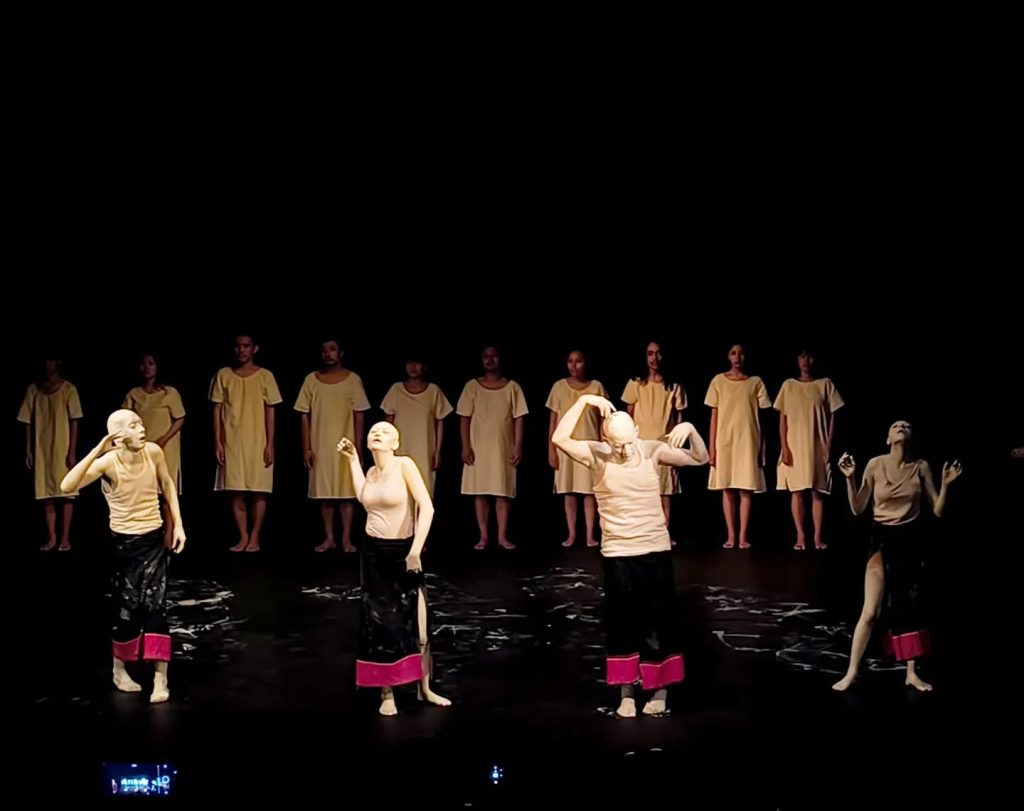
After nearly 15 years away from Nepal, artist and educator Binod Shrestha returns with an ambitious project, ‘Silent Bone,’ spanning four venues and three site-specific performances, exploring displacement, memory, violence and the traces they leave behind. Currently a professor at the University of North Texas in the United States, Binod has spent two decades teaching while continuing an interdisciplinary artistic practice that has evolved from painting to installation and performance.
In this conversation, he discusses why ideas matter more than medium, why art should provoke questions rather than provide answers, and how Nepal’s political history continues to shape the bodies and minds of its people.
Q: You have spent many years teaching in the United States. What inspired you to return to Nepal with this project now?
Binod: The idea actually began almost 20 years ago when I was in graduate school in the United States. I wanted to create a large-scale performance involving many people, but teaching and work delayed those plans. After teaching for 20 years, I finally felt the timing was right. At the same time, I revisited my earlier research on violence in Nepal, especially the legacy of the civil war, and began reading about contemporary political movements. Everything seemed to align. It felt like the right moment to return and realise this long-held project.
Q: How has your artistic practice evolved over the years?
Binod: I originally wanted to become a painter. Even when I went to India and later to the United States, painting remained my focus. That gradually changed. Making paintings was expensive, and one of my professors reminded me that artists don’t need costly materials to create meaningful work. That stayed with me. I began working with recycled materials, installations and eventually performance. For me, ideas are always more important than the medium. The concept should determine whether the work becomes a painting, installation, performance or something entirely different.
Q: This project was spread across several galleries and public spaces. Why did you choose this format?
Binod: I think of the entire project as an anthology. Each exhibition or performance is like an individual chapter with its own identity, but all are connected by a larger narrative. Each venue also offers different possibilities. Some spaces are intimate and suited for text-based installations, while others allow large-scale installations or performances where I can control light and sound. Rather than forcing every work into one gallery, I wanted each location to shape the experience.
Q: What connects all these exhibitions conceptually?
Binod: The project explores displacement, migration, memory and the residues left by violence. The venues themselves carry historical and political significance. Patan Museum reminds me of displacement through Nepal’s monarchy. Chobhar connects to the mythology of Kathmandu Valley. Asan represents centuries of trade and cultural exchange. Taragaon Next, meanwhile, represents contemporary artistic engagement. Together they create a dialogue between Nepal’s history and its present.
Q: Your performances are quiet rather than overtly dramatic. What are you trying to communicate?
Binod: I’m not interested in depicting the act of violence itself. I’m interested in what remains after violence—the emotional, psychological and social residue carried within people. Every Nepali body, in some way, carries the residue of political violence. We have experienced repeated political upheavals without fully processing them. Those experiences continue to shape how we react, remember and relate to one another. My performances express those lingering memories through repetition, stillness and quiet movement rather than spectacle.
Q: Audiences in Asan seemed curious about the performance. How do you respond to different interpretations?
Binod: I actually welcome that. I don’t expect everyone to immediately understand the work. Even asking, “What is happening?” is an important beginning. Curiosity opens a conversation. Art doesn’t need to provide fixed answers—it should encourage people to think differently.
Q: After being away for so long, how do you see Nepal’s contemporary art scene?
Binod: I don’t think I’m fully qualified to make broad conclusions because I haven’t consistently followed everything happening here. However, I’ve noticed significant growth. There are more colleges, galleries, artist-run spaces and residency opportunities than when I first started. These institutions are creating important support systems for younger artists, which is encouraging.
Q: As both an artist and a professor, what differences do you notice between students in Nepal and those in the United States?
Binod: Nepali students are doing very interesting work today. The biggest advantage they have is access to information. Twenty years ago, geographical distance also meant informational distance. Today they can instantly see what’s happening anywhere in the world. The biggest difference is cultural rather than artistic. American students tend to be more direct and more demanding. If they disagree with a grade, they’ll ask questions and expect explanations. Nepali students are generally much more respectful and polite in their interactions, even when they disagree.
Q: You financed much of this project yourself. What do you hope to gain in return?
Binod: Financial return isn’t my primary motivation. I’ve invested around US$10,000 to US$11,000 because I believe the experience itself has value. Nearly 30 students have worked alongside me. If they take something meaningful from this project into their own practice, that’s already a return. The conversations, documentation, future opportunities and the questions audiences ask are also forms of return. Not everything valuable can be measured economically.
Q: What role should artists play in society?
Binod: My responsibility is simply to make the work honestly and present it to the public. Whether society accepts it or rejects it isn’t something I can control. In many ways, it’s similar to the idea of karma—you do what you believe is right without becoming attached to the outcome.
Q: What does art mean to you personally?
Binod: Art is a fundamental human need to express ourselves and to understand who we are. No matter what society thinks, there will always be people who want to make music, create art or tell stories. Art also functions as a mirror—it reflects society to itself.
Q: Your project embraces uncertainty instead of providing clear conclusions. Why is that important?
Binod: Life itself is uncertain. The only certainty we have is that everything changes. As artists—and as people—we need to become comfortable with uncertainty. Openness allows curiosity, and curiosity allows understanding. If we always seek immediate certainty, we risk becoming closed-minded. Repeated encounters with an artwork allow us to see it differently over time, just as viewing an object from another angle changes our perception.
Q: Finally, what does the meaning of life mean to you?
Binod: I don’t think finding a single definition of life’s meaning is the most important question. What’s more important is living fully while trying not to harm others. If there is one purpose, perhaps it’s to leave the world a little better than we found it. Whether we succeed is another question.
View original source — OnlineKhabar ↗
Related stories

The Punch
PoliticsJul 16, 2026 · 1 min
Christians now more comfortable with Muslim-Muslim ticket, says APC chieftain
The Punch
The Punch
PoliticsJul 16, 2026 · 1 min
R. Kelly seeks clemency, asks Trump to reduce 31-year prison sentence
The Punch
South China Morning Post
PoliticsJul 16, 2026 · 1 min
Sheikh Hasina’s return bid threatens to upend Bangladeshi politics
South China Morning Post

The Hill
PoliticsJul 16, 2026 · 1 min
EPA’s proposed rule change will put national security at risk
The Hill