Times of Israel
Syria says it foiled attempt to smuggle advanced arms to Hezbollah from Iraq
Syrian authorities on Thursday said they had foiled an attempt to smuggle a large shipment of advanced weapons and missiles over the border from Iraq, destined for the Hezbollah terror group in Lebanon.
Syria’s Interior Ministry, in a statement carried by the state news agency SANA, said that a suspicious vehicle was found parked near the border with Iraq, and that specialized security units searched it.
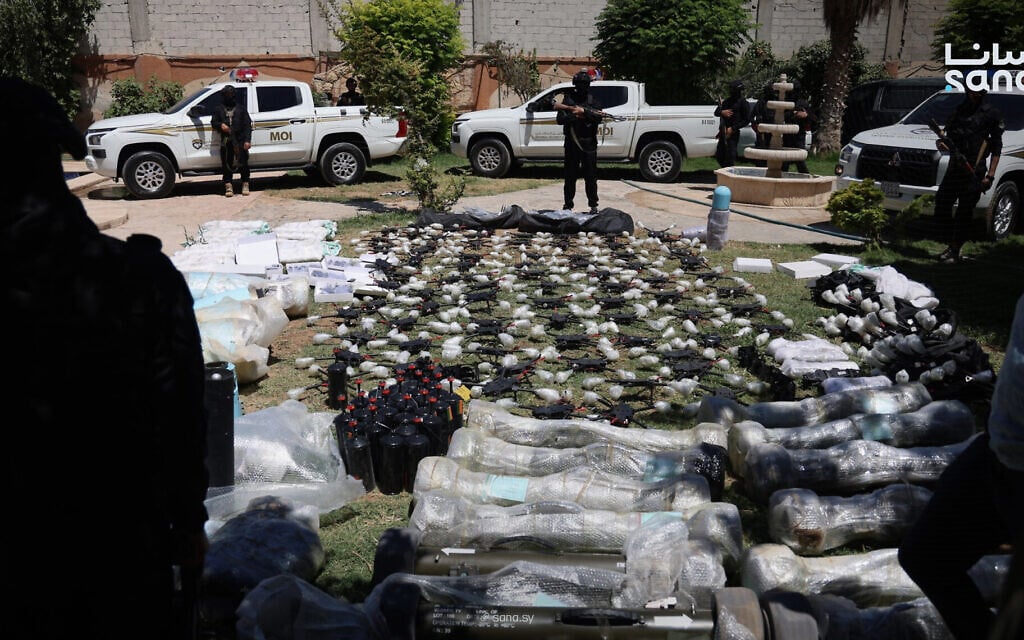
“A search uncovered a cache of weapons that included long-range missiles, anti-tank guided missiles and drones,” SANA reported.
Images published by SANA showed that the arms cache included anti-tank weapons, and a large number of fiber optic-guided first-person-view (FPV) drones, which have been used repeatedly by Hezbollah in attacks on Israeli forces in southern Lebanon.
Citing preliminary investigations based on evidence collected at the scene, Syria’s interior ministry said that the “shipment was intended to transit Syrian territory before being delivered to the Hezbollah terrorist militia in Lebanon.”
Get The Times of Israel's Daily Edition
by email and never miss our top stories
By signing up, you agree to the terms
Syrian authorities were working to identify those involved in the smuggling operation “and dismantle the networks linked to it,” SANA added.
#Syria: #IRGC took advantage of the 100s of Iraqi oil tankers traveling daily to Baniyas to smuggle a truckload of weapons intended for Hezbollah.
A large cache of anti-tank weapons and a hundred of fiber-optic FPV drones was seized at the Tanf border crossing after entering… https://t.co/rU4zzSymgO pic.twitter.com/woqyJBjZiv
— Qalaat Al Mudiq (@QalaatAlMudiq) July 16, 2026
US President Donald Trump said in June he had spoken to Syrian President Ahmed al-Sharaa about combating Hezbollah.
The former rebels who now run Syria fought against Hezbollah for years as it was sending fighters to support Syria’s then-president, Bashar al-Assad, in a civil war.
Lebanese President Joseph Aoun’s office said Sharaa had assured him Syria would not take sides in Lebanon’s internal affairs.
Sharaa himself, in June, ruled out intervening militarily in the Israel-Hezbollah conflict in Lebanon. He has repeatedly assured Israel and Western powers that Syria was exhausted by years of civil war and that it would not be dragged into conflicts that may lead to further destruction, but would rather focus on reconstruction and stability. It has, however, previously stopped weapons shipments heading to Lebanon.
Meanwhile, Defense Minister Israel Katz spoke with his American counterpart, Defense Secretary Pete Hegseth overnight, his office said.
Katz’s office said that Hegseth updated the defense minister “on the American military’s activities in Iran, and the two agreed to continue cooperation between the countries in the face of any possible developments.”
Katz also briefed Hegseth on Israel’s activities in Syria, Gaza, and Lebanon, his office said.
“We have never asked the United States to act on our behalf along our borders. We are committed to defending the citizens of Israel against every threat, and that is what we intend to do,” Katz said.
Trump has reportedly been urging Prime Minister Benjamin Netanyahu to pull Israeli troops from southern Lebanon, where they are holding a self-declared security zone to keep Hezbollah from the border.
US-led diplomacy started after Hezbollah dragged Lebanon into war by attacking Israel in early March in support of Iran, which was facing a joint US-Israeli air campaign. Talks moved forward despite strong objections from the Iran-backed terror group, which believes only Iranian pressure on Washington can secure an end to the war and Israeli withdrawal.
According to an Axios report on Tuesday, Washington sought a security agreement between Israel and Syria for months but eventually came to the conclusion that Netanyahu was not willing to meet the necessary terms, including pulling troops out of Syria.
Last month, Israel agreed to withdraw its forces from two designated “pilot zones” in southern Lebanon as part of ongoing negotiations with Beirut to allow the Lebanese Armed Forces to assume security control in those areas, with the aim of ensuring that it is clear of Hezbollah weapons. But two and a half weeks have passed and Israel has yet to pull out from either pilot zone, slowing talks between the sides.
Hezbollah has repeatedly attacked Israel across the border over the years with rockets and drones, disrupting the lives of tens of thousands of Israelis and triggering conflicts.
Iran long supplied Hezbollah with weapons through Syria with Assad’s blessing, but there has been some hope that this would stop under the country’s new rulers, who are not aligned with Iran’s regional aspirations.
After the fall of Assad’s regime in Syria, Sharaa responded to Israeli concerns and offered reassurance that the new Syrian government would not threaten the Jewish state or allow Iran to reestablish itself in Syria.
Immediately after Assad’s fall, Israeli forces moved into a buffer zone along the Syrian side of the border, but said this was a temporary measure until the intentions of the new regime could be verified.
Israel has also signaled its desire to have “correct ties” with the new regime, as Netanyahu said in early December 2025.
View original source — Times of Israel ↗
Related stories

The Punch
SportsJul 16, 2026 · 1 min
19-year-old Messi-Yamal photo resurfaces ahead of world cup final
The Punch

ESPN
SportsJul 16, 2026 · 1 min
Tuchel's retreat set up England's exit as Argentin...
ESPN
The Punch
SportsJul 16, 2026 · 1 min
Why I want to be NBA President – Badejo-Okunsanya
The Punch
ESPN
SportsJul 16, 2026 · 1 min
2026 MLB betting guide: Brewers to win it all? Cam...
ESPN