Indian Express
Restaurants on each floor, fading hardware stores: How Delhi’s Hauz Khas market changed in 2 years
Tucked behind Aurobindo Road in Hauz Khas, G Block was one of Delhi’s go-to destinations for hardware, paint, steel and sanitary ware for decades, with most shops there since the 1950s.
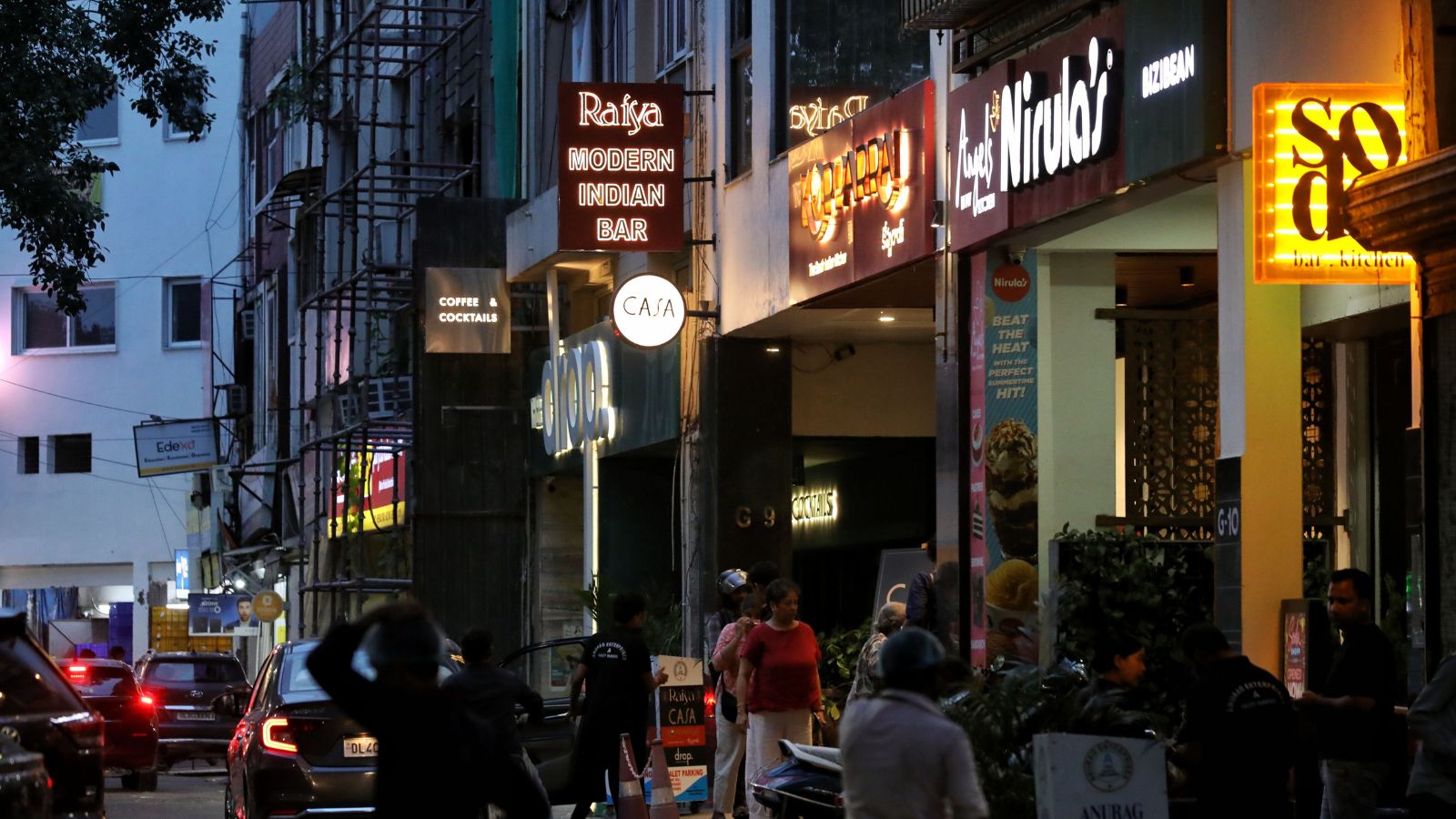
Today, walk in from Aurobindo Road and the first thing that greets you is a building with a different restaurant on every floor: Arisii serving coastal food on the ground floor, Savage, a sandwich shop — which turns into the club Painkiller after 7 pm — on the first, and Bihari restaurant Potbelly on the second.
Shopkeepers estimate that the 16 hardware and sanitary stores have shrunk to 4: Sawan Paints and Electrical, Elegance Hardware, Shiv Sanitary Store, and Lakhotia’s Laxmi Steel Sanitary and Hardware store.
Juxtaposition of cafes and hardware stores. (Express Photo by Abhinav Saha)
In their place, at least a dozen restaurants and cafés have opened in under two years: Arisii, Savage/Painkiller, Potbelly, Raiya, Casa Pasta Bar, Kopparrai, Nirula’s, Bizibean, Soda Shop, Public Supply, NYNY and Drop Coffee among them — with more on the way. To-let signs hang on almost every building, and several are under active construction.
For 56-year-old Amarjeet Singh Khurana, the ground floor of his G-15 building was a grocery store his father opened before he was born, one he ran himself for 26 years after taking over in the late 1990s.
Last December, he leased it out. Today it’s NYNY, a pizza joint. Khurana lives on the floor above it, while the second floor is occupied by a commercial office.
“Business was slow since the rise of e-commerce platforms like Blinkit and Zepto, and I was quite alone in managing the space, so I decided to retire,” he says.
Story continues below this ad
Prime location
For the new arrivals, the calculation has been straightforward: a central location in South Delhi with affordable rental prices.
Amol Kumar (39), founder of NYNY, was looking for a space to take forward what he started with Leo’s Pizzeria, which opened in 2016. He’d looked at the G-15 space once before at the start of 2025 and passed on it.
“It was quite dirty,” he says, but eight months later, his realtor brought him back for a second look at night. He says, “I suppose I saw more promise, because then I could see there’s activity happening, a lot more restaurants were already up and running.”
Inside NYNY, waiters weave between tables of chattering customers. Some attention is on the wall projecting the Wimbledon match. On days when there isn’t a match, videos of New York streets play on loop, staying on theme.
Story continues below this ad
The lime-washed walls give it an old-school garage look; the orange-tiled wall behind the bar is lined with shelves which hold some paintings, a NAS record, a stack of books including a Pizza cookbook, and small knick-knacks.
With about 10 tables and singular or couple seating even around a column of the shop, the restaurant is open from 12 am to 12 pm.
Situated right next to NYNY is Public Supply, with a similar colour palette of orange and grey. Speakers outside both restaurants seem to be competing, creating a co-mingling of sounds that singularly would be pleasing.
Although the cuisine offered in both differs drastically; while NYNY asks you to indulge with their Neapolitan pizza slices, Public Supply is a “wellness-focused place,” with a menu ranging from smoothie bowls to coffees.
Story continues below this ad
Opened about nine months ago, it was 29-year-old Ayush Gulati’s interest to bring “food that feels good to have,” after spending years in London. “I just loved the neighbourhood around the place — this is a very rich neighbourhood,” he says.
With an orange name board and black sharp lettering of the name, ‘Public Supply’ catches the eye. One can glimpse the interiors from the outside due to the glass build: grey walls, a see-through bar where one can watch coffees and matchas being made, the menu lit up in beige and orange, and a huge logo lit up in white right at the entrance – P:S.
Public Supply is a “wellness-focused place,” with a menu ranging from smoothie bowls to coffees. (Express Photo)
“I’ve used the colon because it reminds me of a digital clock, and that’s what we are: open 7 days a week,” says Gulati.
Pointing to a girl with pink hair, Gulati says, “It’s her second time here; we have built regulars now, and that’s all we want.”
Story continues below this ad
“When one big player enters, other big players also come up, and the whole market brightens up,” says Gulati about G Block becoming a food hub.
Just beside Public Supply are Shiv Sanitary Store and Sameer Scrap Dealer. At evening time, around 6, a distinction is apparent: the workers of these stores talk and sit outside while visitors of restaurants on the other side of these stores are seen smoking and gabbing. Cars flow in and out of the small street, as do the valet workers.
Casa Pasta Bar has the distinction of being the market’s first restaurant, opening in November 2024 on the first floor of a newly constructed building, G-9.
The location was appealing to the owners as “Hauz Khas offered a central location, with easy access to 70% of South Delhi localities. At the time, it also presented a good opportunity in terms of rental value,” says Jessica Solomon, Brand Marketer of Casa.
Story continues below this ad
Since then, their business has grown roughly 20%, driven by the area’s rising footfall, with weekend numbers running about 50% higher than weekdays.
Kopparrai, occupying the ground floor of the same G-9 building as Casa, followed in April 2025. Raiya occupies the second floor of the building.
Most restaurant owners in the market told The Indian Express they expect the last of the hardware shops to be replaced within the next year or two.
The other side
For the hardware shop owners who remain, the shift has been disorienting.
Story continues below this ad
“It used to be a hardware market; if any customer that came in knew they’d get everything related to hardware, electricals, or sanitary items here. Now, new customers don’t come in anymore,” says Mani, owner of Sawan Paints and Electrical, which sits beside the building housing Arisii, Savage and Potbelly.
Arun Lakhotia (55), whose grandfather and father started Laxmi Steel Sanitary and Hardware Store in 1965, has watched the market empty out from the inside.
“About 10 years ago, there were 16 shops; gradually, due to one reason or another, they kept closing. In the past two years or so, things have quickly changed… it has now become an eating hub,” he says.
At Elegance Hardware, 18-year-old manager Aman describes a more immediate friction: “We can’t park our own vehicles sometimes because there is no space. The restaurant visitors park their vehicles in front of our shops, making it difficult for our customers to enter our store.”
Story continues below this ad
Saurabh Taneja of Shiv Sanitary Store has been in the market for 52 years — long enough to remember when rents on G Block ran to Rs 400-500 a month, with a security deposit of Rs 20,000 and leases that stretched past three decades.
“The rent used to increase by 10% every three years,” he says. “Nowadays, people get a good rental amount; most showrooms [restaurants] here are paying Rs 3.5-4 lakh for rent per month.”
His own shop at G-7 once paid just Rs 750 a month before he was compelled to shift. By his estimate, property values in the market have risen roughly two-and-a-half times in the last two to three years. “After the Covid-19 pandemic, the market started changing, and 80% of the businesses changed or shut down,” he adds.
Anurag Enterprises runs a 15-person valet team for the restaurants, parking cars along roughly 500 metres of the main road. “A lot more restaurants are going to be opening up,” says Prince Pathak, 20, one of the valets, gesturing at buildings under construction nearby.
Shopkeepers at G Block market estimate that the 16 hardware and sanitary stores have shrunk to four. Express Photo
Behind the change
Much of the shift traces back to zoning and legal changes.
G Block falls under ‘shop-cum-residence’ according to Delhi’s Master Plan 2021, which means those using the residence floors for commercial purposes had to pay a conversion charge to do so, say members of the B1 and G Block Residents’ Welfare Association (RWA).
On October 31, 2025, the Supreme Court upheld the Municipal Corporation of Delhi’s right to collect those conversion charges — a ruling that cleared the way for many owners to lease or sell out.
Long-time tenants describe a parallel dynamic: as older, low-rent hardware leases lapsed under the Rent Control Act, landlords found it far more lucrative to bring in restaurants willing to pay lakhs a month instead of a few hundred rupees.
For residents who have lived in the adjoining B1 Block colony for decades, the transformation of the once-quiet commercial market into a bustling food hub has turned the lane behind their homes into what they describe as a “service corridor”, bringing exhaust fumes, noise, garbage and parking congestion to their doorstep.
Lalit Parakh (69), a jeweller who has lived in B1 for nearly 40 years, points to a Naturals ice cream outlet on his walk through the market. “That used to be Bank of Baroda, you know,” he says.
“The hardware shops didn’t require the rear entrances, so it was mostly sealed. But after they were vacated and the new restaurants started coming in, the back entrances were opened, facing our houses,” Parakh says.
He and other residents say exhaust ducts release fumes into the colony and generate noise late into the night.
The residents have accepted their helplessness because this may be an issue, but it is the restaurants’ right by law to have their ducts open.
Chandrasekhar (62), a chartered accountant born and raised in B1, says, “We have common electricity lines for almost everything. The market consumes a lot of power. We’ve repeatedly sought separate feeder lines, but nothing has happened. I’ve often seen power poles outside our houses sparking.”
Mukul Verma, RWA president of the B1 and G Block, says the issue has been raised with authorities. “We are currently in talks with the BSES to establish separate feeder lines for G Block. They have promised us a solution soon,” he says.
He adds that he has closed the rear entrance to the restaurant operating in his own building: “I am not responsible for what the other building owners do. The onus is on the MCD and authorities concerned to resolve that.”
Residents said they have submitted complaints and are prepared to move court if authorities fail to act. The Indian Express reached out to the MCD for comment but did not receive a response.
Puttarlal Gupta (66), who has been a supplier visiting this market for more than 35 years, says he has seen the market transform before his very eyes. “I don’t work here, but I’ve watched this market change… more and more restaurants are coming in and stores are shutting down,” he says.
View original source — Indian Express ↗
Related stories

TASS
TechnologyJul 16, 2026 · 1 min
Europe ready to see all Ukrainian men drafted — Russia's representative to OSCE
TASS

The New York Times
TechnologyJul 16, 2026 · 1 min
Will SpaceX’s 13th Test Flight of Starship Be Lucky?
The New York Times

The Verge
TechnologyJul 16, 2026 · 1 min
Ninja’s microwave air fryer could be the fix for soggy reheated pizza
The Verge
Indian Express
TechnologyJul 16, 2026 · 1 min
UPSC Key: Kudankulam, Semiconductor Mission (ISM) 2.0 and Intercontinental ballistic missile
Indian Express