Antara News
Indonesia simplifies rules to fast-track waste-to-energy projects
Jakarta (ANTARA) - Indonesia has streamlined regulations for waste-to-energy (WTE) projects, cutting hundreds of requirements to just three rules to accelerate urban waste management and renewable energy development, Coordinating Minister for Food Affairs Zulkifli Hasan said on Thursday.
The regulatory overhaul aims to remove longstanding bureaucratic hurdles that have delayed WTE investments while helping the government address mounting urban waste volumes and expand renewable energy generation.
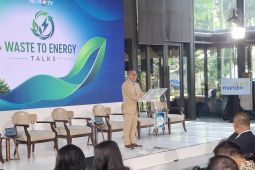
"My task is only one: improve the regulations. We reduced hundreds of rules to just three," Hasan said during the Waste to Energy Talks: Reducing Waste, Powering the Future forum in Jakarta.
He said developers previously had to secure approvals from multiple levels of government and coordinate with numerous ministries and state institutions before projects could proceed.
The process included obtaining approvals from local governments and regional legislative councils (DPRD), while also coordinating with the Ministry of Finance, the Ministry of Energy and Mineral Resources, the Ministry of Environment, and state electricity company PT PLN (Persero).
"I will give you an example. If I were an entrepreneur seeking to develop a waste-to-energy project, I would first have to obtain approval from the district legislative council and the district head. If the project covered two districts, I would also need approval from the governor and the provincial legislative council," Hasan said.
After securing those approvals, developers still had to arrange financing, obtain energy-sector permits, complete environmental impact assessments, and finalize power purchase agreements with PLN, he added.
Hasan said President Prabowo Subianto later established a national task force on waste management and assigned him to oversee regulatory reforms and resolve bottlenecks involving ministries and government agencies.
"If obstacles arise, I simply call the relevant parties. If I still cannot resolve them, I report directly to the president. The president takes the lead," he said.
The reforms are backed by Presidential Regulation No. 109 of 2025 on Urban Waste Management through Environmentally Friendly Renewable Energy-Based Waste Processing.
The regulation replaces Presidential Regulation No. 35 of 2018, which previously governed the acceleration of waste-to-energy power plant development.
The policy comes as Indonesia faces a growing waste challenge, with national waste generation reaching approximately 141,926 metric tons per day, according to government data.
Under the new framework, sovereign wealth fund Daya Anagata Nusantara (Danantara) will facilitate investor selection and project development, while state electricity company PT PLN (Persero) will purchase electricity generated by WTE facilities.
Hasan said the government aims to resolve waste emergencies in priority urban areas by 2027 and 2028, with the remaining regions expected to follow by 2029.
"The emergency areas must be completed in 2027 and 2028. The rest will follow in 2029," he said.
The government plans to prioritize urban clusters generating at least 1,000 metric tons of waste per day to ensure projects remain economically viable.
Authorities have identified 24 WTE clusters, each potentially serving two or three districts or cities within a single service area.
Hasan said accelerating the projects would also require local governments to ensure reliable waste collection, transportation, and a sustainable supply of waste feedstock.
The government expects WTE facilities in priority areas to be completed in phases through early 2028.
Related news: President targets urban waste with 34 new power plants
Related news: Indonesia to begin 34 waste-to-energy projects, Prabowo says
Related news: RI Govt moves to turn urban waste into renewable energy
Translator: Aria Ananda, Martha Herlinawati Simanjuntak
Editor: Azis Kurmala
Copyright © ANTARA 2026
View original source — Antara News ↗
Related stories

The Punch
WorldJul 16, 2026 · 1 min
Police rescue middle-aged man during patrol in Anambra
The Punch
The Punch
WorldJul 16, 2026 · 1 min
BREAKING: A’Court sets aside judgment nullifying INEC guidelines
The Punch
The Punch
WorldJul 16, 2026 · 1 min
Why army’s response to Kogi school attack was delayed — Commander
The Punch
The Punch
WorldJul 16, 2026 · 1 min
Gbajabiamila sues ‘fake’ agency DG, demands N15bn over defamation
The Punch