The Next Web
Nokia and Nvidia built the first commercial AI-RAN, aiming to double network capacity
The firms powering the AI boom now want a piece of the mobile network. Nokia says it has built the industry’s first commercial AI-RAN platform, together with Nvidia, calling it the biggest shift in radio in decades.
RAN stands for radio access network, the gear that links phones to the wider network. An AI-RAN runs it on AI chips instead of fixed hardware. Nokia says the approach can lift spectral efficiency by more than 100% by 2028, it announced.
In plain terms, that means squeezing far more data through the same airwaves. Spectrum is scarce and costly. Doubling what it can carry is a big claim, and a big prize.
The numbers, and the pitch
Nokia says the platform has already shown more than 20% spectral gains. It expects 50% by 2027, and more than 100% by 2028. Pilots start at the end of this year, with a commercial launch in 2027.
The 💜 of EU tech
The latest rumblings from the EU tech scene, a story from our wise ol' founder Boris, and some questionable AI art. It's free, every week, in your inbox. Sign up now!
The system pairs Nokia’s anyRAN software with Nvidia’s Aerial computing platform. Operators would not rip out their networks. They could bolt an AI unit onto existing base stations, or run it in the cloud.
The real shift is the business model. Nokia wants to sell upgrades as software subscriptions, not costly hardware swaps. Chief executive Justin Hotard says that will become the main driver of its RAN business, he told Bloomberg. The hardware, he added, will not cost “materially” more than today’s.
A deal built on a $1bn bet
The partnership has money behind it. Last October, Nvidia took a $1bn stake in Nokia. This is the first big product of that tie-up, and investors like it. Nokia shares are up about 90% this year.
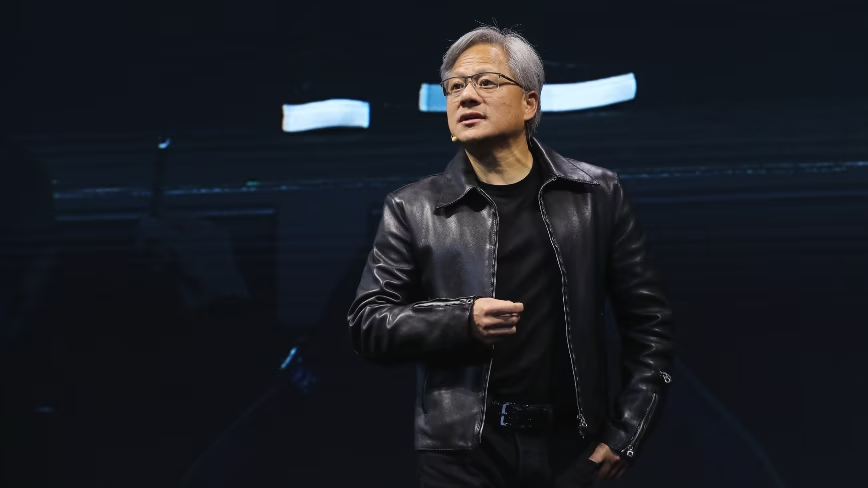
Nvidia’s Jensen Huang framed it in his usual sweeping terms. The radio network, he said, is “the next AI infrastructure,” and the plan is to turn the RAN into “a planet-scale AI computer.”
The deeper goal is to process data closer to the user. Less lag helps things like robots and self-driving cars, and it puts more Nvidia chips in the network.
The bigger land grab
Nvidia is not stopping at Nokia. At Mobile World Congress it lined up Ericsson, Deutsche Telekom, T-Mobile, SK Telecom, and SoftBank to build 6G on AI-native kit.
Nokia’s rival Ericsson is upgrading too, but made a different bet. It stayed a pure mobile-network supplier and skipped data centres. “We selected to be in a different part of the value chain,” its outgoing chief said.
Why it matters
The push fits a pattern. Nvidia keeps embedding itself wherever AI touches, from Japan’s robot makers to the phone mast, even as it has had to halve its Asian buyer list under US rules.
For operators, the promise is simple. Carry more traffic without buying more spectrum. Whether AI-RAN delivers that in the real world is the test that starts in 2027.
View original source — The Next Web ↗
Related stories
Engadget
TechnologyJul 16, 2026 · 1 min
Smart speakers could help OpenAI lose even more money
Engadget

TechCrunch
TechnologyJul 16, 2026 · 1 min
Why AMI Labs’ Alexandre LeBrun won’t call his AI ‘AGI’ or ‘superintelligence’
TechCrunch

Dawn
TechnologyJul 16, 2026 · 1 min
Court extends physical remand of three suspects in alleged kidnapping, rape of two foreign women
Dawn
Engadget
TechnologyJul 16, 2026 · 1 min
Ofcom, the UK's communications regulator, is investigating TikTok's child safety measures
Engadget