Indian Express
Anatomy of a comeback: How Scaloni engineered another Argentine remontada
The greatest trick the devil ever pulled off was convincing the world he didn’t exist.
There is a touch of Keyser Söze about Lionel Scaloni. There is a reason why Luis de la Fuente’s positional organisation, Thomas Tuchel’s strategic detail and Didier Deschamps’ attacking framework have all been analysed, to the minutest of details. Yet, no manager at this World Cup has slipped through tactical scrutiny quite like Argentina’s.
For every time Scaloni has been asked to explain an Argentine remontada, his answer has been the same: it is inexplicable, he does not understand it either. Wednesday’s semifinal against England was another case in point. Argentina overturned a deficit — only the second comeback in a World Cup semifinal this century — to win 2-1. Asked how his team did it, Scaloni offered only a smile.
“I am surprised. This group never ceases to surprise me. It’s very difficult to get people to understand what the players are doing. My understanding is that when we face adversity, when we smell blood, that’s when we play our best football.”
And yet, footballing discourse does not have room for hyperbole. ‘Smelling blood’ cannot account for 12 goals after the 75th minute, seven of them after the 90th. There has to be an explanation.
Against England, there was.
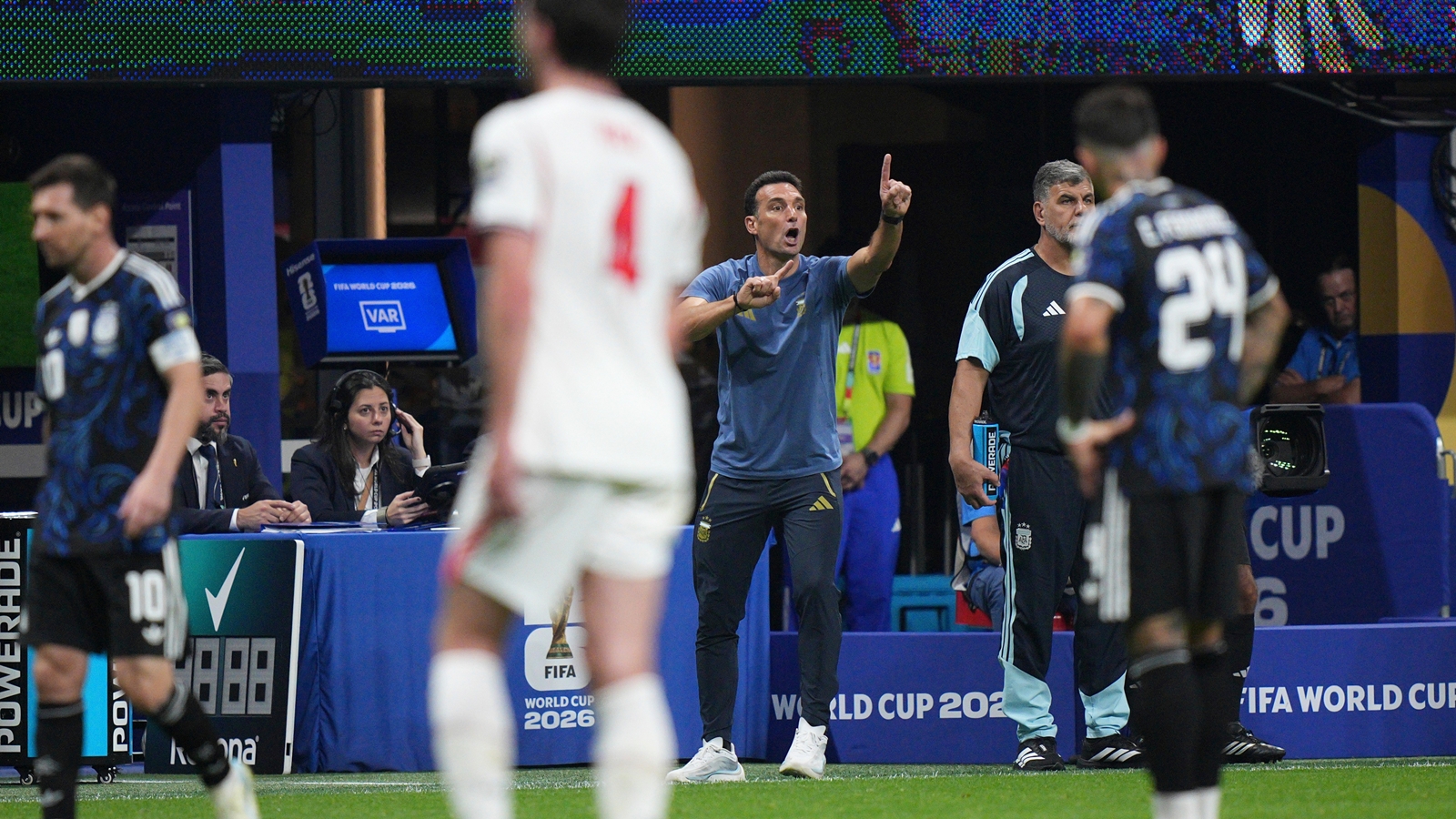
Argentina head coach Lionel Scaloni during the World Cup semifinal between England and Argentina in Atlanta, Wednesday, July 15, 2026. (AP Photo/Jacob Kupferman)
64th minute: The substitution that sparked the comeback
Thomas Tuchel accused his players of retreating after Anthony Gordon’s opener, but numbers tell a different story. Between Gordon’s goal in the 55th minute and Scaloni’s first substitution nine minutes later, Argentina managed just one shot, worth 0.2 expected goals.
And then arrived Nico Gonzalez.
On paper, a single substitution. In effect, it created three solutions for Scaloni.
Story continues below this ad
Gonzalez occupied his usual position on the left flank, allowing Alexis Mac Allister to move back into midfield and restore Argentina’s numerical superiority there. And Lionel Messi, instead of trying to break lines with intricate through balls, went direct with aerial deliveries.
Before England realised what hit them, Messi had launched a raft of crosses to the left, and found Gonzalez on every occasion. In the next five minutes, the Messi-Gonzalez diagonal combination knocked on the English doors three times.
72nd minute: Tuchel falls for Scaloni’s bluff
England head coach Thomas Tuchel reacts during the World Cup semifinal soccer match between England and Argentina in Atlanta, Wednesday, July 15, 2026. (AP Photo/Stephanie Scarbrough)
Recognising that Reece James — only recently back from injury — was struggling with Gonzalez, Tuchel moved to reinforce his right flank. Ezri Konsa, a right-sided defender, replaced goalscorer Gordon.
The England manager didn’t realise he was walking into Scaloni’s trap.
Story continues below this ad
As Tuchel committed resources to Argentina’s left, Scaloni doubled down on his right. At the same time as Konsa’s arrival, he brought on right-back Gonzalo Montiel and right-sided midfielder Rodrigo de Paul. Messi, who had a central role till then, also switched to the right.
The result is reflected in the statistics. Seventeen of Argentina’s 20 crosses (85 per cent) came from the right flank, 11 of those from the triangle of Messi-Montiel-de Paul.
In one breathtaking 40-second spell, De Paul delivered two inviting crosses for Mac Allister. Jordan Pickford denied one. The other struck the post.
Argentina were knocking. They would soon bring the door down.
Story continues below this ad
82nd minute: Tuchel reacts, but still falters
Tuchel, a Champions League winner, realised he had been sold a dummy. He tried to correct it by introducing left-back Nico O’Reilly, but the decision to take Declan Rice out would prove to be costly.
For much of the evening, Elliot Anderson’s job had been simple: deny Messi space. He had done so with immaculate efficacy. But with Rice withdrawn, he was outnumbered in midfield.
Three minutes later, Argentina worked a short corner. Messi exchanged a pass with De Paul, drawing Anderson towards the pair. What the English midfielder had not spotted was a third Argentine shirt lurking near the D: Enzo Fernandez.
A sublime long-ranger. 1-1.
Four minutes before the goal, Scaloni had made another telling substitution. He had introduced another attacker — Lautaro Martinez — by withdrawing left-back Nicolas Tagliafico. This change would prove to be crucial 11 minutes later.
Story continues below this ad
92nd minute: Magic that transcends logic
Argentina’s Lionel Messi (10) walks with the ball to take a corner kick during the World Cup semifinal soccer match between England and Argentina in Atlanta, Wednesday, July 15, 2026. (AP Photo/Jacob Kupferman)
Since conceding, Argentina had generated 1.41 xG compared with 0.4 beforehand. They had relentlessly attacked from the flanks, producing 37 final-third entries from wide areas. They also had, from the time Gordon scored, 88 per cent ball possession.
And yet, the scoreline read 1-1. Something had to give. When the scope of tactics ends, genius begins.
And there he was: Messi, on the right. Tuchel had the situation covered. Or so he thought. He had doubled up on Messi — both O’Reilly and Spence tasked to prevent him from crossing with the wand of his left foot.
Left foot?
Messi shaped to deliver with his left, sold both defenders the feint, shifted onto his right and whipped in a delightful ball.
Story continues below this ad
Lautaro Martinez’s header. 2-1. Comeback for the ages. Scaloni had authored the comeback. Messi supplied the final flourish.
View original source — Indian Express ↗
Related stories

ESPN
SportsJul 16, 2026 · 1 min
2027 five-star fits: Breaking down Texas' first co...
ESPN

Sky Sports
SportsJul 16, 2026 · 1 min
DeChambeau hits back at 'no strategy' claim | Faldo: I rattled his cage!
Sky Sports

BBC Sport
SportsJul 16, 2026 · 1 min
'Nobody wants to get divorced' - Glasner on Forest challenge
BBC Sport

The Punch
SportsJul 16, 2026 · 1 min
Bayelsa Utd unveils Maikaba as new coach, targets NPFL return
The Punch