Times of Israel
IDF begins work on Jordan Valley security berm, carving scar through Palestinian farms
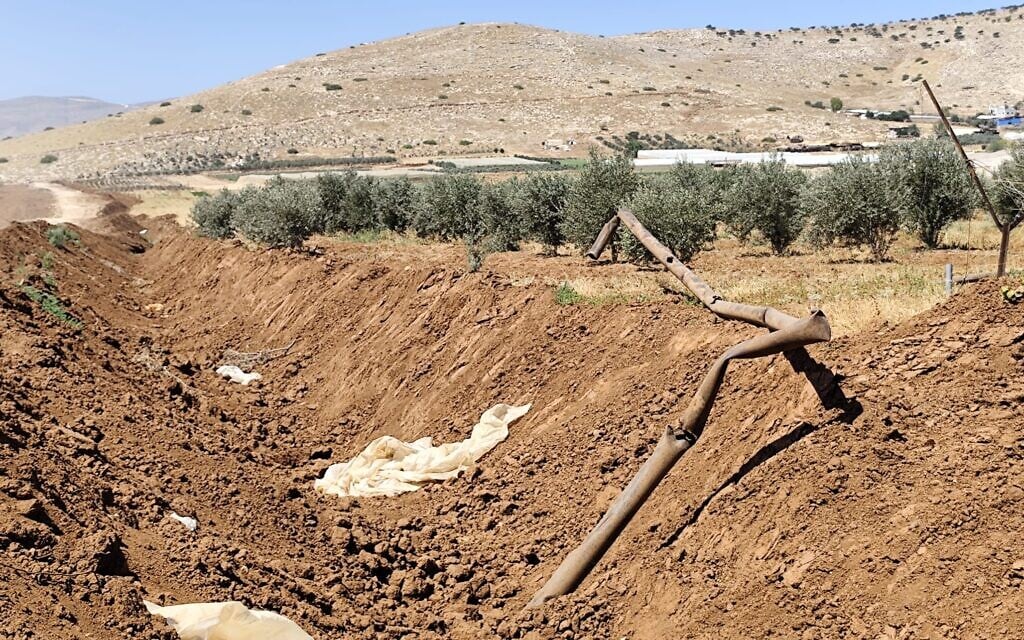
Over the past two weeks, IDF troops have been excavating land belonging to Thaer Basharat, a farmer from the village of Ras al-Ahmar in the northern Jordan Valley.
Footage from the site shows a trench roughly one meter wide and one meter deep running through the middle of Basharat’s farmland. Along parts of the route, the trench is flanked by mounds of earth topped with metal poles.
The works stretch for several kilometers, cutting a scar through lands owned by Basharat and other residents of Ras al-Ahmar, an agricultural community of hundreds who work hundreds of dunams of fields, greenhouses and groves.
Basharat recalled that army officials showed up in December to inform residents that they would be building a military road through the area.
“But this isn’t a military road — it’s a takeover of the land,” he told The Times of Israel.
Get The Times of Israel's Daily Edition
by email and never miss our top stories
By signing up, you agree to the terms
According to the army, which announced the project that same month, the works are the start of a plan to construct a barrier aimed at thwarting weapons smuggling and terror attacks. The barrier will consist of a paved patrol road for military vehicles, a “natural obstacle” alongside the road, and, where necessary, trenches and earthen embankments, the IDF said.
In response to questions from The Times of Israel, the military said the project is designed to prevent smugglers or attackers in vehicles from being able to travel from the Jordan Valley into the central West Bank and toward Israel.
To build the barrier, the military issued seizure orders covering 1,160 dunams (287 acres) in the northern Jordan Valley. The orders authorize the army to seize land, including privately owned property.
According to Dror Etkes of the Israeli NGO Kerem Navot, which monitors land ownership in the West Bank, more than 85 percent of the land — 989 dunams (245 acres) — is privately owned by Palestinians. The remainder is classified as state land or land whose ownership status is unknown.
The seizure orders indicate that the barrier will stretch for approximately 20 kilometers, running from an area near the village of Bayt Hassan to near Tayasir, north of Tubas. Roughly parallel to Route 578, a main north-south West Bank artery known as the Allon road, the planned barrier is replete with turns and switchbacks that will cut a jagged path through the landscape, taking it through a number of agricultural villages along the way.
While most of the projected route is in Area C, where Israel maintains full civilian and security control under the Oslo Accords, part of it also goes through Area B, where Israel retains security control but the Palestinian Authority administers civilian affairs.
While it will be possible to travel around the barrier, and the army claims farmers will have access to controlled crossings through it, the project is expected to create significant hardships for those living nearby. Those along the route fear that construction will not only expropriate and damage their farmland, but once completed, the barrier will also cut off access to fields and sever connections between neighbors.
‘No mercy’
In April, the High Court of Justice granted a state request to start working on parts of the route, despite a petition against the project submitted on behalf of 100 Palestinians and the municipalities of Tubas and Tammun.
The court has not yet issued a final ruling on the petition, which argues that the plan will cause extensive harm, but in the meantime, construction has begun.
In its interim decision on April 16, the court said it had allowed work to commence because roads on both sides of the planned barrier remain open to Palestinian traffic. The court also noted that the barrier is expected to include controlled crossings that will allow farmers to access their land by vehicle.
The IDF stressed to The Times of Israel that construction is being carried out in accordance with the court’s decision and subject to certain restrictions, particularly regarding the demolition of structures located along the route.
When it announced the barrier in December, the army said it would measure some 20 meters in width, with buffer zones on both sides.
Any buildings 20 meters to the east or west of the proposed barrier will be destroyed so that they do not pose a security threat to the barrier and military personnel manning it, IDF Central Command head Maj. Gen. Avi Bluth said.
Attorney Tawfiq Jabareen, who represents the petitioners, told The Times of Israel that the indirect impact of the barrier will extend far beyond the roughly 1,000 dunams covered by the military’s seizure orders.
According to Jabareen, as much as 50 square kilometers (19.3 square miles) of privately owned Palestinian land could ultimately become practically unworkable if farmers lose easy access to their fields.
Basharat said construction had already had an impact on land where he grows bananas and other crops.
“[The army] cut the water lines” that ran through the land where the barrier is being built, he said. “They’ve confiscated cars and tractors. You can’t even get close.”
With the water infrastructure severed and irrigation vehicles barred from approaching the area, Basharat said he has been forced to bring in water at night, when forces aren’t around.
He alleged that soldiers were preventing Palestinians from approaching within 300 meters of the barrier on either side, despite the seizure orders covering a corridor only about 50 meters wide.
The IDF denied the allegations, with a spokesperson telling The Times of Israel that “the seizure order is being implemented in accordance with its designated scope and no more.”
The statement said vehicles had been confiscated by security forces, but only “after obtaining permission from the relevant authorities.”
According to Basharat, both farmers and herders in Ras al-Ahmar have been affected. The trench, he said, has also made it impossible to move flocks westward to open grazing areas.
“They have no mercy,” he said of the IDF.
Jabareen said the barrier will cause an estimated $200 million in losses for Palestinian growers, noting that the area is home to several large, industrialized agricultural operations.
“There are thousands of workers employed in orchards and greenhouses in the area. They grow bananas, strawberries and grapes,” he said. “We’re talking about large agricultural companies and packing facilities that support this entire industry — not a single person with one or two dunams of land.”
According to the army, which dubbed the project Scarlet Thread, the idea of the barrier was conceived after a terror attack in the nearby Mehola Junction in August 2024 in which 23-year-old Yonatan Deutsch was shot dead by Palestinian terrorists.
Military officials say the obstacle and patrol road is key to ensuring those smuggling weapons or carrying out attacks in the Jordan Valley cannot flee westward toward Tubas or nearby towns.
“The Scarlet Thread project is based on a clear military need to regulate and monitor the vehicular traffic between the [Jordan] Valley and the five villages and the rest of Judea and Samaria,” the IDF told The Times of Israel in December.
The “Five Villages” refers to a cluster of Palestinian population centers in the region, including Tubas and Tammun.
“This is to prevent the smuggling of weapons and to thwart the carrying out of attacks while the perpetrators escape deep into the various sectors after carrying them out.”
However, Jabareen argued that the barrier’s true purpose is to sever Palestinians from their land.
“In light of what is happening, I have no doubt that the intention and purpose of the barrier is to prevent Palestinians from reaching the Jordan Valley — to disconnect them from their land,” he said.
Surrounded
One particularly problematic section of the planned route runs around the small Palestinian hamlet of Khirbet Yarza, which is expected to be completely encircled by the barrier. Nine families, about 50 people in total, live there.
It is unclear why the planned route surrounds the community on all sides, and it remains uncertain how residents will continue living there once construction is complete.
During an April High Court hearing, the state said the village would be bordered on one side by the trench and earthen embankment, while the military patrol road will go the other way around the village.
The IDF did not respond to The Times of Israel’s request for comment regarding this specific section of the barrier.
Although construction has not yet reached Khirbet Yarza, but resident Rami Odeh said he was already feeling the efefcts of the project due to the fact that he can’t approach Ras al-Ahmar by vehicle.
“I make a living herding sheep, and I get water for my flock from Ras al-Ahmar,” Odeh told The Times of Israel. “Now I can’t. I bring water at night so they won’t confiscate the tractors and cars.”
Odeh said that alongside the construction of the barrier, which he fears could eventually make life in the village impossible, residents have also faced increasing harassment from settlers, whom he said are trying to force them out.
He described an incident on July 3 that he said involved armed settlers opening fire.
Odeh told The Times of Israel that he, his father, his sibilings and several neighbors were returning home when a settler from a nearby outpost blocked their way inside Khirbet Yarza.
When they continued on anyway, he said, seven or eight masked men carrying weapons arrived and began shooting. He said he could not tell whether they were firing into the air or toward the group.
According to Odeh, the masked men also assaulted his father and sisters after he fled the scene. Four people were injured.
Responding to The Times of Israel, the IDF said troops were dispatched after receiving a report that Palestinians had been assaulted by Israeli civilians.
“Upon arriving at the scene, the forces conducted searches but did not locate any Israeli civilians. The incident and the findings at the scene were transferred to the Israel Police for further handling,” the military said.
The Israel Police said in response to The Times of Israel’s request for comment that police “opened an investigation into the incident, which remains ongoing. As the investigation is active, we are unable to provide further details at this stage.”
During an April 13 High Court hearing, the state addressed concerns about Khirbet Yarza and rejected claims that residents faced expulsion, saying that despite the construction of the barrier, no restrictions had been placed on living in the village.
When Odeh spoke with The Times of Israel on July 5, he estimated that construction would reach his family’s land within weeks, based on the pace of work.
“There is enormous fear about the future,” he said. “The situation is a disaster.”
View original source — Times of Israel ↗
Related stories

The Punch
WorldJul 16, 2026 · 1 min
JUST IN: FG releases 2026 common entrance results
The Punch
The Punch
WorldJul 16, 2026 · 1 min
UNIZIK denies lecturer’s involvement in viral sex scandal video
The Punch
The Punch
WorldJul 16, 2026 · 1 min
Ex-Rivers gov Rotimi Amaechi’s mother dies at 89
The Punch

Rio Times
WorldJul 16, 2026 · 1 min
Colombian city Medellín expands arts scene with Vibra Urabá festival, new MAMM modern art museum exhibition and global…
Rio Times