Buenos Aires Times
Memorial unveiled for Romanian diplomat who saved Jews from Nazis
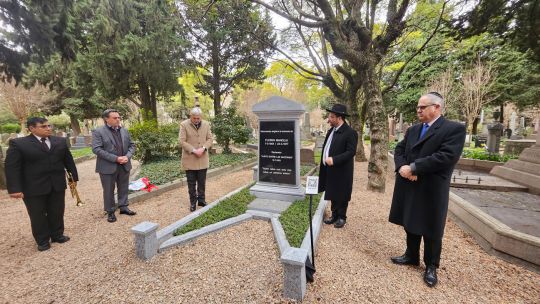
The British Cemetery of Buenos Aires has staged a solemn ceremony to honour Florin Manoliu (1904-1977), a Romanian diplomat and academic recognised as “Righteous Among the Nations” for his humanitarian work during World War II.
In 1943 and 1944, Manoliu worked alongside George Mandel-Mantello, a Jewish diplomat based in Geneva, to distribute citizenship papers from El Salvador that shielded Hungarian Jews from deportation. Using his position as economic counsellor in Bern, Switzerland, the Romanian attempted to carry a diplomatic bag containing hundreds of these documents across Nazi-controlled territory. He was arrested in Vienna and interrogated in Berlin, but managed to safeguard the papers and ensure their eventual transfer.
During the same mission, Manoliu obtained copies of the Auschwitz Protocols – eyewitness testimony from escapees detailing the camp's extermination process – and delivered them to Mandel-Mantello in Geneva in June 1944, enabling their dissemination to the Allied press. His actions provided one of the earliest exposures of Auschwitz's horrors to the world.
After the war, he faced prosecution in Romania on corruption charges but was later acquitted. Amid mounting political repression, he fled the country illegally in 1947 and settled in Bahía Blanca, Argentina, where he later taught at the Universidad Nacional del Sur (UNS) and became known for his academic integrity.
This week's ceremony brought together diplomatic authorities, Jewish community leaders, academics and representatives of human rights organisations, all of whom gathered to pay tribute to Manoliu, who died in 1977 and was laid to rest in the British Cemetery.
Opening the event, John Hunter, President of the British Cemetery, underscored the importance of recovering figures whose moral actions transcend borders and generations. Trumpeter Ruben de los Santos then performed the Romanian national anthem, a symbolic tribute to the diplomat's homeland.
A series of tributes followed: Romania’s Ambassador in Argentina Dan Petre placed Manoliu within the country's diplomatic history, highlighting his decisive role in disseminating the Auschwitz Protocols; Israeli Ambassador Eyal Sela emphasised the universal significance of those who chose to act in the face of horror; award-winning journalist Gustavo Mandará, who authored a book on Manoliu, recalled the diplomat's personal connection to Bahía Blanca and his understated humanitarian work; Raúl Woscoff, former president of the Bahía Blanca City Council and a leading voice in interreligious dialogue, stressed the importance of preserving the memory of the Holocaust; Susana Chalon, President of B'nai B'rith Argentina, placed Manoliu within the contemporary struggle against anti-Semitism; finally, Arturo Guevara, a representative of the UNS and one of Manoliu's former students, offered a personal testimony about his mentor’s academic work and intellectual integrity.
The centrepiece of the ceremony was the unveiling of a memorial to Manoliu, an emotional moment overseen by Eliahu Hamra, Chief Rabbi of the AMIA Jewish community association, who reflected on memory as an act of justice. The monolith for Manoliu, erected at the initiative of the British Cemetery, now stands as a permanent reminder of the diplomat’s moral courage and his commitment to defending life.
The event ended aptly with a performance of 'Ode to Joy,' once again performed by de los Santos, symbolising hope and fraternity among nations.
View original source — Buenos Aires Times ↗
Related stories

The Punch
TechnologyJul 16, 2026 · 1 min
Stakeholders back NCC rules, seek tougher telecom enforcement
The Punch

VentureBeat
TechnologyJul 16, 2026 · 1 min
The agent security gap: 54% of enterprises have already had an AI agent incident, and most still let agents share…
VentureBeat

Engadget
TechnologyJul 16, 2026 · 1 min
NTSB investigators confirm Tesla driver overrode Full Self-Driving system in fatal crash
Engadget
TechRadar
TechnologyJul 16, 2026 · 1 min
No sleep score, no steps: this Signal smart ring from an ex-Google head is focused on cracking cuffless…
TechRadar