Times of Israel
Coalition passes media overhaul law, giving government greater regulatory control
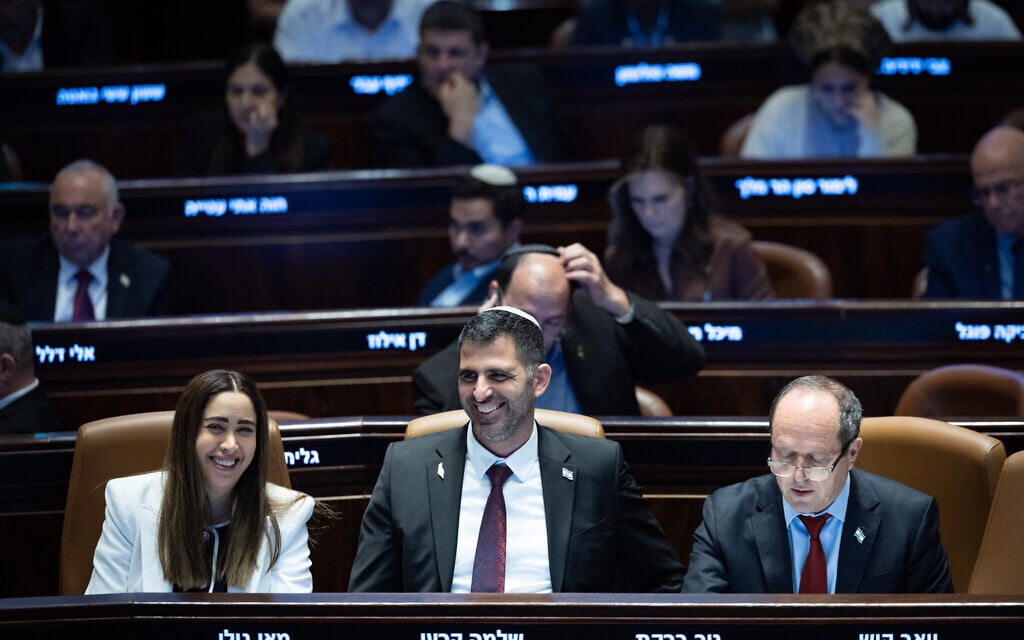
The Knesset voted 53-48 to pass Communications Minister Shlomo Karhi’s sweeping media overhaul on Thursday, in the final part of the coalition’s legislative blitz before the Knesset dissolves on Friday ahead of the October 27 election.
The law significantly expands government control over Israel’s broadcast media and news sector by overhauling media regulation. It removes longstanding oversight mechanisms, minimum journalistic standards, obligations to invest in original Israeli productions and restrictions on cross-ownership. And it gives the government greater influence over television ratings and state advertising allocation.
The legislation also included a last-minute amendment that will exempt the pro-government Channel 14 news outlet from a new requirement obligating broadcasters to provide certain content to television platforms free of charge. The exemption is estimated to be worth roughly NIS 40 million ($13.8 million) annually.
Prime Minister Benjamin Netanyahu, on trial in cases relating to media control, participated in the debate, though not in the final vote. Karhi thanked him from the podium for assigning him to pilot the legislation through the Knesset: “Mr. Prime Minister, I want to thank you and tell you that the mission you gave me four years ago — to deliver right-wing reform of the media — was today successfully completed.”
Such a directive would appear to violate a conflict-of-interest agreement that Netanyahu signed with the attorney general, barring the premier from getting involved in setting policy pertaining to the media, given his ongoing criminal trial into his allegedly illicit attempts to influence press coverage.
Addressing the issue amid uproar from the opposition, Karhi later claimed that he received a legal opinion determining that Netanyahu is not actually in a conflict of interest by getting involved in the legislation.
Immediately after the law’s passage, petitions against it were filed with the High Court of Justice by several government watchdog groups and political parties, who requested that the court issue an interim order freezing its implementation before ultimately issuing a ruling that strikes down the legislation.
The petitions allege a slew of severe procedural flaws in the legislative process, which they say should invalidate the law by itself, something the Knesset legal adviser has repeatedly warned of regarding the manner in which the media law was passed.
A petition filed by the Movement for Quality Government in Israel also pointed out that parts of the law come into effect immediately, which will “cause irreversible damage to the media market” just ahead of the October 27 election.
“The communications minister himself declared that his goal is to ‘crush the left’s monopoly on the media’ — in other words, to subordinate the press to the government,” said Yaniv Goldberg of the Movement for Quality Government.
“We have petitioned the court because without a free media there are no free elections, and we are confident that the court will stop this legislative ambush as well.”
Karhi defended the legislation, arguing that it serves to balance what he claims is an overwhelmingly anti-government media landscape.
“After a determined struggle against every possible element from the deep state, tycoons, attorneys, officials and fearmongering networks – we managed to pass the right-wing media reform,” he wrote in a social media post.
Karhi claimed that the new law “breaks up monopolies,” removes regulation and transfers power back to the consumer, adding that the reform will lead to “more diversity, more freedom, more right-wing coverage and less regulation.”
Opposition leaders denounced the legislation, accusing the government of trying to take control over the media to ensure success in the upcoming elections.
“In a democratic country, it is forbidden to silence the free press,” said former prime minister Naftali Bennett, head of the Together party, in a statement.
“In its final days, the government is passing absurd and dangerous laws whose sole purpose is to preserve its own political survival,” said Bennett, vowing to overturn this and other laws passed this week if elected.
The Yisrael Beytenu party accused the government of turning Israel into a country “modeled on [Recep Tayyip] Erdogan’s Turkey,” where press freedom and the independence of the judiciary have largely been neutered by the government.
“After trying to take over the judicial system, the government responsible for the October 7 massacre now wants to take over the media as well. Instead of a free press, they want a media made up of government mouthpieces and court reporters. In the next government, we will repeal this law as well,” the party said.
The law establishes a new media regulator that is formally independent, but the committee responsible for selecting its leadership would be chaired by the director general of the Communications Ministry, giving the communications minister effective control over appointments.
It also abolishes the longstanding requirement that commercial broadcasters maintain structurally independent news companies, a safeguard intended to insulate editorial decisions from the commercial interests of media owners.
The legislation also largely eliminates longstanding restrictions on cross-ownership in Israel’s media market, allowing the owners of broadcast television channels to also own news outlets.
The change would particularly benefit billionaire Patrick Drahi, a Netanyahu ally who owns both the HOT telecommunications company and i24NEWS, which has until now been barred from broadcasting over cable and satellite platforms. By removing the restrictions – designed to prevent a small number of owners from amassing excessive influence over public opinion – large media conglomerates can expand across multiple sectors and significantly broaden their reach.
The law also includes provisions to increase government influence over television ratings data and the allocation of state advertising budgets.
Tehilla Shwartz Altshuler, who leads the Israel Democracy Institute’s Democracy in the Digital Age Program and has followed the legislation closely, told The Times of Israel that rather than making the market “more free and accessible,” it strips away key obligations from commercial broadcasters while leaving them subject to less scrutiny.
A provision raising the annual revenue threshold for classification as a “minor channel” from NIS 80 million to NIS 2 billion would in practice “release all broadcast channels from their significant obligations,” including requirements to operate separate news companies and invest in original Israeli productions.
Critics argue the change would particularly benefit the pro-government Channel 14, allowing it to retain the lighter regulatory status it already enjoys even after outgrowing the original threshold, while larger commercial broadcasters would also be released from many of their current obligations.
Channel 14 would therefore continue to be exempt from requirements including establishing a separate news company, investing in original productions, and paying licensing fees.
Clauses regarding oversight and ethical standards obligating channels to ensure minimum journalistic standards were removed from the law, which, Shwartz Altshuler said, “amounts to an explicit statement that there is no place for oversight of news quality in Israel,” effectively treating professional journalism as equivalent to any content regardless of whether it is “harmful, biased, fabricated, or produced in accordance with professional standards.”
“This is a change of tectonic magnitude, contrary to any known professional logic and to everything presented so far,” she added.
Shwartz Altshuler further warned that the law’s exemption of international streaming platforms from investing in Israeli productions discriminates against local broadcasters by allowing “foreign giants” to compete in the Israeli market “without any commitment to local production,” while reducing investment in original Israeli content, which was one of the stated goals of the legislation.
The current version of the bill is the product of repeated revisions following resistance from coalition partners.
Earlier proposals included a government-run streaming app that would allow the public to watch television channels and sports broadcasts free of charge, but the provision was dropped after opposition from the ultra-Orthodox Shas and United Torah Judaism parties, who objected to the service operating on Shabbat.
It also includes new provisions reportedly demanded by the far-right Noam MK Avi Maoz, restricting cable and satellite providers from broadcasting content involving violence, sexuality or religious conversion.
This decision stripped much of the substance from the legislation, which originally envisioned shutting down the Idan Plus platform and replacing it with a free public streaming app. Savings from the move were intended to provide the financial basis for the new media regulator.
Critics argue that the legislation’s substance has been matched only by the manner in which it was advanced. Knesset legal advisers, the attorney general, opposition lawmakers and media experts have described the law as having been pushed through in one of the most irregular legislative processes in recent memory, accusing the coalition of repeatedly circumventing parliamentary norms by ignoring legal advice, introducing sweeping last-minute revisions, splitting the legislation to bypass procedural obstacles and giving lawmakers only hours to review major changes before voting.
Even as the legislation was being debated in the plenum ahead of the final vote, Knesset Legal Adviser Sagit Afik warned lawmakers in a letter that approving coalition reservations that had never been substantively debated by the committee “constitutes a defect,” particularly in light of what she described as the bill’s already deeply flawed legislative process.
The coalition has resorted to increasingly extreme measures to pass at least some parts of the legislation, which passed the first of three plenum readings in November. It started with the formation of a special committee to discuss the bill, headed by Likud MK Galit Distel-Atbarian, to bypass the Knesset Economics Committee headed by Likud MK David Bitan, who had blocked previous efforts by Karhi, including his legislation to shut down the Kan public broadcaster.
After six months of discussions that only covered limited parts of the bill, the committee – and subsequently the Knesset plenum – voted to split the legislation into separate bills, allowing the coalition to push ahead with parts of the legislation while postponing other provisions.
The coalition advanced the bill as one of a series of controversial measures it is seeking to enact before the Knesset dissolves, after securing the support of its ultra-Orthodox partners in exchange for passing legislation they had demanded, including a Basic Law declaring Torah study a foundational value of the state and a temporary law freezing the arrests of Haredi draft dodgers.
View original source — Times of Israel ↗
Related stories

The Punch
PoliticsJul 16, 2026 · 1 min
Appeal Court voids Electoral Act provisions on party primaries, membership register
The Punch

The New York Times
PoliticsJul 16, 2026 · 1 min
Judge Unseals Filings From Jack Smith Subpoena for Lawmaker’s Phone Data
The New York Times
South China Morning Post
PoliticsJul 16, 2026 · 1 min
US to focus counterterrorism efforts on left-wing groups, Rubio says
South China Morning Post

RNZ
PoliticsJul 16, 2026 · 1 min
Before her death Caitlin McDonald needed a 'home and wrap-around care, not rejection'
RNZ