
Straits Times
US Marines board vessel in Gulf of Oman, military says
DUBAI - Iran and the United States exchanged intensifying fire on July 16 in a week-long escalation that has largely unravelled the truce made in June, while Tehran disputed President Donald Trump’s claim that a US citizen had been released.
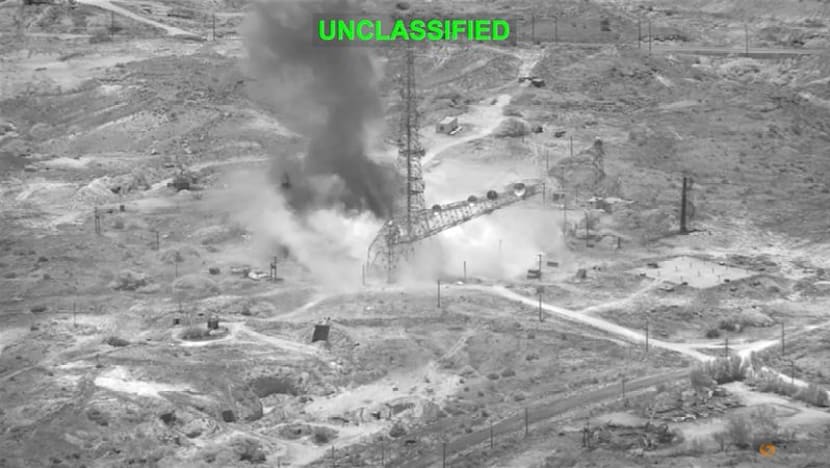
The US military said it launched a sixth night of consecutive strikes on Iran on July 16 “to further degrade Iranian military capabilities”.
For the first time since a memorandum of understanding paused fighting in June, two big waves of US air strikes hit Iran in a single day on July 15, mostly aimed at its southern coast.
Tehran has countered with missiles and drones targeted at US military bases in neighbouring states including a recently expanded air base in Jordan that Iran said was used in a US attack on an Iranian children’s cancer hospital on the night of July 15.
On the evening of July 15, US projectiles struck Qeshm Island and near Bandar Abbas – home to Iran’s largest port and key navy and Revolutionary Guards facilities – both on the Strait of Hormuz. Several locations in Bandar Abbas were hit by projectiles, the semi-official Mehr news agency reported.
Iranian news outlets also reported US strikes late on July 16 on three bridges and the train station in coastal Bandar Khamir and a US missile attack on Iranshahr Airport in south-eastern Iran.
Reuters could not immediately verify the reports.
The week of increasingly intense exchanges has tested the restraint both sides largely observed during four months of fighting before the June truce.
Yet, even as the attacks escalated, Trump on July 15 welcomed what he described as the release of a US citizen detained in Iran, identified by a human rights lawyer as Dena Karari, calling it a gesture of goodwill by Tehran.
On July 16, however, Iran’s judiciary challenged that account, saying no American prisoner had been released or exchanged from Iranian prisons, according to state media.
Shipping halted again
The re-escalation has once again largely halted traffic through Hormuz, the world’s most important shipping route for oil and gas, pushing up global energy prices.
Tehran resumed its blockade of the Strait of Hormuz and Washington again blockaded Iranian ports from July 15.
Iran has signalled it could prod its Houthi allies in Yemen to close another key strait: the Bab al-Mandeb at the mouth of the Red Sea, sources told Reuters, if Washington attacks Iran’s infrastructure. Iran last week hit ships moving through a corridor in the strait.
Karoline Leavitt, White House press secretary, told a briefing on July 16 that Trump would not “sit by and allow these active acts of terrorism to take place in the strait without ensuring Iran pays consequences for that.”
But she added the president was “always open to diplomacy at the very same time”.
Iranian sources told Reuters that Iran’s aim was to establish its authority over the strait, although otherwise Tehran is not keen on a wider escalation that would torpedo June’s preliminary deal, which it still regards as giving it most of what it sought.
Within Iran, the renewed bombing has left residents anxious.
“Living with this fear that war could start again is very exhausting. You cannot live like this... Personally, I want diplomacy to prevail,” Mahlegha, 46, a government employee, told Reuters by phone message from Tehran.
Iran says US strikes can’t break its grip on strait
Iran wants all ships using the Strait of Hormuz to travel through a channel close to its shores, and has made no secret that it intends to charge passage fees at the end of a 60-day negotiation period set in June’s memorandum.
Washington had encouraged ships to use an alternative route to the south, along the Omani coast.
US forces say their air strikes have hit Iranian military targets along the coast to cripple its ability to control the strait. Iranian military spokesperson Brigadier General Mohammad Akraminia said on July 16 this would never work because Iran can strike the strait from anywhere on its territory.
Trump has not ruled out the possibility of using ground forces, including to seize Kharg Island, site of Iran’s main oil export terminal. He has repeated threats to hit Iranian power plants and bridges next week unless Tehran resumes negotiations.
Alex Vatanka, director of the Iran program at the Middle East Institute in Washington, said the warring sides were “back to square one”, and would eventually face a choice of whether to back down or escalate. REUTERS
View original source — Straits Times ↗
Related stories

The Punch
WorldJul 16, 2026 · 1 min
We’ll never be silenced, say Peter Akah, Mama Pee after EFCC grilling
The Punch
Straits Times
WorldJul 16, 2026 · 1 min
While You Were Sleeping: 5 stories you might have missed, July 17, 2026
Straits Times
The Punch
WorldJul 16, 2026 · 1 min
Lewandowski’s MLS debut postponed over air quality concerns
The Punch
CNA
WorldJul 16, 2026 · 1 min
US strikes in Iran hit airport, bridges and railway station
CNA