CNA
Lower age limit, lower fees but Community Care Apartments unlikely to see surge in demand: Analysts
Singapore
The changes widen the pool of eligible buyers and may nudge people to plan ahead, but the bigger hurdle is a reluctance to leave familiar surroundings.
New: You can now listen to articles.
This audio is generated by an AI tool.
17 Jul 2026 06:00AM
SINGAPORE: Dr Koh Hui Hiang, 61, wants her retirement years to be spent in a place where help is close at hand, especially if she becomes immobile one day.
A Community Care Apartment, which bundles senior-friendly housing with care services, could have been just that. But Dr Koh, an associate lecturer in optometry, would only have turned eligible at 65 under the old rules.
On Monday (Jul 13), the government announced that the eligibility age for such apartments will be lowered from 65 to 55, effective from the next application exercise. Monthly basic service package fees will also be cut.
“I'm 61 years old, I could have applied for this, right? But I suppose I missed the boat,” said Dr Koh, who applied for a short-lease two-room Flexi flat a few years ago.
For seniors like her, the changes mean earlier access to aged-care housing options. Still, property and gerontology experts said that demand for these apartments is unlikely to rise significantly in the near term.
All things being equal, a wider pool of buyers should lift demand, said Mr Nicholas Mak, chief research officer at Mogul.sg. But he pointed to "mental obstacles" that keep seniors from applying, including a narrow profile of buyers that the apartments tend to appeal to, such as those with health or mobility issues.
“I think it's going to increase demand quite marginally – very, very little. It's not going to open the floodgates.”
FALLING APPLICATION RATES
The lowered age threshold takes effect from the October 2026 Build-to-Order (BTO) sales exercise, and comes amid falling application rates for Community Care Apartments.
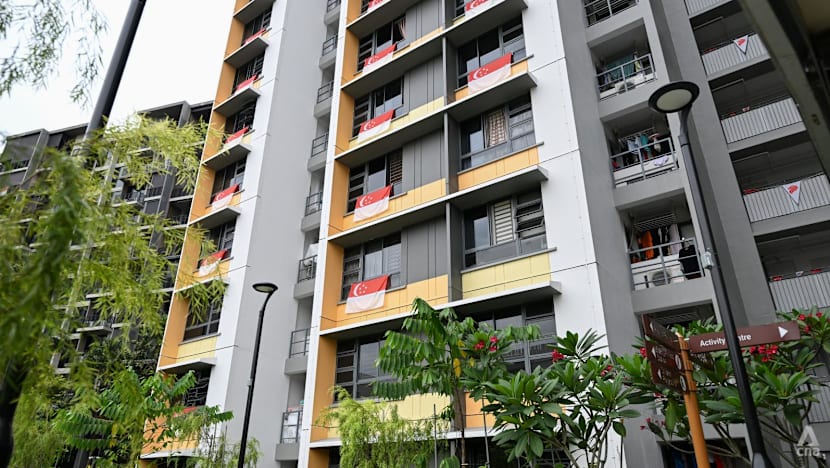
HDB has launched five such projects so far, in Bukit Batok, Queenstown, Bedok, Geylang and Sengkang.
The first, Harmony Village@Bukit Batok in 2021, drew an application rate of 4.2 – or about four seniors vying for each unit. The latest, Fernvale Plains in Sengkang, was undersubscribed at 0.7.
Associate Professor Wee Shiou Liang from the S R Nathan School of Human Development at the Singapore University of Social Sciences said the decline reflects a preference to age in place rather than any flaw in the flats themselves.
“Most seniors want to stay put. Familiarity matters enormously in later life – old neighbours, routines, a favourite coffee shop, networks built over decades," he said.
"Moving anywhere, even to a better-designed home with care on tap, means giving up some of that and adapting to a new environment. So the deeper barrier is usually not price or eligibility – it is the sense that there is no felt need to move yet.”
PLANNING EARLIER
Analysts agreed that lowering the eligibility age alone is unlikely to drive an immediate jump in uptake. A 55-year-old is typically still working, healthy and not yet thinking about care, said Assoc Prof Wee.
“Its significance is more about mindset than numbers. Lowering it to 55 is a deliberate nudge to get people planning earlier and moving while they can still adapt and become part of a new community,” he said.
The change gives people an extra decade to weigh such apartments against other housing options, such as a short-lease two-room Flexi flat, he added.
Two-room Flexi flats are open to those 55 and above, with leases of up to 45 years. Like Community Care Apartments, they cannot be resold on the open market; if a resident moves out, HDB pays out the unused lease value.
Both types of flats include a bedroom, a bathroom and a living-dining-kitchen area. Two-room Flexi flats, which range from 38 to 46 sq m, also have a household shelter.
Community Care Apartments are 34 sq m and come fitted with pre-installed fittings and senior-friendly features such as easy-to-slide partitions, built-in wardrobes and cabinets, and a wheelchair-accessible bathroom with slip-resistant flooring and grab bars.
Mr Lee Sze Teck, senior director of data analytics at Huttons, expects Flexi flats to keep outdrawing Community Care Apartments, as this is a newer product that will take time for seniors to accept, he said.
The median application rate for two-room Flexi BTO flats for seniors was 2.6 in the latest June sales exercise.
Community Care Apartment residents must also pay a basic service package fee, which covers support such as help with minor home fixes, arranging add-on care services and 24-hour emergency response, with further services available at extra cost.
“Some of them may not feel a need for that because if they are still able to do some of these things, then why do they want to go for a Community Care Apartment?” he said.
INCREASED AFFORDABILITY
From the second quarter of 2027, the basic service package fee will fall by between 18 and 75 per cent. Costs for social programming and maintenance for standalone communal spaces in future projects will be removed from the fees. Emergency alert devices, previously bundled in, will become optional.
The health ministry will also subsidise components similar to those already covered under national long-term care schemes, including staff support and emergency response.
Mr Mak said the lower fees and new subsidies will do more for affordability than the age change does for eligibility, removing a barrier for lower-income seniors.
“It might encourage some people who are above the age of 65, who previously did not want to apply for Community Care Apartments because of the cost – now they may consider,” he said.
The sixth project will launch in Toa Payoh in October, next to Caldecott MRT station. Property analysts expect demand there to rise slightly given the location.
Huttons’ Mr Lee said acceptance of these apartments will still take time, and the cost of providing services could fall as demand grows.
“Then at that point in time, there may be a certain tipping point that seniors will find it worthwhile for them,” he said.
Assoc Prof Wee said the apartments are an option alongside nursing homes, private assisted living, co-living models, shared stay-in caregiving services and Age Well Neighbourhoods.
“The goal is not to funnel everyone into any single model, but to widen the range of choices so that people with different care needs, preferences and family situations can find something that lets them age with connectedness, autonomy, meaning and joy,” he said.
Community Care Apartments fall between fully independent living at home and the residential care of a nursing home, he added, aimed at seniors with low-to-moderate needs who want housing and care bundled together.
For the model to gain traction, perceptions need to shift first, Assoc Prof Wee said. The aim should be to help seniors see these apartments as a positive choice made early while they are still well, rather than a last resort turned to only in a crisis.
Dr Tan Woan Shin, deputy executive director at the Geriatric Education and Research Institute, said creating supportive environments for ageing well in the community requires testing a range of housing options across the public and private sectors, both in infrastructure and service offerings, before adapting them based on feedback from the market and residents.
Given that most Singaporeans own their homes, ageing in place is often the default, Dr Tan said.
"Therefore, it is equally important for their existing environments to be supportive, enabling our older population to function well, have timely access to care, and do the things that matter to them," she said.
Mdm Ng, a 62-year-old retiree who wanted to be known only by her surname, said she is not considering these apartments yet. She recently moved into a five-room flat, and has no plans to make another big move soon.
“But life is quite unpredictable. We never know,” she said. “In any case, this is a good initiative.”
Source: CNA/er(cy)
Related stories

The Punch
WorldJul 16, 2026 · 1 min
We’ll never be silenced, say Peter Akah, Mama Pee after EFCC grilling
The Punch

BBC
WorldJul 16, 2026 · 1 min
Rubio calls for global crackdown on far-left extremism
BBC

RNZ
WorldJul 16, 2026 · 1 min
Petrol, diesel prices fell between May and June - Stats NZ figures
RNZ

Indian Express
WorldJul 16, 2026 · 1 min
BIMSTEC security chiefs vow to jointly combat terror, streamline maritime law enforcement
Indian Express