CNA
Xpeng L03: New electric SUV puts AI and Google Maps at the centre
Obsessions
The coupe SUV combines up to 520km of claimed range with advanced driver assistance, built-in Google Maps technology and a cabin aimed at everyday family use.
New: You can now listen to articles.
This audio is generated by an AI tool.
17 Jul 2026 06:18AM
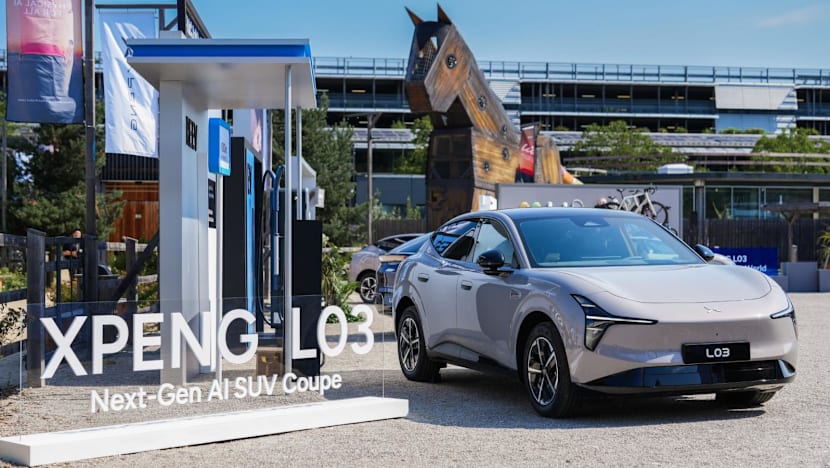
Chinese electric vehicle maker Xpeng has unveiled the L03, a new AI-focused coupe SUV that it is positioning as an entry point to the brand for global buyers, including those in Singapore.
Launched on July 16, 2026, at an event that was broadcast across 65 markets from Munich, the L03 arrives at a time when electric vehicles are becoming increasingly mainstream in Singapore and Chinese brands are competing more aggressively for attention in the mass-premium segment.
For Singapore motorists, the car’s appeal is likely to rest on three areas: design, in-car technology and everyday usability. Xpeng is pitching the L03 as a model that brings some of the brand’s more advanced intelligent driving features into a more accessible package.
The exterior is one of the clearest signals of that ambition. Developed under the leadership of JuanMa Lopez, a former Ferrari head of exterior design, the L03 adopts what Xpeng calls a “vital flow” design language, with a low, wide stance and a fastback roofline.
At 4.65m long, 1.92m wide and 1.6m tall, the L03 is not a small car by Singapore standards. It has a claimed drag coefficient of 0.228, with Xpeng saying its aerodynamic design adds as much as 47.5km to the car’s range. rameless doors, semi-concealed handles and what the company calls “Starship” 400-beam LED headlights are intended to give it a more premium appearance than a conventional family SUV.
AI TAKES CENTRE STAGE
Beyond the styling, Xpeng is placing much of its emphasis on computing power. The range-topping Ultra variant usesthree Xpeng Turing AI chips, with a claimed 2,250 TOPS, or tera operations per second. Singapore is expected to receive the single-chip version, which delivers 750 TOPS for AI-assisted functions.
The L03 uses Xpeng’s Vision-Language-Architecture 2.0 system, or VLA 2.0, which the company describes as a foundation model for the physical world. In practice, the technology is intended to help the vehicle interpret more complex road situations and support full-scenario navigation. For Singapore drivers, the relevant question will be how well such systems cope with dense expressway traffic, short slip roads, multi-storey car parks and frequent stop-start driving.
Safety features listed by Xpeng for the model include Blowout Stability Control, Driver Incapacitation Assist and 17 active safety functions. Reverse Trace Assist, which allows the vehicle to retrace its path when reversing out of tight spaces, may be among the more relevant features for daily urban use. Some capabilities will be rolled out through future over-the-air updates.
“At XPeng we believe that the level of AI technology in our vehicles will be the game changer for the mobility of the future. That is why one of XPeng’s key priorities is to always be among those manufacturers providing the customers with the most advanced technology,” said He Xiaopeng, chairman and CEO of Xpeng. “We are building a Physical AI company. We want to use technology to change how people move and how people live. We believe technology should be for everyone. Not just for a few people. That's why we work to bring smart technology to more people around the world.”
NATIVE GOOGLE MAPS INTEGRATION
Another notable feature is native Google Maps integration. Xpeng says it is the first automaker in Asia-Pacific to establish such an integration using the Google Maps Auto Software Development Kit, allowing it to build Google Maps technology into its own navigation interface.
That could matter in Singapore, where accurate routing, live traffic data and reliable search for locations are central to daily driving. The L03’s XOS 6.0 Smart Cockpit includes a 15.6-inch 2.5K central display and a 26.8-inch head-up display, with charging points and points of interest shown through the built-in system rather than through smartphone mirroring.
The fully electric L03 offers up to 520km of WLTP-rated range,according to Xpeng, with the rear-wheel-drive variant completing the 0 to 100km/h sprint in 6.6 seconds. Fast charging from 10 per cent to 80 per cent takes a claimed 20 minutes. Those figures put it broadly in line with the expectations of buyers moving from mainstream SUVs into newer-generation EVs.
CABIN COMFORT AND PRACTICALITY
Inside, Xpeng is targeting what it describes as “progressive families”. The cabin has 16 comfort functions, including ventilation and 14-point massage for front occupants. There are also soft-touch trim, velvet headliner and brushed-metal speaker covers, while audio is delivered through a 1,000-watt amplifier and 20-speaker system.
Xpeng also claims a 50 per cent reduction in road noise compared with previous models and a 10dB reduction in cabin noise. If borne out in local conditions, that would strengthen the L03’s case as a family EV rather than merely a technology showcase.
Practical features include 37 storage spaces, a10-litre pull-out drawer under the rear seat, 539 litres of boot space and a further 102 litres in the front trunk. The cabin also includes eight magnetic attachment points and five quarter-inch threaded mounts for accessories such as cameras or tablets.
The L03 will enter a crowded and increasingly competitive EV market in Singapore, where models such as the BYD ATTO 3 and Volkswagen ID.4 already target buyers seeking practical electric SUVs. Xpeng’s challenge will be to show that its mix of design, native Google integration and AI-assisted driving is more than a specification-sheet advantage. For now, the L03 appears aimed at motorists who want an EV that feels more technologically ambitious than the typical family crossover, without moving fully into flagship territory.
Source: CNA/bt
Related stories

The Punch
TechnologyJul 17, 2026 · 1 min
Telecom operators endorse NCC framework
The Punch

TechCrunch
TechnologyJul 16, 2026 · 1 min
San Francisco mayor pushes for tougher rules after the Waymo traffic fiasco
TechCrunch
TechRadar
TechnologyJul 16, 2026 · 1 min
Ukraine wants combat humanoid robots — but expect Wall-E over Terminator, as simpler, wheeled tech still wins
TechRadar

CBC
TechnologyJul 16, 2026 · 1 min
Meta will now tell parents if their teens talk about suicide with the company's AI chatbot
CBC