Indian Express
Bulldozers will have to roll when encroachers thwart law, says Supreme Court
5 min readNew DelhiJul 17, 2026 05:00 AM IST
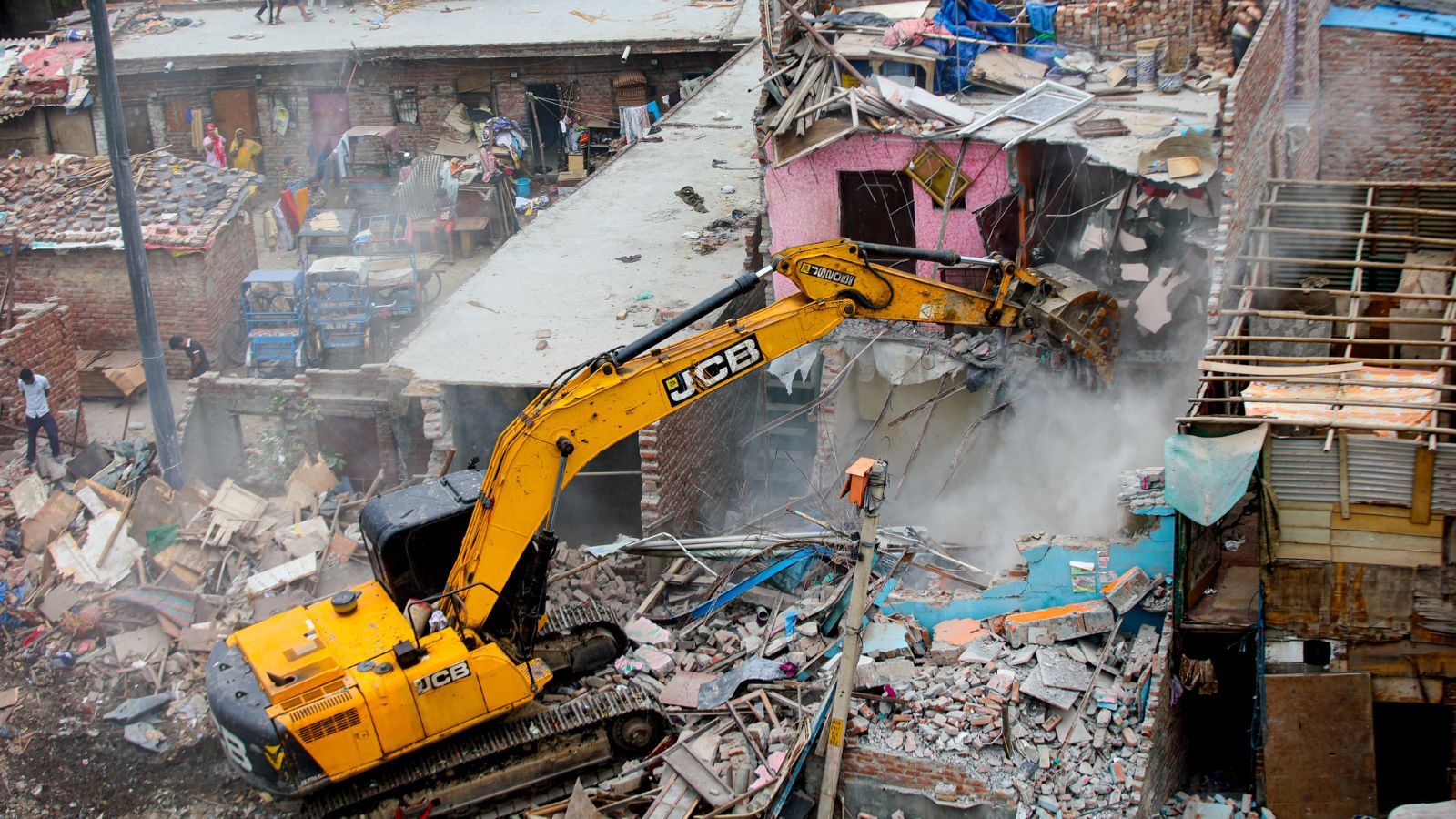
The bench, also comprising Justices Joymalya Bagchi and V Mohana, pointed out to the petitioners that their pleas involved disputed questions of fact which will have to be adjudicated by someone.(Representational/File Photo)
OBSERVING THAT bulldozers will have to roll “when a comfortable corruption between municipal authorities and illegal encroachers thwarts the rule of law”, the Supreme Court on Thursday refused to consider a batch of pleas alleging widespread contempt of the apex court’s 2024 judgment against “bulldozer justice”, and asked aggrieved parties to move their respective High Courts.
A three-judge bench presided over by Chief Justice of India Surya Kant heard petitioners who sought contempt of court proceedings against various state authorities for allegedly flouting the SC’s November 13, 2024 judgment, which held that using bulldozers to demolish homes of people merely because they are accused in some cases is contrary to the rule of law.
The bench, also comprising Justices Joymalya Bagchi and V Mohana, pointed out to the petitioners that their pleas involved disputed questions of fact which will have to be adjudicated by someone.
Agreeing, Additional Solicitor General Aishwarya Bhati said the petitions are from across the country, and a factual inquiry will be required in each case.
The CJI said, “And the facts are bound to vary from case to case. The court might be required to summon the record and examine it.”
He said the SC had already laid down the broad principles, and it is now for the High Courts and courts below them to ensure compliance.
As Senior Advocates Sanjay Hegde, C U Singh and Huzefa Amadi pressed the bench to decide the case in the light of the November 13 judgment instead of leaving it to the High Courts, Justice Bagchi said “the backdrop of the judgement” “in fact really shocked the conscience of this court, because there was an infraction, not of municipal laws, but the foundation of presumption of innocence, where there was pick and choose of certain individuals accused of crime by going against their properties…”
Story continues below this ad
Justice Bagchi stressed, “Yes, bulldozers need to be used when the rule of law is thwarted by a comfortable corruption between municipal authorities and illegal encroachers. But then we need also to protect that under the guise of implementing law, there should not be a terrorisation of individuals, or special treatment. It actually runs against one of the basic tenets that can a person claim negative equality…”
“No judgment can be looked at in isolation of the factual situation,” Justice Bagchi said.
Hegde said his client Ganesh Gupta had a fruit juice stall on which a bulldozer was used. Justice Bagchi said, “It can be used… Question is whether this person had an authorisation or the process of law was followed or not.”
Hegde said in his case, there was a TV anchor who sat on a bulldozer and came there. The CJI said all these facts will have to be looked at by someone.
Story continues below this ad
Ahmadi said in his matter, which involved the demolition of a mosque, there was an egregious breach of the court’s order.
“The High Court gave me protection and said you will give time to file reply etc and till then don’t pass a final order. Even before a final order was served upon me, they came and demolished and then I had to move for contempt before this court and your lordships gave me order of status quo.”
He said, “So far as I am concerned, there was no action taken by authorities from 1999 to 2024. This action only got initiated on account of a letter which was issued by a local politician where he said how can you have Asia’s largest mosque in this particular state… So, therefore, this is not one of those standard cases, it is one of pick and choose… In my case, there was also no allegation of encroachment on public property…”
Senior Advocate Singh argued that if the SC doesn’t stand up for its own judgment, then who will?
Story continues below this ad
“Who said we will not? We will stand for our judgments. We will direct the HCs to ensure compliance with our judgment,” said the CJI.
Justice Bagchi said what the bench intended to convey is that the judgment “cannot be read as a statute. Judgment has to be read in the context…”, more so when there is a caveat attached to it that the directions will not be attracted if there is unauthorised structure in any public place such as road, street, footpath, abutting railway line or any river body or water bodies.
© The Indian Express Pvt Ltd
Ananthakrishnan G. is a Senior Assistant Editor with The Indian Express. He has been in the field for over 26 years, kicking off his journalism career as a freelancer in the late nineties with bylines in The Hindu. A graduate in law, he practised in the District judiciary in Kerala for about two years before switching to journalism. His first permanent assignment was with The Press Trust of India in Delhi where he was assigned to cover the lower courts and various commissions of inquiry.
He reported from the Delhi High Court and the Supreme Court of India during his first stint with The Indian Express in 2005-2006. Currently, in his second stint with the daily newspaper, he reports from the Supreme Court and writes on topics related to law and the administration of justice. Legal reporting is his forte though he has extensive experience in political and community reporting too, having spent a decade as Kerala state correspondent, The Times of India and The Telegraph. He is a stickler for facts and has several impactful stories to his credit. ... Read More
Tags:
supreme court
View original source — Indian Express ↗
Related stories

The Punch
WorldJul 17, 2026 · 1 min
Stakeholders push reforms to sustain Nigeria’s economic gains
The Punch
The Punch
WorldJul 17, 2026 · 1 min
Lagos blames heavy rainfall for worsening road conditions
The Punch
The Punch
WorldJul 17, 2026 · 1 min
N’East stakeholders hail Tinubu over N80bn flood intervention fund
The Punch
The Punch
WorldJul 17, 2026 · 1 min
Sokoto targets 244 PHCs, launches 75 under safe delivery initiative
The Punch