CNA
How Christopher Nolan turned Homer’s The Odyssey into an IMAX epic
brand studio
Advertorial
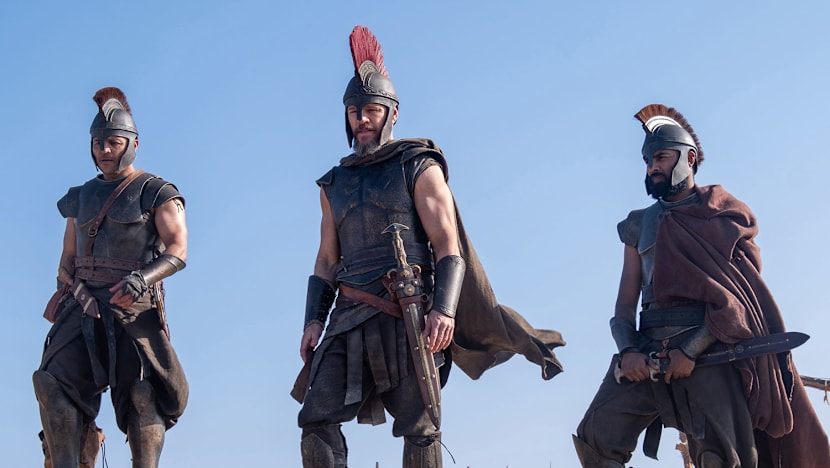
From practical sets and real-world locations to newly developed IMAX cameras, the director pushed filmmaking technology to bring the ancient myth to life.
New: You can now listen to articles.
This audio is generated by an AI tool.
17 Jul 2026 09:32AM
Some stories seem made for the biggest screen possible. The Odyssey, Homer’s tale of gods, monsters, war and homecoming, is one of them.
Nearly 2,800 years after the poem is believed to have taken shape, Christopher Nolan is bringing it to cinemas as a large-format action epic. The Odyssey is the first feature film shot entirely with IMAX film cameras, marking a new milestone for the filmmaker behind Oppenheimer, Dunkirk, Interstellar and The Dark Knight trilogy.
For Nolan, the appeal was not just scale, but the challenge of making a story from antiquity feel immediate to today’s audiences. “The Odyssey is an incredible work that’s extremely important to the history of the world and development of culture, but it has never been adapted as a modern blockbuster,” Nolan said. “I was energised by the challenge of creating the mythic world of ancient Greece and excited about telling its story, with all its rich themes, in a way I’d never seen.”
AN EPIC HOMECOMING
Set after the Trojan War, The Odyssey follows Odysseus, king of Ithaca, as he attempts to return home to his wife Penelope and son Telemachus. His journey across the seas is anything but straightforward, with storms, gods, monsters and his own choices standing between him and the life he is trying to reclaim.
Matt Damon plays Odysseus, a role Nolan described as requiring imagination, wisdom and weariness. The character is not simply a heroic warrior, but a man shaped by war, guilt, longing and the need to get home. Damon, who worked with Nolan on Oppenheimer and Interstellar, called the role “the biggest movie” he had ever done in terms of scale and ambition.
Anne Hathaway plays Penelope, the queen who waits for Odysseus while fending off suitors who want his throne. Tom Holland plays Telemachus, the son who has grown up in his father’s absence and must find his own courage amid a crisis at home.
The ensemble also includes Robert Pattinson as Antinous, Lupita Nyong’o in dual roles as Helen of Troy and Clytemnestra, Zendaya as Athena, Charlize Theron as Calypso, Samantha Morton as Circe and John Leguizamo as Eumaeus.
REAL PLACES, REAL SCALE
Nolan’s films have often been defined by their commitment to practical filmmaking and The Odyssey pushes that approach into mythic territory. The production was shot across Morocco, Greece, Italy, Iceland, Scotland and the United States over 91 shooting days across six months.
“I wanted to create a world where you really can imagine that you are on that boat with Odysseus,” Nolan said. “Harsh seas. Wind. Rain. Snow. You want all of it for the fantastical scope that Homer’s first readers would have had.”
For the fall of Troy, production designer Ruth De Jong and her team built a vast, 360-degree set in Ait Benhaddou, Morocco, incorporating existing architecture to ground the sequence in reality. The set covered more than 10,000 sq m, with over 60 structures and space for 2,000 extras.
Multiple versions of the Trojan Horse were made for different locations, each about 11m tall. Nolan’s version was designed not as a wheeled object, but as a battered offering to Poseidon, found sinking in the surf and dragged into Troy.
Elsewhere, Nestor’s Cave in Greece was used for Odysseus’ encounter with Cyclops, while Iceland’s stark, otherworldly landscape stood in for Hades. Favignana, near Sicily, became Ithaca, anchored by the 15th-century Castello di Santa Caterina.
The castle location came with one major complication: There was no access road. Equipment had to be moved by funicular lift and helicopter, while cast and crew members hiked up to the castle each day during the three-week shoot.
WHY IMAX MATTERS
The Odyssey fulfils a long-held ambition for Nolan: to shoot an entire feature in IMAX. Until now, he had used IMAX film cameras only for select sequences in earlier films.
Achieving that, however, was far from easy. Traditional IMAX film cameras are large and loud, making close-up dialogue scenes difficult. For The Odyssey, Nolan and cinematographer Hoyte van Hoytema worked with IMAX on a new camera model, known as the Keighley, which could be placed inside a sound-dampening casing. Once encased, the cameras weighed close to 136kg and could only run for a few minutes before needing to be reloaded. A dedicated crew was needed to move and position them.
The demands of IMAX shaped the wider production, too. By the end of the shoot, The Odyssey had used about 640km of film stock, longer than the distance from Toronto to New York. The 5,300 costumes by costume designer Ellen Mirojnick and her team were also created using natural materials, hand-loomed cloth and aged bronze, so the details would hold up to the sharpness and scale of IMAX.
All of this was in service of a simple idea: to make the myth feel real.
As Nolan put it: “It was a hard job – as it should be. It’s The Odyssey.”
The Odyssey is now showing in cinemas and on IMAX screens, with exclusive 35mm film screenings at Shaw Theatres. Get tickets now.
Related stories

Antara News
TechnologyJul 17, 2026 · 1 min
Indonesia targets global semiconductor supply chain role
Antara News
TechRadar
TechnologyJul 17, 2026 · 1 min
Google takes aim at Canva and Adobe as its AI image editor Pics gets an official rollout date
TechRadar

Nepali Telecom
TechnologyJul 17, 2026 · 1 min
Redmi Note 17 Pro launched with 9000mAh battery
Nepali Telecom

Philippine Daily Inquirer
TechnologyJul 17, 2026 · 1 min
Did Mariel Padilla unfollow Angel Locsin and Anne Curtis on Instagram?
Philippine Daily Inquirer