The Guardian
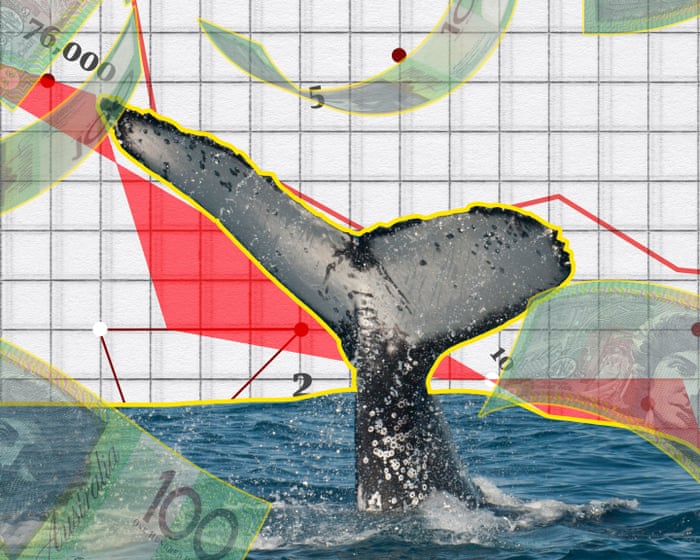
The Crunch: Whale migration, house prices on the move, and a lot of missing cash
Hello and welcome to another edition of The Crunch!
First, some sad news. This is my (Josh’s) final newsletter, after 64 editions and probably a few too many adjectives. If you promise to feature lots of illustrations and can write killer newsletter subheads (these aren’t the actual criteria), there’s still a few days left to apply to join our award-winning team.
And now on to this week’s newsletter, in which we have charts on a bunch of missing cash, crowd-sourced mapping for earthquake emergency responders, ageing in Hong Kong, and humpback whale migrations.
But first … the complicated rise of One Nation
One Nation, Australia’s right-wing populist party, has had a spectacular increase in support since the federal election last year, pipping the Liberal party to either first or second in some recent polls. This threatens to upend Australian politics, but, because of our preferential voting system, has also made it harder to work out exactly what will happen at the next election.
Pollsters tend to look at previous elections when working out how polling will translate into actual seats. But with One Nation riding so high, we’re now in “unknown territory”, according to one we spoke to in our look at whether the party has a path to power:
House prices in focus
If you’re Australian you’re used to talking about housing and house prices. Everywhere. With everyone. It never ends. But for many this has gone into overdrive as house prices have fallen in recent months.
For a recent One Big Chart we put this fall in the context of the gains from the last 10 years:
Our colleagues in the UK also had a great visual feature on Britain’s “green revolution”, and what is holding it back.
Four charts from the fortnight
1. Yeah, but where is Nemo?
Every March and April thousands of humpback whales make the journey from feeding grounds in Antarctica towards warmer waters around Australia. The Sydney Morning Herald have a story following this migration with maps, charts, video and more:
This reminded us a bit of a story our UK colleagues did last year on bird migrations.
2. The good kind of logging
One Nation claims to have raised millions of dollars in a recent online fundraiser to “fire the liar”. But how much did they actually get, and who from?
The Australian Financial Review has analysis based on some neat data journalism – they logged around 10,000 donations that were displayed on the website’s ticker.
“Over the two-week period, every Australian electorate recorded at least one donation to the campaign, even the metropolitan and urban seats where One Nation’s message has previously struggled to gain traction.” There’s more at the AFR.
3. Make it rain!
Of the billions of dollars’ worth of Australian banknotes printed each year, only 9% to 14% are being used for legitimate transactions, according to estimates from the Reserve Bank of Australia. What about the rest?
This is the start of a story from Julian Fell and Ben Spraggon at the ABC:
(In the actual story that briefcase is animated and it’s delightful).
4. The internet can be good
The Turkish city of Kahramanmaraş is home to about half a million people. But when rescuers responded to a massive earthquake in 2023, there weren’t good maps of the city to work from.
Akash Wadhwani has the incredible story of volunteers around the world filling in more than 2m buildings and thousands of kilometres of roads on a shared online map:
“Every trace flows into OpenStreetMap, the free map of the world that anyone can edit and nobody owns. Rescue teams download it onto their phones and their GPS units. And suddenly the questions that matter have answers: which roads reach this valley, how many houses stood in that town, where do people actually live.”
Bookmarks
How Die Zeit built a searchable database of Nazi party members
Building a world map in only 500 bytes
Pop stars are disappearing
A very extra visual story on the fertiliser crisis
How Spain pulled apart France’s defence
Off the charts
Hong Kong is one of the fastest ageing societies in the world. The South China Morning Post has a beautifully illustrated story looking at what that means for society and the people themselves:
Sign up
If you would like to receive The Crunch to your email inbox every fortnight, sign up here.
View original source — The Guardian ↗
Related stories

The Hindu
PoliticsJul 17, 2026 · 1 min
West Asia war LIVE: U.S. expands airstrike against Iran by hitting more bridges
The Hindu

France 24
PoliticsJul 17, 2026 · 1 min
Japan changes imperial succession law but keeps ban on female emperor
France 24

RNZ
PoliticsJul 17, 2026 · 1 min
Former finance minister Sir Bill Birch dies
RNZ

Times of Israel
PoliticsJul 17, 2026 · 1 min
Democratic Socialists of America platform backs Palestinian ‘right to resist’
Times of Israel