Indian Express
‘Revenge’ still hangs over the Argentina-England rivalry
The Falkland Islands have been under continuous British administration since 1833, though the roots of the enmity stretch further back to the British invasions of Buenos Aires in the early 19th century.
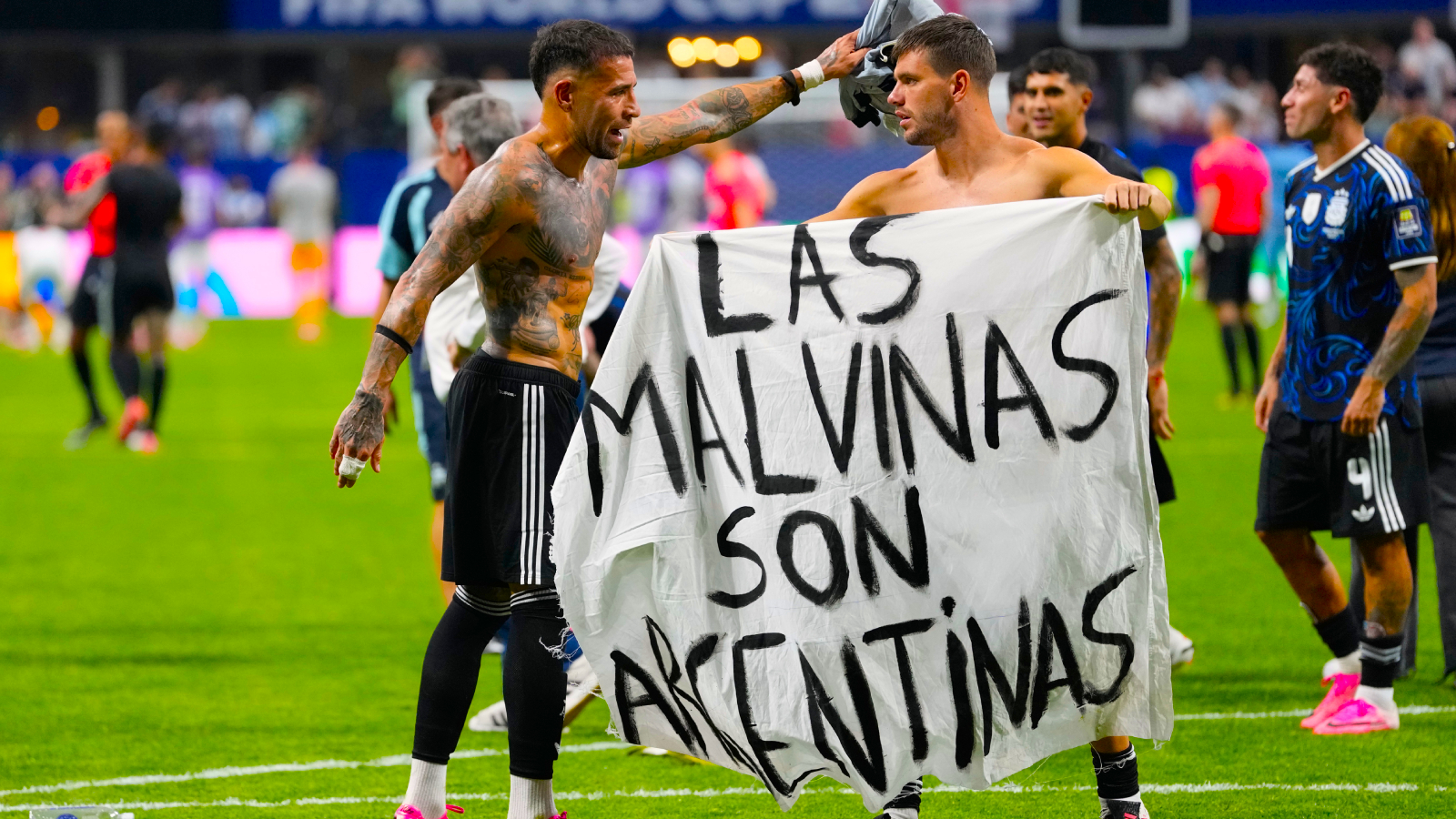
“The World Cup might not be ours, but the Falkland Islands definitely are,” was Downing Street’s response after Argentina’s football team unfurled a banner proclaiming “Las Malvinas son Argentinas” upon eliminating England to reach the final.
That the outgoing Keir Starmer government felt compelled to reaffirm British sovereignty over the archipelago off the coast of Argentina in the South Atlantic, and that the prime minister himself has urged FIFA to investigate the players who displayed the banner, is enough to illustrate how England versus Argentina has long been a proxy for unresolved questions of territory, nationalism, and historical memory.
It wasn’t always like this. Football arrived in Argentina in the 19th century with British immigrants, and the Scottish schoolmaster Alexander Watson Hutton is widely regarded as the “Father of Argentine football”.
Even when the two sides met in their notoriously rough 1966 World Cup quarter-final — where Argentina captain Antonio Rattín refused to leave the pitch for six minutes after being sent off, sitting in protest on a red carpet reserved for Queen Elizabeth II, before England manager Alf Ramsey branded the Argentine players “animals” — the rivalry remained a footballing one. That changed for good, 16 years later.
The Falkland Islands have been under continuous British administration since 1833, though the roots of the enmity stretch further back to the British invasions of Buenos Aires in the early 19th century. Argentina has long claimed that it inherited the islands’ sovereignty from Spain after independence.
In 1982, military dictator Leopoldo Galtieri’s decision to invade the islands, to shore up domestic support amid economic turmoil and public anger over the junta’s human rights abuses, ended in a British victory under Margaret Thatcher, hastening the dictatorship’s collapse and Argentina’s return to democracy. But the “Malvinas” remained deeply embedded in Argentina’s national consciousness. Every football match against England thereafter was played under the shadow of a war neither side had left behind.
If the Falklands War gave the rivalry its political charge, the next meeting gave it its mythology. In the 1986 World Cup quarter-final, Diego Maradona produced two of the most famous goals in football history within the space of four minutes.
The first was the infamous “Hand of God”, and the second, a mesmerising solo run shredding through half the England team. Argentina won 2-1 before going on to lift the World Cup, and Maradona himself described the victory in his autobiography as a symbolic “revenge” for 1982, noting that his team knew Argentine soldiers had died in the conflict, “shot down like little birds.”
And if the 1986 meeting had a hero, the next World Cup encounter in 1998 found the villain in David Beckham. Sent off for petulantly kicking Diego Simeone after the Argentine provocatively touched his head while he lay on the ground, Beckham became the scapegoat for England’s penalty shootout defeat. It didn’t take him long to find redemption when he scored the winning penalty in England’s 1-0 victory over Argentina at the 2002 World Cup.
All that brings us to Atlanta 2026 and the fallout from their latest clash.
In London, Nigel Farage called for the Royal Navy to be readied; in Buenos Aires, Vice-President Victoria Villarruel branded the English “usurping pirates,” invoking a viral anthem that binds the Malvinas to Maradona and Messi. The diplomatic temperature had already risen when Argentina formally protested the movements of the British warship HMS Medway earlier this month.
The drama has also reached the Premier League, where many of the Argentine players holding that banner share dressing rooms with their English counterparts — Enzo Fernández with Reece James and Trevoh Chalobah at Chelsea, or Cristian Romero with Djed Spence at Tottenham Hotspur. But when Chelsea celebrated Fernández’s 85th-minute equaliser on social media, a fierce backlash prompted the club to delete the post.
A former foreign-policy aide to Thatcher has called for the UK work visas of every Argentine EPL player involved in the banner display to be revoked. Even during the 74-day Falklands War, Tottenham’s Ossie Ardiles and Ricky Villa faced hostile chanting from fans, but no coordinated calls for exclusion from English football.
As football historian Jonathan Wilson has observed, the rivalry remains a “strange, quasi-Oedipal relationship that manifests itself in football, each game adding new layers of intrigue and resentment”. Some have tried to cool it down. Minutes after the final whistle, Argentine President Javier Milei insisted that the victory was “just a football match”, warning against “cheap displays of patriotism”. Even before kick-off, Argentina manager Lionel Scaloni too declared that it was “a football game and that is all”.
Forty years earlier, Maradona had offered almost exactly the same reassurance. Confronted by reporters seeking to link football to the Falklands, he replied: “No, no, no. It’s only football.” History begs to differ.
Murari is senior assistant editor, Indian Express Hindi ([email protected]), Saptarshi is deputy copy editor, The Indian Express ([email protected])
View original source — Indian Express ↗
Related stories

The Punch
WorldJul 17, 2026 · 1 min
Uganda drops case against women arrested for kissing in public
The Punch

Straits Times
WorldJul 17, 2026 · 1 min
UK police charge man over Iran-linked spying offences
Straits Times

Philippine Daily Inquirer
WorldJul 17, 2026 · 1 min
NUJP condemns criminal charges vs ex-news editor Marchel Espina
Philippine Daily Inquirer

Philippine Daily Inquirer
WorldJul 17, 2026 · 1 min
Ateneo sets scholarship program in honor of players Adili, Baterbonia
Philippine Daily Inquirer