Indian Express
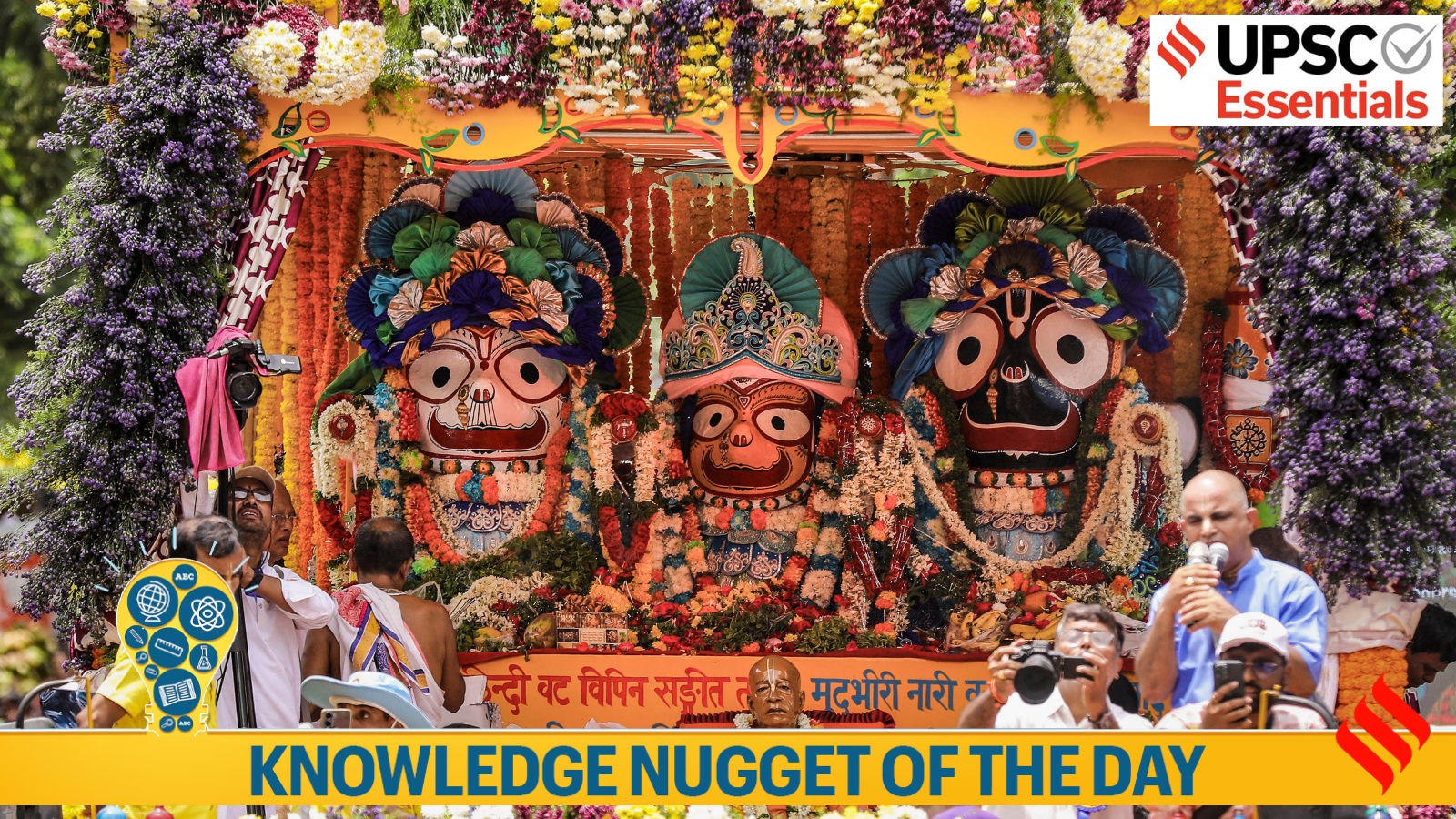
Knowledge Nugget: Jagannath Rath Yatra begins. What makes this festival unique?
Take a look at the essential concepts, terms, quotes, or phenomena every day and brush up your knowledge. Here’s your knowledge nugget on Puri’s Jagannath Rath Yatra, associated temple, and architecture.
Lord Jagannath Rath Yatra in Puri, Odisha, began on July 16. At least two men died, and over 100 were hospitalised following an “unprecedented rush” of devotees during the Rath Yatra. The state government had deployed nearly 12,000 police personnel, 19 senior IPS officers, and over 100 senior administrative officers to oversee security and traffic management for the annual Rath Yatra, or car festival, of Lord Jagannath.
1. According to Hindu mythology, the Lord, along with his siblings — elder brother Lord Balabhadra and sister Devi Subhadra — embarks on a nine-day annual sojourn from the 12th-century Jagannath Temple to the Gundicha Temple, which is believed to be the deities’ aunt’s abode and, in some traditions, their birthplace. At the Gundicha Temple, they stay till the ‘Bahuda Yatra’ (returning car festival), scheduled for July 24 this year.
2. The deities board three huge decorated chariots following the Pahandi ritual (ceremonial procession), before marching for around 3 km to the Gundicha Temple. Millions of devotees pull the chariots on the Bada Danda (Grand Road) of Puri town.
Devotees carry Lord Jagannath to the chariot as they participate in Mahaprabhu Jagannath Rath Yatra at Puri Jagannath temple, in Puri on Thursday. (ANI Photo)
3. The three chariots — Taladhwaja Rath for Lord Balabhadra, the Darpadalan Rath for Goddess Subhadra, and the Nandighosa Rath for Lord Jagannath- have their own colours, height, diameter, wooden horses, guardian deities and even charioteers. They are made from the wood of locally available trees. Three tree species — Phasi, Bhaunra and Asana —are the major components of the chariots.
4. Chhera Panhara ritual: Before the chariots are pulled on Rath Yatra, the scion of the erstwhile Puri royal family, performs a special ritual called “Chhera Panhara”, as part of which he sweeps the floor of the chariots with a golden broom. The ritual is said to stress the dignity of labour and show that no task is low or high in the eyes of the Lord.
Puri king Gajapati Dibyasingha Deb, who ascended the throne in 1970 at the age of only 17, has been performing the Chhera Panhara ritual since 1971.
5. Bahuda Yatra: During the return festival or Bahuda Yatra, the deities are offered a special cake called ‘Poda Pitha’, made of rice, coconut, lentils and jaggery at the Mausimaa Temple (their aunt’s temple). When the chariots reach Singhadwara (the Lion’s Gate) of the temple, some special rituals are conducted by the servitors.
Story continues below this ad
6. Suna Besha: The day after the Bahuda Yatra, the deities are adorned with gold ornaments, including crowns, and hands and legs made of gold on the chariots in front of the Lion’s Gate, which is called Suna Besha. This marks one of the last parts of the annual Rath Yatra.
7. Niladri Bije: The homecoming of the deities is called “Niladri Bije”, celebrated on the 12th day of the Ashadha month, which also marks the end of the Rath Yatra festival. The sibling deities are taken to the sanctum sanctorum again in pahandi (ceremonial ritual).
8. As per rituals, devotees offer Rasagola (a sweet dish made of cheese) to Goddess Laxmi on behalf of Lord Jagannath to appease her, as she gets angry for not being taken on the Raths to the Gundicha Temple. For the past few years, people in Odisha have also celebrated the day of Niladri Bije as Rasagola Divas.
Sri Jagannath Temple, Puri. (Wikimedia commons)
12th-century Jagannath Temple
1. According to the temple website, Jagannatha at Puri was built in the 12th century AD by King Ananta Varman Chodaganga Deva of the Eastern Ganga dynasty. The finishing touch and installation of deities were completed during the reign of Anangabheema Deva III in 1230 AD.
Story continues below this ad
2. The Jagannath temple consists of a deul, the convex curvilinear spire that can be viewed from a distance, the garbhagriha, the sanctum where the deity resides, a front porch called jagmohana, where devotees gather, and an offering hall called bhog mandir. Crowning the top is the Nilachakra (an eight spoked wheel) of the Lord Vishnu.
3. The outer wall is heavily decorated with carved figures of divine and semi-divine beings along with other floral and geometrical motifs. There are four gateways at four cardinal directions. The eastern gate is called Singha Dwar, the western gate is Vyaghra Dwar, the northern gate is Hasti Dwar and the Southern gate is called Aswa Dwar. The temple represents the Kalinga school of architecture, a regional variation of the Nagara style.
4. According to the Odisha government, the temple is built of Khondalite stone without the use of mortar. Iron dowels have been used to keep the stone blocks in position. By oxidation of these iron dowels, profuse damage has been caused to the structure.
5. During the reign of King Prataprudra Dev of Suryavamsa, the temple was covered with lime plaster during the period from 1504 to 1532 AD to prevent further structural damage mainly caused by the stress corrosion of iron clamps and dowels used for reinforcement of the structure.
It is also believed that as non-Hindus are not allowed to enter the Jagannath temple, Lord Jagannath, believed to be the Lord of the Universe, steps out of his sanctum sanctorum during Rath Yatra to meet all his devotees.
Story continues below this ad
6. Several scholars have proposed that Lord Jagannath evolved through the assimilation of tribal, Buddhist, Jain and Vaishnav traditions. According to temple scholar Dr Harihar Kanungo, the deity was originally a “Sabara Debata” (Adivasi god) who was named Jagannath or Lord of the Universe by Buddhists.
7. Kanungo has argued that Jagannath was established in Puri in the 9th century AD, and “came under Brahmins after the decline of Buddhism”. The restrictions based on caste and religion took root around the 16th century. Lord Jagannath is originally a “non-Hindu, non-Brahminical god, and therefore (the temple) should be accessible to people of all faiths,” he says.
8. Historians Benimadhava Padhi, Anncharlott Eschmann and Hermann Kulke have supported the theory of gradual Hinduisation of Lord Jagannath. Nilakantha Das, one of the five Panchasakha who played a critical role in the recognition of the Odiya language, spoke of the Jain origins of Jagannath.
BEYOND THE NUGGET: Nagara Style of architecture
1. The Indian temple architecture is broadly characterised by two overarching traditions, namely the Nāgara or northern building tradition and Draviḍa or southern building tradition. Although geographically defined, they are not exclusive to the two regions.
Story continues below this ad
2. In addition to these two, Indian art treatises include a third type of building tradition called the “Vesara” or hybrid. The etymological bearing of the term has led scholars in the past to understand this category as a synthesis of the northern and southern artistic traditions and associate it with the geographically fitting Deccan region.
3. The multi-storeyed towers of the Nāgara and Draviḍa temples harbouring the garbhagɽha (sanctum) of the temple are composed of a string of aedicules (small temple forms). These are transformed through diminution, repetition, splitting, super-imposition, and contraction to achieve its decorative exterior.
Lingaraj temple, Bhubaneswar. (Wikimedia Commons)
4. Each tradition uses different varieties of aedicules. For instance, the Nāgara superstructure incorporated the āmalaka (fluted bulbous capstone of a Nāgara śikhara), gavākṣa (cow’s eye motif or horseshoe arch), and bālapañjara (nāsī-roofed cage aedicule) over pillarlets. The Draviḍian vimāna (south Indian shrine) featured kūṭa (domed aedicule), śālā, (wagon-vault roofed aedicule), and bālapañjara.
5. Kalinga-style architecture is a subset of Nagara-style architecture. These temples were called deul (the term emerged from Sanskrit term devalaya) by local architects. There are three types of deul or temples:
Story continues below this ad
(a) Rekha-deul: In this, the sikhara or spire is linear or straight. Here, Rekha means straight. The most distinct example of Rekha Deula is the Lingaraja Temple at Bhubaneswar.
(b) Pidha-deul: Its sikhara has tiers of diminishing pidhas or platforms. Here pidha means a low flat wooden tablet to sit on. It is also called jagamohana, which is in fact a mandapa raised in front of the sanctum. The assembly hall at the Konark Sun Temple is an example.
(c) Khakhara-deul: The top of the sikhara looks like a gourd or barrel shaped roof. Khakhara has been derived from the term khakharu i.e., a pumpkin and gourd. The temples of the feminine deities as Shakti are temple of that type.
Post Read Questions
(1) Consider the following statements:
1. Jagannatha Temple at Puri was built by King Ananta Varman Chodaganga Deva.
Story continues below this ad
2. The homecoming ritual of the deities during the Jagannath temple yatra is called “Niladri Bije”.
3. During the yatra, Lord, along with his siblings, embarks on a nine-day annual sojourn to the Gundicha Temple.
How many of the statements given above is/are correct?
(a) Only one
(b) Only two
(c) All three
(d) None
(2) Which of the following temples has/have a Nagara-style shikhara? (UPSC CSE 2026)
1. Malegitti Shivalaya, Badami
2. Huchimalligudi Temple, Aihole
3. Dashavatara Temple, Deogarh
4. Virupaksha Temple, Pattadakal
Select the answer using the code given below :
(a) 1 and 2
(b) 2 and 3
(c) 3 only
(d) 3 and 4
Answer Key
1. (c) 2. (b)
Story continues below this ad
(Sources: Rath Yatra in Puri: Significance of the deities’ journey ‘to their birthplace’, Rath Yatra of Lord Jagannath: Why millions throng Puri to witness the annual event, Odisha government, ASI, How Indian temple architecture is rooted in art, religion, and politics)
Subscribe to our UPSC newsletter. Stay updated with the latest UPSC articles by joining our Telegram channel – IndianExpress UPSC Hub, and follow us on Instagram and X.
🚨 Click Here to read the UPSC Essentials magazine for July 2026. Share your views and suggestions in the comment box or at [email protected]🚨
View original source — Indian Express ↗
Related stories

The Punch
TechnologyJul 17, 2026 · 1 min
Nigeria’s mobile subscriptions hit 188 million, Glo retains 23.18 million users
The Punch

AllAfrica
TechnologyJul 17, 2026 · 1 min
Africa: UK to Cut Aid to Some African Countries by 90%
AllAfrica

The New York Times
TechnologyJul 17, 2026 · 1 min
A Mathematical Tribute to the Soccer Ball
The New York Times

The New York Times
TechnologyJul 17, 2026 · 1 min
Rare Pair of Improbably Light ‘Super-Puff’ Planets Is Discovered
The New York Times