The Next Web
A luggage maker’s filing just pinned DeepSeek at $52bn
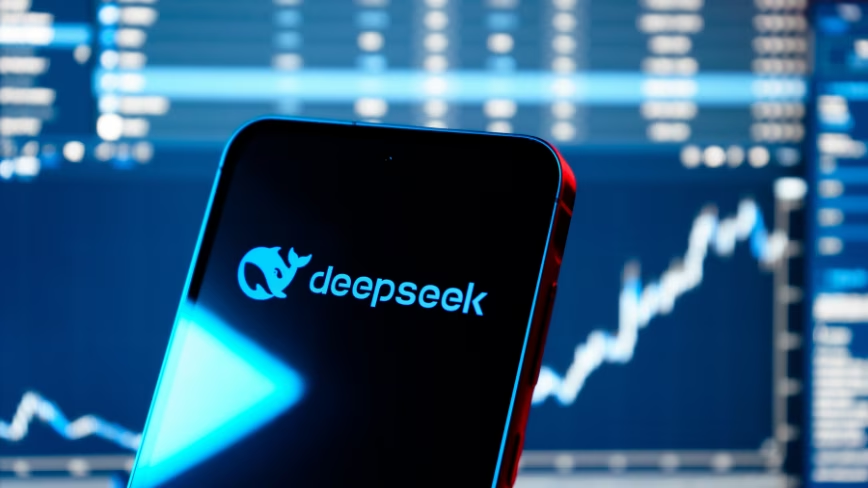
The most precise figure yet attached to DeepSeek’s worth did not come from the lab, its bankers or its founder.
It surfaced in a stock-exchange filing by Anhui Korrun, a Chinese luggage maker, which discloses a stake small enough to imply the Hangzhou AI startup is valued at around $52bn.
The arithmetic is narrow but specific, and it is the reason a suitcase manufacturer briefly became an AI story.
Korrun’s subsidiary Ningbo Purun put 2.9bn yuan into a fund managed by Monolith Management, taking a 0.8265% indirect stake in DeepSeek at a level comfortably above the $45bn valuation floated in May.
Reverse the maths and the whole company prices out at 350.88bn yuan, or roughly $51.8bn, per the filing first reported by Reuters.
That is an implied number, derived from one investor’s entry point, rather than a fresh round DeepSeek has announced at that headline figure.
The distinction matters more than it sounds. A valuation inferred from a 0.83% holding tells you what one fund paid on one date, which is a data point rather than a deal, and it can drift the moment a larger cheque clears.
These slivers surface in China because listed minority investors have to disclose them. A luggage firm answering to its own shareholders ends up publishing a number the AI lab itself has never confirmed, and the maths only holds if the fund reported its stake and its cost accurately.
It still slots neatly into a rising line. DeepSeek spent years running on the capital of High-Flyer, the quantitative hedge fund of founder Liang Wenfeng, before taking outside money for the first time this year.
That debut round, closed in June, pulled in roughly $7.4bn at a post-money valuation near $50bn, with Tencent and battery giant CATL among the backers.
The Korrun disclosure, tied to an investment completed by 17 June and reported to the firm on 15 July, lands a hair above that mark.
So the figures stack rather than clash. The $45bn talk was an opening target, the June round set a floor near $50bn, and the $52bn implied here nudges the same trajectory upward by degrees rather than leaps.
For scale, that price still leaves DeepSeek a fraction of the sums attached to OpenAI and Anthropic, whose recent rounds run into the hundreds of billions of dollars.
It is a striking tag all the same for a lab that built its name on models trained far more cheaply than its American rivals.
The bolder numbers are still ahead. DeepSeek is weighing a further raise that reporting has placed between $71bn and $74bn, roughly 500bn yuan, ahead of a planned public listing.
The gap between those numbers is the story of a frantic few weeks. A round near $50bn in June and $74bn talk by mid-July would mark a rise of almost half in valuation before a single share has changed hands.
An initial public offering is the next real test. The company has begun preparing a filing for Shanghai’s STAR Market, with a target to lodge documents this year and a possible debut in 2027.
Whether investors reward that ambition is a separate question from whether Beijing wants a homegrown AI champion on a domestic exchange, and the two are not the same thing.
An onshore listing keeps a strategically prized company inside China’s own markets, insulated from the export controls and index politics that have dogged its peers abroad, and gives domestic investors a rare direct stake in the country’s best-known AI name.
Until the prospectus lands, the cleanest read on DeepSeek’s price will keep arriving secondhand, through the books of the investors who own tiny pieces of it.
Liang, already the richest founder in AI on paper, may find the next confirmation is one his own company chooses to publish, rather than one a luggage firm lets slip at 0.8265% a time.
View original source — The Next Web ↗
Related stories

The Punch
TechnologyJul 17, 2026 · 1 min
Nigeria’s mobile subscriptions hit 188 million, Glo retains 23.18 million users
The Punch

Wired
TechnologyJul 17, 2026 · 1 min
San Francisco Demands Apple and Google Delete AI ‘Nudify’ Apps From App Stores
Wired

TASS
TechnologyJul 17, 2026 · 1 min
Fyodorov's resignation could be catastrophic for Ukraine — Rada member
TASS
BBC
TechnologyJul 17, 2026 · 1 min
River work to help critically endangered eels
BBC