Indian Express
‘Grieving’ elephant that chased vehicles for 3 years after speeding truck killed its herd finally captured
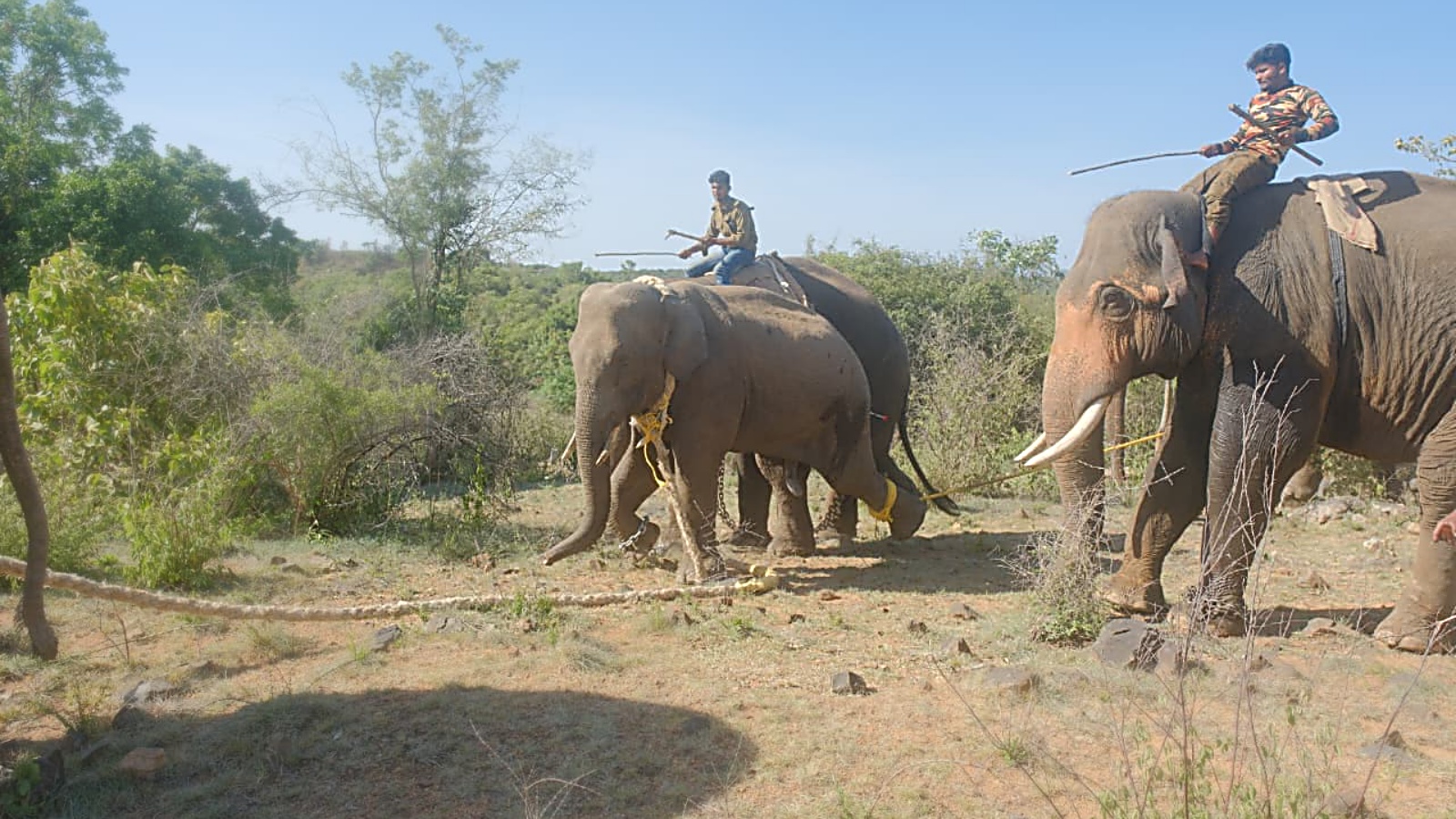
An elephant that lost all other members of its herd in a highway accident in the Chittoor district of Andhra Pradesh three years ago, and subsequently went on a rampage raiding crops, attacking livestock and leaving villagers terrorised in the Palamaner forest division, was finally captured and taken to an elephant camp for veterinary and behavioural assessments.
Officials described the elephant as “grieving”, making its behaviour unpredictable and potentially dangerous to people as well as to itself.
The sub-adult tusker was part of a herd of four, including two sub-adult males, one female, and a calf. On the night of June 14, 2023, a speeding truck rammed into the herd while the elephants were crossing the Bengaluru-Chennai National Highway (NH-4) near Palamaner. Three elephants died, but this one escaped without any injuries.
“This elephant lost its herd and became a grieving, solitary animal. Since the tragedy, it has frequently returned to the area where the accident occurred, crossing the NH-4 at unpredictable times. It became a threat not only to people on the highway, but also to itself as the possibility of another accident was high,” Conservator of Forests, Anantapur Circle, R Yashoda Bai, told The Indian Express.
“It was not eating properly, chewing up garbage and trash, and its health was deteriorating. Villagers were also complaining about it. It had to be rescued,” Yashoda Bai added.
The forest department was continuously monitoring the elephant’s movements and behaviour, and had spent considerable resources to keep it and the people who live in the area safe, officials explained.
‘I thought I was going to die’
During one of its many run-ins with people, the elephant fell on top of Palamaner Forest Division Forest Section Officer S Sukumar.
Story continues below this ad
“I thought I was going to die. Imagine an elephant falling on you,” he said, recalling the incident.
The incident happened on September 13, 2025, when the elephant was aggressively pursuing vehicles and people on NH-4. Sukumar and forest department tracker B Hari were trying to drive the elephant away when, even though it initially ran towards the forest, it suddenly turned around and charged at the duo.
In the subsequent chase, the elephant slipped and fell on Sukumar. After a few minutes, the confused elephant found its footing, stood up and ran away. A seriously injured Sukumar was admitted to a hospital and spent weeks recovering. Months later, this week, he took part in the operation to capture the elephant.
Using drones and thermal sensor cameras, continuous monitoring of the elephant was undertaken to confirm its identity, study its behaviour, map its movement pattern, and identify suitable capture sites. (Source: Express Photo)
G Subburaj, District Forest Officer, Chittoor, said that it took months of monitoring and planning to capture the elephant safely.
Story continues below this ad
“This young elephant would have been happy and safe with its herd. Instead, it was lonely and disoriented with frequent mood swings,” he said.
While the elephant showed aggression towards humans, it fled when forest guards or trackers approached it on “kumki” elephants — trained captive elephants used to capture or rescue wild elephants.
“We realised that it ran away because these [kumki] elephants were older and bigger. When we used young elephants of the same age as this elephant, it approached and tried to be friendly. It appeared that the young kumki elephants were trying to console him. This helped a lot in planning and managing the operation to capture it,” said Yashoda Bai.
Since the 2023 accident, the elephant had continued to chase people, particularly two-wheeler riders, besides repeatedly damaging crops. It had also become a risk to itself on the NH-4.
Story continues below this ad
Sophisticated operation
The Forest Department submitted proposals seeking permission to capture the elephant. After detailed examination of the field situation, permission was accorded by the Principal Chief Conservator of Forests (Wildlife) and the Chief Wildlife Warden under the provisions of the Wildlife (Protection) Act, 1972.
Following approval, the Forest Department constituted an Advisory Committee, Field Capture Team, veterinary teams, tracking teams, logistics teams and communication teams. Using drones and thermal sensor cameras, continuous monitoring of the elephant was undertaken to confirm its identity, study its behaviour, map its movement pattern, and identify suitable capture sites.
Risk assessments were carried out to identify safe darting locations, emergency evacuation routes and transportation logistics. Simultaneously, coordination meetings were held with the police, Revenue, Health, Animal Husbandry, Fire Services and other line departments to ensure seamless support during the operation.
It was also decided to deploy five trained Kumki elephants from the Musalimadugu Elephant Camp, where elephants are trained.
Story continues below this ad
Finally, on July 15, the elephant was captured near Palamaner, not far from where it lost its herd.
The whole operation cost around Rs 5 lakh.
The elephant was transported to Musalimadugu Elephant Camp, where it will remain under veterinary observation and a behavioural assessment will be carried out.
Deputy Chief Minister and the Minister for Forests and Environment, K Pawan Kalyan, praised the operation and commended the Forest department for balancing public safety with wildlife conservation.
View original source — Indian Express ↗
Related stories

The Punch
WorldJul 17, 2026 · 1 min
Falana threatens to sue FG over luxury houses for judges
The Punch
The Punch
WorldJul 17, 2026 · 1 min
2026 JAMB highest scorer recieves ₦1m scholarship
The Punch
The Punch
WorldJul 17, 2026 · 1 min
NDLEA declares drug kingpin, three associates wanted, freezes N9.8bn linked to syndicate
The Punch
The Punch
WorldJul 17, 2026 · 1 min
Alonso axes five Chelsea senior players — Report
The Punch