Indian Express
Row over film on Lord Jagannath: Can courts stop release of a CBFC-certified film?
6 min readNew DelhiUpdated: Jul 17, 2026 02:40 PM IST
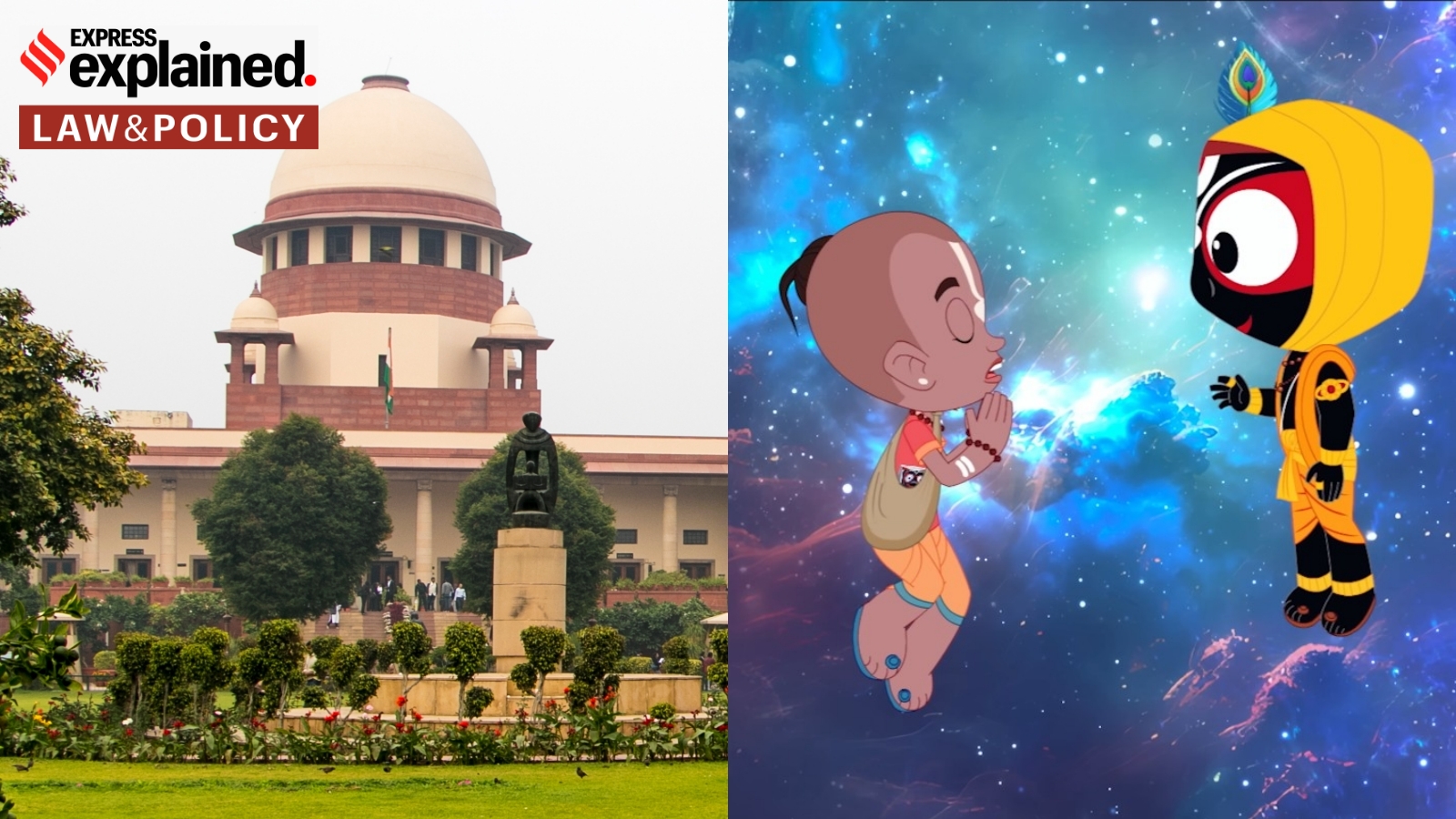
A still from the animated film which was supposed to release today. The Supreme Court deferred its release to after the Rath Yatra. Wikimedia Commons/YouTube
The Supreme Court on Friday (July 17) declined to permit the release of the animated film Mahaprabhu Jagannath on its scheduled release date today but directed the producer to postpone the release until after July 27, when the annual Rath Yatra in Puri concludes.
The order, by a bench of Justices B V Nagarathna and R Mahadevan, came after the Orissa High Court, on July 15, restrained the film’s release over concerns regarding the depiction of Lord Jagannath and the possible impact of its screening during the Rath Yatra.
The producer had challenged the scope of the High Court’s powers, and the extent to which a certified film can be restrained on apprehensions of public disorder.
The HC’s jurisdiction and scope
The High Court had held that the film’s depiction of Lord Jagannath’s childhood and adventures was “not in tune with the religious texts of the Skandha Purana and the Brahma Purana”. It said that releasing it during the Rath Yatra would be “counterproductive”.
One of the main challenges to the order was that the court “committed a grave jurisdictional error by traveling far beyond the scope of the pleadings and granting an interim relief that exceeds the specific prayer sought by the Writ Petitioners”.
It says that the petitioners had only sought to restrain the release within the state of Odisha. The High Court, instead, imposed “a blanket stay… thereby operating as a nationwide stay.”
The film held three separate ‘U’ (universal) certificates from the Central Board of Film Certification (CBFC) for its Hindi, Telugu and Odia versions, dated May, June and July, respectively. The stay stalled the certified Hindi and Telugu versions in states “where no cause of action existed and no relief was ever sought”.
CBFC certification
Story continues below this ad
The plea states that once “an expert statutory body… examines a film and certifies it for unrestricted public exhibition, there is a strong legal presumption of validity”, and courts should not substitute and follow “its view over the expert wisdom of the CBFC based on unverified apprehensions”.
It cited the Supreme Court judgment in Union of India v. K.M. Shankarappa, in which the court struck down a provision letting the Union government call for and revise the decisions on a film, holding that the executive cannot exercise revisional power over an expert body’s certification merely on apprehension of public resentment.
The plea said: “Merely because a small section of the society has a different view, from that as taken by the Tribunal, and choose to express their views by unlawful means would be no ground for the Executive to review or revise a decision of the Tribunal.”
The plea says that “it is not open to any authority, executive or judicial, to re-adjudicate that determination or to stall the film’s exhibition on the ground of an apprehended law-and-order situation”.
Story continues below this ad
The original PIL took the position that certification by the CBFC cannot be treated as conclusive where credible material exists showing that the contents of a film are inconsistent with the accepted religious traditions of a faith that is practised by millions of devotees. Their position was that the CBFC granted the certification without considering how the film’s depiction would affect public order and religious sentiments.
Timing and screening dispute
The High Court order says that the producer released the film “out of the blue” without making any changes that they had assured at the screening before the Gajapati Maharaja and the Shree Jagannath Temple Administration.
The producer’s petition disputes this and says that at the screening held on July 6, the committee “walked out after viewing a mere 10 to 15 minutes of the film” and that “they failed to provide any feedback or specific objections and arbitrarily demanded that the film should not be released at all.”
It says that the petitioner, out of “sheer respect,” deferred the release from July 10 to July 17.
Story continues below this ad
Pointing to the investment of around Rs 10 crore, the public campaign for the film began around two months ago, and the teaser and trailer were released in June. The plea states that the PIL being filed two days before the release was done to “inflict maximum commercial and financial damage.”
It states that the HC’s stay “will trigger a cascading effect of contract breaches, cancellation of theatrical slots, and a huge loss of capital that has already been spent, constituting an irreparable financial and reputational injury that cannot be compensated in terms of money.”
The plea also flags that the HC misunderstood the narrative of the film, as the character “Jagan” is a figure of imagination of a child character, and not visible to others. It says “no human actor portraying the deity in reality” reinforces the disclaimer that the film is a fictional devotional film.
On free speech
The HC order says that even if the movie enjoys the guarantee of freedom of expression and speech, a balance has to be created when such a creation impacts “the thoughts and the actions of the common people… it should ensure a high degree of attention and retention.”
Story continues below this ad
It said that “at times it creates an immediate influence and at times may shatter the sentiments, the emotions and the religious belief, which cannot be allowed if it results in unrest in the peaceful society.”
The petition leans on a line of Supreme Court judgments on artistic licence to argue that “artistic and creative licence… in a devotional, animated work meant for children must be placed on a high pedestal.”
It also cites the Madras High Court ruling on The Da Vinci Code, in which the court struck down arguments to ban the 2006 film over its depiction of Jesus Christ fathering a child, holding that “a fictional work having a clear disclaimer cannot be interpreted as a genuine threat to public order or peace”.
The plea states that freedom of expression “cannot be held hostage to a heckler’s veto,” and that neither the PIL petitioners nor the temple administration possess any statutory power under the Shree Jagannath Temple Act, 1955 to direct the non-screening of a certified film.
View original source — Indian Express ↗
Related stories

TechRadar
TechnologyJul 17, 2026 · 1 min
How to watch Ann Droid online from anywhere – it's *FREE*
TechRadar

TechRadar
TechnologyJul 17, 2026 · 1 min
'The first week of pre-orders brought in $180 million'
TechRadar

Wired
TechnologyJul 17, 2026 · 1 min
A $10K Bounty Aims to Make Sony’s PlayStation 5 a Computer Again
Wired

France 24
TechnologyJul 17, 2026 · 1 min
Trump reviving election fraud claims to contest midterm results, say Democrats
France 24