Buenos Aires Times
‘Our bodies contain poison’: Landmark trial in Argentina probes dangers of agrochemicals
A landmark trial in Argentina concluded last month, on June 25, at Federal Oral Court No. 2 in Rosario. It investigated the health consequences of agrochemical spraying in the city of Pergamino, Buenos Aires Province.
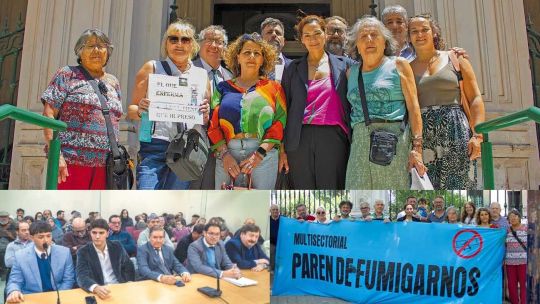
On one side of the courtroom were two women whose health had been affected, who joined the case as private plaintiffs. On the other side sat nine men – farmers, an agronomist, a crop-spraying contractor and public officials – who were accused of environmental contamination.
In the end, the image spoke more powerfully than the verdict itself. Everyone was acquitted, bar two municipal officials.
The significance of the trial lies not in the final ruling, or the role played by the Judiciary. What matters is what it revealed.
As Pergamino resident Anabel Pomar, a journalist who was herself affected by the spraying, put it, the proceedings had “laid bare a contaminated reality.”
The trial
Agricultural producers often refer to Pergamino as Argentina’s “capital national de la soja” (“National Soybean Capital”) or even “la perla bonaerense” (“The Pearl of Buenos Aires Province”).
But many local residents know it by another, harsher name: “la capital del veneno” (“poison capital”), reflecting the heavy health burden borne by its low-income neighbourhoods that are surrounded by intensively farmed land. In those areas, illness – and death – have become part of everyday life.
The trial centred on allegations of poisoning and environmental contamination caused by agrochemicals and their spraying. It was brought by local resident Sabrina Ortiz, who joined the proceedings as a private plaintiff after alleging that she and her family had been exposed to repeated aerial and ground spraying.
The alleged offences examined by the court covered the period between 2011 and 2019, when families in Pergamino began reporting illnesses they claim were linked to crop-spraying carried out as close as 10 metres from their homes, a distance in breach of minimum buffer zones established by local municipal regulations.
The proceedings were the first federal criminal trial in Argentina to bring before the courts every link in the agribusiness chain: farmers, agronomists and the public officials responsible for regulating such activities.
The nine defendants were farmers Mario Roces, Fernando Cortese, Víctor Tiribó and brothers Carlos and Hugo Sabatini; agronomist José Luis Grattone; crop-spraying contractor Cristian Taboada; and two officials from Pergamino’s Rural Environment Directorate, Guillermo Naranjo and Mario Daniel Tocalini.
The complexity of the case was reflected in comments made by Judge Román Lanzón while reading the verdict that acquitted all but two of the accused.
After acknowledging that “there is no doubt that phytosanitary products contaminate and harm both human health and the environment, and that living near fields where these agrochemicals are used is not the same as living far away,” said Judge Lanzón, before adding: “A criminal judge is not here as a superhero to provide the answers society is asking for, but to apply the law.”
His remarks stunned many of those in the courtroom, as well as supporters gathered outside the courthouse on Rosario’s Boulevard Oroño. It also stirred the memories of those who did not live to see the trial conclude.
Among them was Mónica, an 11-year-old girl who died of acute leukaemia in 2014. Her mother, Paola Díaz, testified during the proceedings.
Also remembered was Florencia Morales, one of the first residents to denounce the effects of agrochemicals after moving with her family to what they believed would be a healthier rural environment, only to find crop spraying taking place next to their home. She later developed cancer that metastasised to her spine and died on May 2, 2023.
The verdict
The court ultimately found only two defendants criminally responsible: municipal officials Naranjo and Tocalini, whose duties included overseeing the regulation and monitoring of agrochemical use in Pergamino.
Both received suspended prison sentences of two years and were barred from holding public office for four years. They were also ordered to perform two hours of unpaid community service each week on projects related to public health and environmental protection.
In addition, the judges requested an investigation into the conduct of Pergamino Mayor Javier Martínez.
As for the remaining defendants, the court ruled that the evidence presented was insufficient to establish criminal liability. The written reasoning behind the judgment is due to be released on August 10. It may be appealed.
“The emotional impact of this verdict has been enormous,” Carlos Gonzalo Quintana, lawyer for the plaintiffs, told the Perfil newspaper.
“But we will wait for the court’s reasoning before analysing the judgment in detail and preparing an appeal before the Court of Cassation in an effort to overturn this first-instance ruling.
“If we have to take the case all the way to Argentina’s Supreme Court or to the Inter-American Court of Human Rights, we will do so because this is about violations of environmental rights.”
Witnesses
Alejandra Bianco lives in southern Pergamino and decided to join the lawsuit because her family’s illnesses closely mirrored those suffered by Ortiz.
Both women lived away from the urban centre but were surrounded by farmland where agrochemicals were routinely sprayed.
“My children became ill when they were 17,” said Bianco.
“My eldest son, Benjamín, developed idiopathic thrombocytopenic purpura [an autoimmune disorder in which the immune system destroys blood platelets] “and my younger son, Ignacio, developed thyroid cancer.”
Her husband, who has since died, suffered from liver and pancreatic cancer, while Bianco herself was diagnosed with uterine cancer.
“I don’t know what the judges were thinking when they delivered this verdict,” she said. “To me it shows a complete lack of respect. They ignored the voices of those who are no longer here. Sabrina has carried almost this entire fight on her own. I simply stood beside her.”
Ortiz filed the complaint that gave rise to the case in 2018 as a member of the Madres de Barrios Fumigados collective.
Before then, she had suffered a miscarriage. Ortiz later experienced two strokes, which she attributes to prolonged exposure to neurotoxic substances. Laboratory tests found levels of glyphosate in the blood of both Ortiz and her two children well above what she describes as acceptable limits.
Ortiz says she endured years of threats and intimidation. One farmer allegedly shot her dog, while her repeated complaints to authorities went unanswered. At the end of 2017 she qualified as a lawyer so that she could represent both her own family and others affected by the spraying.
‘Our bodies contain poison’
Standing outside the courthouse after the verdict, Ortiz remained defiant. “The scientific evidence is overwhelming. Our bodies contain poison,” she said.
“This is only one stage in the process, and we know this verdict can be overturned. We will keep fighting until this is achieved and they stop making us sick once and for all.”
Over the course of the trial’s hearings, numerous scientists and medical specialists gave evidence.
Virginia Aparicio, an agronomist with Argentina’s National Institute of Agricultural Technology (INTA) who oversaw laboratory testing of water and soil samples collected from the affected areas, testified that 10 samples analysed between November 2018 and mid-2020 all contained pesticide residues.
Geneticist Delia Aiassa presented evidence on the genetic damage associated with exposure to agrochemicals, including abnormalities detected in Sabrina Ortiz and her son.
Medical toxicologist Verónica Torres described the health conditions affecting Ortiz’s children and testified that, eight years ago, she advised the family to move away from their home in order to escape continued exposure to pesticide spraying.
“Nearly 70 percent of the children with cancer whom we treat in hospitals in Buenos Aires or Córdoba come from areas where they were exposed to agrochemicals – through the water they drank, the air they breathed, or while they were still in their mother’s womb. That has been scientifically established,” said Professor Medardo Ávila, a lecturer at the Faculty of Medical Sciences of the National University of Córdoba and coordinator of the Network of Physicians from Sprayed Communities.
related news
View original source — Buenos Aires Times ↗
Related stories

The Punch
WorldJul 17, 2026 · 1 min
VIDEO: Ododo receives rescued kidnap victims at Kogi government house
The Punch
The Punch
WorldJul 17, 2026 · 1 min
Rescued Kogi school victims receiving care — Police
The Punch
The Punch
WorldJul 17, 2026 · 1 min
I spent money campaigning for Obi, he never appreciated me – Isaac Fayose
The Punch

Philippine Daily Inquirer
WorldJul 17, 2026 · 1 min
Ultra Lotto jackpot rises to P137.99M after no July 17 draw winner
Philippine Daily Inquirer