The Next Web
AI’s fiercest rivals just agreed on one thing: regulate frontier AI now
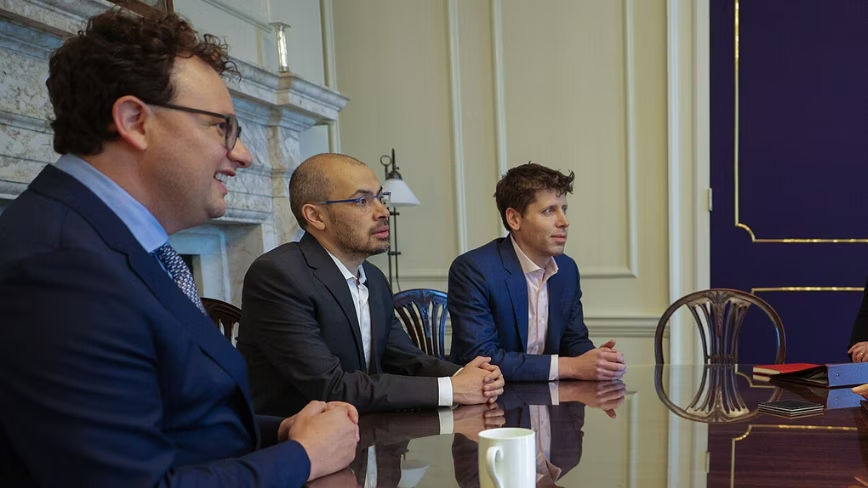
The people building the most powerful AI rarely agree on much. This week, three of them agreed on one big thing. The frontier needs regulating, and soon.
Over five weeks, the chiefs of Google DeepMind, OpenAI and Anthropic each published a memo on how to police the most capable AI models, Axios reported. Their diagnoses line up almost exactly.
Where they agree
All three want frontier models tested by independent outsiders before release. That breaks with the industry’s old habit of self-reporting. All three also want a single body to set standards, certify compliance and restrict access to models judged too dangerous.
They agree on who leads, too. Each wants the US in charge, rather than a patchwork of states or rival national rules. Each points to near-term national-security risks, from cyberattacks to bioweapons. And none calls for a broad crackdown. The target is the small class of the most powerful models.
Where they split
The rivals part ways on how hard the government should hold the button. Amodei, who has also urged a coordinated pause on frontier AI, wants an FAA for AI: a federal agency that can block a release outright.
Hassabis wants a FINRA-style body, industry-funded but government-overseen, starting with voluntary reviews. Altman, writing in the Financial Times, wants an IAEA-style international forum that uses access to models and markets as leverage.
A rare truce
Hassabis’s plan, published Tuesday, drew unusual praise across a bitterly competitive field. Altman called it “thoughtful.” Microsoft’s Satya Nadella said the goal was “a frontier ecosystem that promotes innovation and choice.” Even Elon Musk, no friend of Altman’s this week, called it “a good starting point.” Anthropic’s Jack Clark called the framework “excellent.”
The timing is not random. Over the same five weeks, Washington twice stepped in to restrict or delay frontier models, first Anthropic’s Fable and Mythos, then OpenAI’s GPT-5.6, over cyber fears. The Trump administration is publicly anti-regulation, but privately less sure a hands-off approach can hold. Meta’s Mark Zuckerberg is said to be drafting a memo of his own.
The catch
Not everyone is cheering. OpenAI, Google and Anthropic already have the lawyers, security teams and Washington ties to handle a heavy certification process. Startups and open-source developers do not. Critics warn the result could be regulatory capture: safety rules that quietly entrench the biggest labs. It is the same set of rivals who sparred at the G7 weeks ago, now lobbying hardest for the rules.
Published July 17, 2026 - 10:46 am UTC
Back to top
View original source — The Next Web ↗
Related stories
Dawn
TechnologyJul 17, 2026 · 1 min
Apple closes in on Nvidia in race for world's most valuable company
Dawn

The Guardian
TechnologyJul 17, 2026 · 1 min
More Canadian wildfire smoke shrouds US midwest, mid-Atlantic and north-east
The Guardian

TechRadar
TechnologyJul 17, 2026 · 1 min
Two 32GB DDR5-6000 RAM kits just dropped in price — choose V-Color's low-latency Manta XSky or Corsair's Vengeance
TechRadar

Wired
TechnologyJul 17, 2026 · 1 min
Conspiracy Theorists Think Trump’s Speech Paves the Path to the Insurrection Act
Wired