Indian Express
Beyond Trending: What is monarchy?
4 min readNew DelhiJul 17, 2026 06:37 PM IST
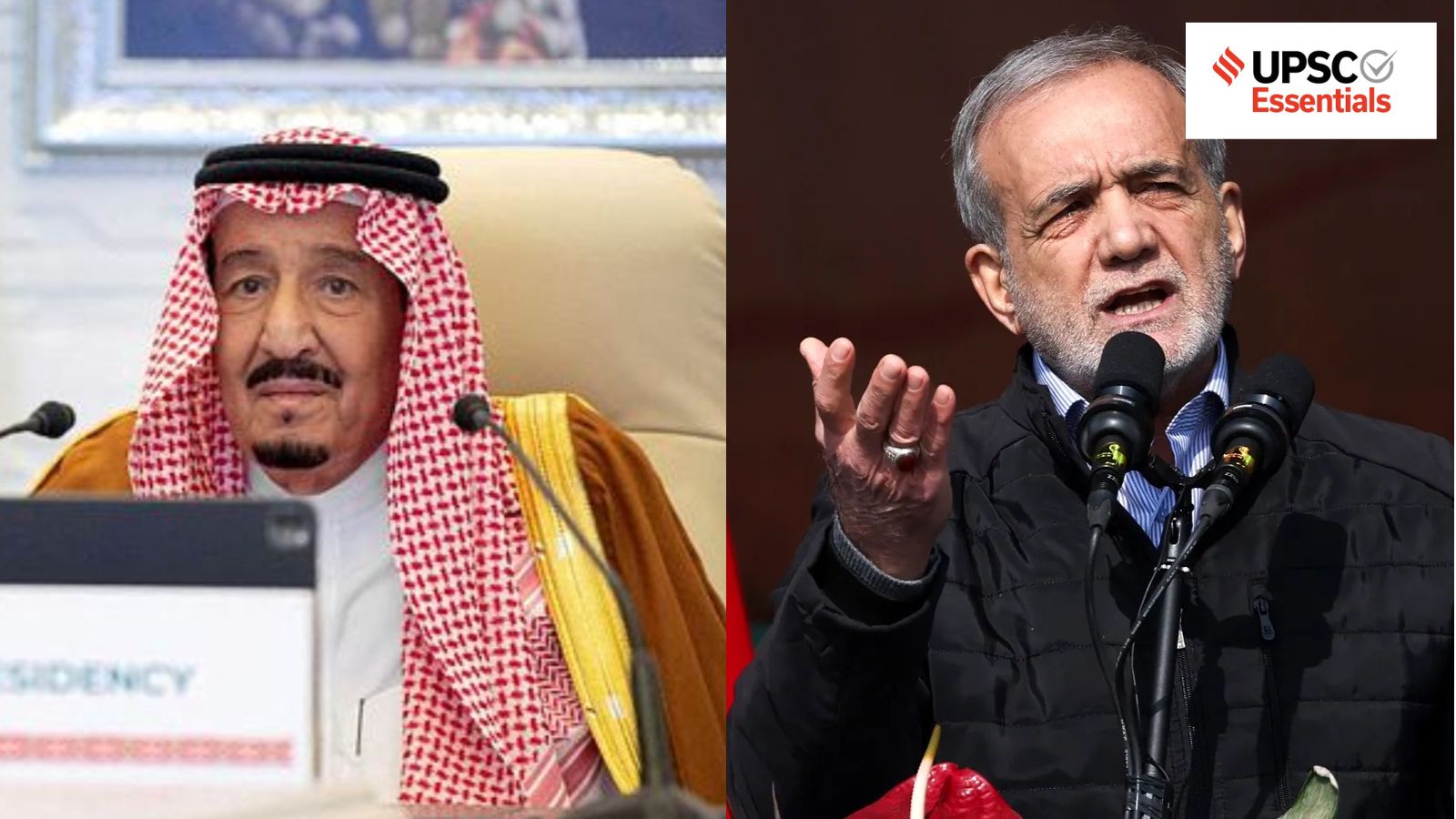
King Salman bin Abdulaziz of Saudi Arabia and Iranian President Masoud Pezeshkian. (Reuters, file)
Amid the ongoing US-Israel war on Iran, America-led security architecture in West Asia is facing unprecedented strain. Iran’s missile and drone attacks on American military bases in the Gulf Cooperation Council (GCC) countries exposed Washington’s inability to protect its Gulf allies.
The resulting security concerns have prompted Arab Gulf states to review their dependence on the US as the principal guarantor of their national security and regional stability. At the same time, they appear compelled to consider Iran’s role in any prospective security architecture by regional players.
However, it’s easier said than done in view of the deep-seated differences between Iran and the Gulf monarchies. In addition to sectarian and geopolitical differences, Iran and the Gulf Arab states diverge in their forms of governance. While Iran is a republic born of the 1979 Revolution, the GCC states are hereditary monarchies.
Understanding what a monarchy is therefore important to analyse the prospects for an emerging regional security architecture.
What is monarchy?
Monarchy is a political system based on the sovereignty of an individual, the monarch (king, shah, sultan, emperor, etc.), whose position is usually hereditary and held until life or abdication. As one of the oldest forms of political system, monarchy survived and evolved through diverse historical, political, economic and ideological developments.
It is broadly divided into two types: absolute monarchy and constitutional monarchy.
Absolute monarchy
In absolute monarchy, the monarch functions as both head of state and head of government, and exercises legislative, executive, and judicial power.
Story continues below this ad
In an article, Resilient Royals: How Arab Monarchies Hang On (2012), Sean L Yom and F Gregory Gause III note that royal houses in the eight Arab monarchies – Jordan, Morocco, Saudi Arabia, and the Persian Gulf littoral states of Bahrain, Kuwait, Oman, Qatar, and the UAE – all wield near-absolute power.
Constitutional monarchy
In constitutional monarchy, the role of the monarch is codified in the state constitution, and the power of the monarch is limited by constitutional law. Constitutional monarchy usually combines hereditary rule with democratic governance. While the monarch generally remains the head of the state, actual political authority rests with the elected bodies.
Depending on countries, the monarch’s role often varies from exercising limited constitutional powers to serving as a largely ceremonial figure. For instance, in the British monarchy, the king serves as the ceremonial head of state, while the Prime Minister heads the government and exercises executive authority.
In the case of Japan, the monarch’s role is largely symbolic. In Norway, the monarch exercises considerable authority under the constitution, including the ability to veto and approve all laws and the power to declare war.
Story continues below this ad
Gulf monarchies, Iran, and regional security order
Scholars note that the most remaining absolute monarchies in the twenty-first century are in West Asia. The resilience of the monarchies in the region has been a subject of scholarly debates. Some scholars have focused on the cultural explanation of monarchy’s resilience in the region.
But Sean L Yom and F Gregory Gause III argue that the durability of monarchies in the Arabian Peninsula stems less from inherent cultural or institutional uniqueness and more from a combination of massive rentier state oil wealth, strong international patronage, and the historical ability to co-opt key domestic constituencies.
These factors not only helped Gulf Arab monarchies to weather various shocks but also shaped their perception of threats. The Islamic Republic of Iran, born out of the 1979 revolution, was initially seen as posing a threat to the Arab monarchies and the US-led regional order. Any prospective emergence of regional security architecture, away from the US, would therefore require Iran and other Gulf Arab monarchies to overcome various cleavages.
Send your comments at [email protected].
Click Here to read the UPSC Essentials magazine for June 2026. Subscribe to our UPSC newsletter and stay updated with the news cues from the past week.
Story continues below this ad
Stay updated with the latest UPSC articles by joining our Telegram channel – IndianExpress UPSC Hub, and follow us on Instagram and X.
View original source — Indian Express ↗
Related stories

Straits Times
TechnologyJul 17, 2026 · 1 min
Apple unseats Nvidia to become world’s most valuable company as AI bets shift
Straits Times

France 24
TechnologyJul 17, 2026 · 1 min
Trump targets China and Russia with baseless claims of election interference
France 24

TechRadar
TechnologyJul 17, 2026 · 1 min
Ex-MBDA engineer builds $1,100, 40g AI micro-drone using AMD phased-array sonar for YC-backed startup Tornyol to…
TechRadar

TechPana
TechnologyJul 17, 2026 · 1 min
High Court Releases YouTuber Roshan Pokharel on Rs 25,000 Bail in Cybercrime Case
TechPana