CNA
Gen Z workers in Asia say they are using AI to do more – but their bosses are expecting more too
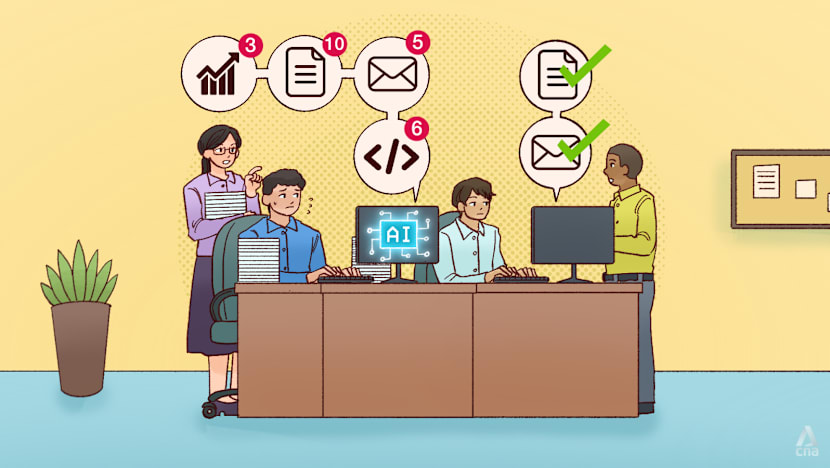
Ever since artificial intelligence (AI) came into her life, Ms Ayushi Raghuwanshi, who works in digital marketing in Gurugram, India, has found that finishing work faster is not a problem. Justifying the extra free time is.
The 26-year-old said AI has reduced the time required to complete routine tasks, as it can help her analyse campaign data, prepare advertising materials, and build presentation slides in far less time.
But the time saved has not made her workload lighter.
"For example, previously, I was handling three to five things a day. Now, to justify my working hours and my job, I take on up to eight tasks in the same amount of time," she told CNA TODAY, adding that she continues to spend eight hours a day in the office.
"When a task that used to take hours now takes minutes, more is expected of me. For the rest of my hours, I feel pressure to show what else I'm doing, since that work no longer takes as much effort or time."
Consultants and workforce experts said this trend of higher expectations, which is not unique to Asia, is likely to become more common as AI becomes embedded in everyday work, redefining what is considered normal performance.
Mr John Hazan, partner and global head of Bain and Company's talent solution practice, said that AI "tends to intensify work rather than reduce it", as employees become able to work faster and take on a broader scope of work.
"Higher capability leads to higher output. That leads to higher expectations, which drive further expansion. Employees focus on what we call 'value-added activities', with limited time for breaks and limited ability to step back from their work."
In Shanghai, China, a 24-year-old recruitment consultant who wanted to be known only as Shi said she has seen the same pattern play out at her company.
Her firm is rebranding itself as an AI-powered recruitment company, promising clients candidate shortlists within 22 to 72 hours – down from one week.
While her own key performance indicators (KPIs) have not formally changed, she said the message from the top down is clear: use AI to speed up the recruitment process.
"I think it's nice to get things done faster, but it's also not reasonable, because clients will get higher expectations, and managers will also get higher expectations that you accomplish things quicker."
Over in Bangkok, Thailand, Ms Pitchaya Liewchanpatana, 28, who manages the development of digital banking products from planning to launch, said that while she previously handled two products, she now manages three with AI assistance.
Her boss has also encouraged her to use AI tools to cope with competing demands, although she said the increased expectations came more as a subtle shift than a formal announcement.
"Sometimes I have two overlapping meetings. My boss would say: 'It's okay, you can do it. You can attend one and ask Copilot (an AI tool) to summarise the other'."
The experiences of these young workers reflect the findings of a Money Mind survey of 3,628 citizens and permanent residents aged 21 to 29 across seven Asian markets: Singapore, Malaysia, Indonesia, Thailand, the Philippines, China and India. Respondents were either employed or looking for work.
The survey was conducted as part of the relaunch of CNA's Money Mind, a personal finance and business news programme, on Jul 1.
Among employed respondents who use AI at work, a large share said AI tools have raised expectations for them to produce more work in the same amount of time.
This was highest in China, where 85 per cent agreed with the statement. India followed close behind at 82 per cent, while Singapore and Indonesia both stood at 69 per cent.
Yet the survey also found that many young workers remain optimistic about AI. China and India, the two markets with the highest level of workplace AI use, also had the highest shares of respondents who said AI is beneficial for their careers, at 88 per cent each.
Assistant Professor Jack Tong, from Nanyang Business School at Nanyang Technological University, said China and India likely stand out because both economies are rapidly transitioning from manufacturing-led growth to innovation- and knowledge-driven industries. In these sectors, AI has become a productivity tool for tasks such as generating ideas, writing code, analysing data and creating content.
Therefore, young, highly educated workers have much greater exposure to AI than workers in more traditional sectors, said Asst Prof Tong, who specialises in AI-human collaboration and technology adoption.
Intense competition for talent in both markets also means employees increasingly feel pressure to show they can use AI not just to work faster, but to deliver higher-quality work, solve more complex problems and create greater business value, he added.
CNA TODAY found this tension reflected in interviews with 16 Gen Z workers across the surveyed markets. Many said AI had made their work faster, while adding that the time saved was often redirected toward more complex work, producing higher-quality output or new expectations to keep learning.
In terms of remuneration, however, none of the workers CNA TODAY spoke to mentioned a clear, direct increase in base pay from using AI at work. Some, however, believe it could help indirectly by allowing them to hit their KPIs more smoothly, which could translate into higher appraisal scores, higher pay and better promotion prospects.
Experts said such optimism is not misplaced, but certain conditions must be met first.
Dr Vivien Shan Wen, senior lecturer in human resource management at the Singapore University of Social Sciences (SUSS), said organisations are more likely to reward workers who use AI to create value rather than those who merely use the tools as a shortcut.
"Two employees may both use ChatGPT, but one simply generates text while another redesigns a workflow, improves decision quality, or solves a business problem that saves the organisation significant time or money," she said.
"It is that difference – not AI use itself – that is likely to drive career progression."
RAISING THE BAR HIGH
In these early stages of their careers, however, many young workers who spoke to CNA TODAY said they are simply being asked to churn out more of the same work using AI, rather than being encouraged or taught to create value for the business.
In Gurugram, just outside India's capital New Delhi, content writer Ridhi Anand, 24, who focuses on insurance and search engine optimisation (SEO) writing, said AI has dramatically increased how much content she is expected to produce.
Before AI became widely used at her company, she said she would typically write between 500 and 2,000 words a day. Now, with tools such as ChatGPT, Gemini and Claude, she is asked to produce about 6,000 words a day, including AI-assisted drafts that she must then rewrite to sound "more human".
While AI has made the work faster, she said it has also made it more monotonous and stressful, especially because AI-generated content still needs to be rewritten and adapted for Google search.
"Productivity has gone up, but my stress levels have also gone up. My boss likes to see more content and sometimes, all the burden falls on me," said Ms Anand.
But this is not necessarily the case everywhere. Mr Sean Tan, career practice leader at Mercer Singapore, said that AI has not necessarily made employees busier "in a traditional sense", but it has changed what is considered normal performance.
"If a tool can help produce a first draft faster or automate parts of a task, the expectation often becomes that employees should now produce more polished work, respond faster, or take on more complex responsibilities," he said.
"The pressure is often less about raw workload and more about a higher performance baseline."
This may be especially challenging for junior workers. Dr Shan of SUSS said employers should expect AI literacy from fresh graduates but not AI expertise, as young workers still need time and support to learn how to evaluate AI-generated content and exercise professional judgment.
The experts added that if AI simply leads to higher expectations without clearer training, support or recognition, it could become a source of frustration rather than improved performance and growth.
An international school teacher in Kuala Lumpur, Malaysia, who wanted to be known only as Ms Shay, is experiencing this firsthand.
The 28-year-old, who teaches English, mathematics and science, admitted that AI has saved her a great deal of time on routine work, such as writing school reports, planning upcoming lessons and replying to emails from parents.
But at the same time, the school has also added AI-related requirements to the teachers' goals, including AI-assisted report checks and educational technology projects in which teachers must demonstrate how they use AI in class.
Ms Shay said the school noticed teachers had more time and had begun assigning more activities, curriculum work and other duties to them. "Now we sometimes have to do things because other people think we are too free."
In Jakarta, Indonesia, Ms Septiani Rahayu, 28, a social media specialist at an aesthetic clinic, said AI has become part of her daily content workflow. She uses it to brainstorm ideas, suggest content angles and produce first drafts for video scripts and captions.
https://www.channelnewsasia.com/commentary/singapore-ai-council-workplace-adopt-productivity-6209631"Now I use AI almost every day to help generate ideas or as a discussion partner, but I still edit and customise the final result myself. AI is more like a work partner than something that does everything for me."
AI has also raised the bar for the speed and quality of work that employees are expected to deliver, said Ms Septiani.
"So we still need the skills to review, edit, and make sure AI-generated work actually meets our needs," she said.
WAITING FOR THE AI DIVIDEND
If AI is raising employers' expectations of workers, the obvious corollary is that higher productivity ought to be matched by higher pay. But is that really the case?
For many of the Gen Z workers CNA TODAY spoke to, the answer is no. While AI has enabled them to be more productive, it has not translated into higher base salaries. Still, some believe the benefits may be reflected indirectly, through better performance appraisals or higher commissions.
Ms Raghuwanshi, the digital marketer in India, said she has thought about this trade-off from both sides. As an employee, she admitted that the instinct was to bristle at being expected to do more for the same pay.
"But when I think about whether I would do the same with my employees if I owned a business, I would. If their effort is not being fully used, or if they are being assisted by someone (or in this case, AI), then I would expect them to do more."
Others saw a more indirect link between AI and the prospects of higher income.
Ms Dinda Amalia Julyandri, 24, a loan financial consultant in Surabaya, Indonesia, said that AI is helping her work through client documents faster and manage a larger pipeline of applications, giving her a better shot at the monthly targets tied to her performance appraisals and incentives.
For now, these financial aspirations have yet to materialise.
In Manila, the Philippines, Mr Julian Ang, 26, a tech sales account executive, said it's too early to tell whether his AI skills, which he learned on his own for over a year, will affect his pay – he hasn't had a formal review yet, given that he only joined a few months ago.
"But in informal reviews … my manager encourages me to be the AI expert of the team, so hopefully this would result in higher pay when the time comes."
The survey findings suggest that pay outcomes remain uneven across the region.
Among employed respondents who use AI at work, China had the highest share who said AI had led to higher pay, at 42 per cent. India and Indonesia followed at 34 per cent each.
But in the other markets, most employed AI users said their pay had not changed. This was the case for 67 per cent of respondents in the Philippines, 61 per cent in Singapore, 60 per cent in Malaysia and 58 per cent in Indonesia.
In Singapore, only 12 per cent of employed AI users said AI had led to higher pay, while 27 per cent said it had led to lower pay. In Thailand, 35 per cent said AI had led to lower pay, the highest among the seven markets.
The findings point to a tension workers may be grappling with today as workplaces intensify AI usage. They may be expected to produce more, but the financial rewards are not guaranteed.
Mr Marcus Lam, executive chairman of accounting firm PwC Singapore, said one possible explanation is that employers increasingly see AI fluency as a baseline workplace skill rather than a specialised capability that automatically commands a wage premium, just like how digital literacy evolved over the past two decades from being a differentiator into a baseline expectation.
Mercer Singapore's Mr Tan said many employers are still not directly linking AI-driven productivity gains to pay, but are instead redesigning roles and raising expectations around output, quality or scope.
But if companies keep demanding more without recognising stronger contributions, they risk creating frustration and disengagement, he said.
The experts also stressed that employers will need to be clearer about how AI-enabled productivity will be reflected in performance reviews and promotions, while ensuring employees receive the training and support they need to meet higher expectations.
AI's GROWING PAINS AND GAINS
For many young workers, their embrace of AI and its benefits is tempered by anxieties about its perils.
Across all seven markets surveyed, more than eight in 10 respondents said they had concerns about AI at work. The most common fears were that AI could lead to job losses or that their skills could become obsolete, with the Philippines showing the highest level of concern about skill obsolescence at 48 per cent.
For Ms Colleen Barcelona, 28, a multimedia designer in the Philippines, AI has been useful because it helps speed up certain work processes, but it has also reinforced her fears of being replaced.
Ms Barcelona said she had previously worked as an illustrator for a brand but was let go after the company decided it no longer needed her to create additional illustrations due to AI.
That experience left her worried that her job could be easily replaced by AI one day. To protect herself, she has been branching into other areas such as social media marketing, SEO, analytics and web design.
In Kuala Lumpur, Mr Jeffrey Tang, 27, said concerns about falling behind in AI were a major factor in his decision to leave his previous role as a user experience (UX) researcher.
His former company encouraged employees to use AI tools such as ChatGPT, Gemini and Figma AI, but he said staff were largely left to learn on their own, with most using ChatGPT and Gemini mainly for simple prompting.
At the same time, clients were beginning to expect faster work because AI was available. Mr Tang said this made him worry about being left behind or replaced if he did not develop stronger AI skills.
He has since moved to a company where staff attend weekly AI training sessions, and there is a person in charge of improving workflows with AI.
These mixed feelings were also captured in the survey, which asked respondents how they were preparing for an AI-shaped future. When asked what skills would best equip them for future jobs, many respondents did not choose AI skills alone.
In Singapore, 48 per cent of respondents identified critical thinking and problem-solving as among the most important skills for future jobs, as did 49 per cent in Malaysia and 54 per cent in the Philippines.
In India and Thailand, AI and automation skills were especially prominent, chosen by 64 per cent and 41 per cent of respondents, respectively.
In contrast, creativity and innovation were more prominent among respondents in China and Indonesia, selected by 54 per cent and 57 per cent, respectively.
While experts acknowledged that workers' concerns about AI are valid, they said simply using AI tools is not enough. What matters is using them wisely and combining them with strong human judgment.
Mr Hazan of Bain and Company said basic prompting and the use of AI tools will soon be considered the minimum expectation and assumption for every professional. Increasingly, what will matter is the worker's ability to verify AI outputs, frame problems clearly and exercise judgment when there is no single right answer.
Likewise, PwC Singapore's Mr Lam said that while proficiency in using AI is important, it should not come at the expense of critical thinking, communication, teamwork and judgment.
"The individuals who thrive will be those who can combine AI capabilities with uniquely human strengths."
Indonesia also stood out in the survey for a different reason: It had the highest share of respondents (44 per cent) who said they had used or were considering using AI to start a side hustle or new income stream.
This was higher than Thailand at 35 per cent, India at 31 per cent, the Philippines at 24 per cent, Malaysia at 12 per cent, China at 9 per cent and Singapore at 3 per cent.
Ms Velisia Serenada, a 27-year-old creative and content strategist in Jakarta, used AI to support a small festive hamper business during the Muslim fasting month of Ramadan last year. The business idea was her own, but she used AI to help with pricing, catalogue copy, promotional ideas and market research.
While AI was not central to her business, she said she found it useful as a low-cost assistant for testing ideas more easily.
HYBRID ROUTE TO THE FUTURE
While many young workers recognised that AI would be part of their future, the survey found that not everyone was equally enthusiastic about embracing it.
Singapore respondents were the least keen on future jobs involving AI. Just over half, or 54 per cent, said they would want a future job that involves AI, the lowest among the seven markets surveyed.
In contrast, the figure was highest in India at 75 per cent, followed by China at 69 per cent and Thailand at 68 per cent. Singapore also had the highest share saying they had no preference, at 20 per cent.
For Singaporean Tan Ming Chuan, who has "no preference", the prospect of AI being part of a future job does not spark either excitement or dread.
"I feel that it is inevitable, and therefore I feel indifferent," said the 27-year-old human resource executive. While AI can help with automation, overreliance on it and a misunderstanding of its capabilities are "a real and growing problem", he added.
To him, the best approach is not to choose between AI and human skills, but to build both. He said AI can save time by automating operational tasks that require little or no human decision-making, but it cannot replace human judgment in "exceptional, nuanced, people-related cases".
Similarly, Ms Ong Si En, a 25-year-old former research coordinator in Singapore whose last job involved working with patients enrolled in healthcare studies, said she was open to using AI for administrative tasks, but not for the human parts of the role.
"AI cannot replace talking to patients, interacting with them, explaining the study to them during screening, or drawing blood," she said. She is currently between jobs.
The difference also showed up in how respondents said they planned to future-proof themselves.
Singapore was the only market in which the "human route" was the most popular option. About 24 per cent of respondents said the best way to prepare for the future was to pursue a white-collar job requiring high empathy or complex strategy.
In China and India, respondents were more likely to choose the "AI route", defined as a preference for jobs centred on building, managing or using AI.
Experts said these differences reflect contrasting labour-market realities, rather than a simple divide between workers who embrace AI and those who reject it.
Dr Karthik Nachiappan, research fellow at the Institute of South Asian Studies at the National University of Singapore, said India may favour the "AI route" because AI is seen as a way to get ahead in a highly competitive, skills-driven labour market and economy.
"AI is a tool of upward mobility. AI adeptness can make you stand out from the crowd as workers become more productive," he said.
He also noted that India's large IT services industry means AI is already deeply embedded in many workplaces, making its use "hardly a choice but a necessity".
For China, Dr Luna Lai, visiting fellow at Singapore-based think tank ISEAS-Yusof Ishak Institute, said preference for the "AI route" stems from a combination of government policy, a "brutally" competitive job market and people's familiarity with AI in everyday life.
"In China, AI (has become) a state-level priority. The government has laid out clear plans, and when you have that kind of top-down signal, people naturally feel that mastering AI is not optional, it's a survival skill."
She also pointed to the country's intensely competitive job market, where people "either upgrade your skills or get left behind", as well as the widespread use of AI in services such as shopping, food delivery and travel planning.
In Singapore's case, experts said the interpretation for the country's preference for the "human route" should not be read as workers resisting AI, as it may reflect a more measured and practical view of what AI means for work.
NTU's Asst Prof Tong said the findings reflect an interesting mindset among Singapore workers. Rather than seeing AI and human skills as competing alternatives, many Singaporean workers appear to view long-term career resilience as coming from capabilities that AI is less likely to replace.
Singapore is a highly developed knowledge economy where many jobs require complex decision-making, stakeholder management and strategic thinking, areas where AI can assist but in which human judgment, accountability and interpersonal skills remain indispensable, he said.
AI can generate answers, but humans remain responsible for asking the right questions and deciding which answers deserve to be trusted.
Echoing this, PwC Singapore's Mr Lam said there may also be greater awareness in Singapore that AI adoption is not just about using new tools, but also about changes to jobs, expectations, skills and responsibilities.
"That can naturally create some caution, especially if workers are still building confidence in how AI will affect their roles and career pathways," he said.
"In my view, this is not necessarily negative. A healthy level of caution can be useful if it leads to responsible adoption, stronger governance and better investment in people."
Still, experts said workers should neither shy away from AI nor become overly reliant on it.
Dr Shan of SUSS said workers do not need to become AI experts overnight, but should develop enough AI literacy to understand what the technology does well, where its limits are and how to use it to complement their own expertise.
The risk of being overly AI-positive, she added, is that workers may become passive users who accept AI-generated answers without questioning their accuracy or relevance.
"AI can generate answers, but humans remain responsible for asking the right questions and deciding which answers deserve to be trusted."
Additional reporting by Bong Xin Ying and Amanda Puspita Sari.
Source: CNA/ay/yy
Related stories

The Punch
WorldJul 17, 2026 · 1 min
Yayi, Adebutu supporters take campaign to Daniel’s mother-in-law’s burial
The Punch
South China Morning Post
WorldJul 17, 2026 · 1 min
Tai Po fire inquiry panel calls for bamboo scaffolding to be phased out
South China Morning Post

Straits Times
WorldJul 17, 2026 · 1 min
Harry Potter author J.K. Rowling blasts Amnesty ‘anti-rights’ label on women’s centre
Straits Times

BBC
WorldJul 17, 2026 · 1 min
Former DUP leader Jeffrey Donaldson to appeal sex offence convictions
BBC