Indian Express
Art and Culture with Devdutt | Did Greeks influence Indian theatre?
6 min readNew DelhiUpdated: Jul 17, 2026 08:10 PM IST
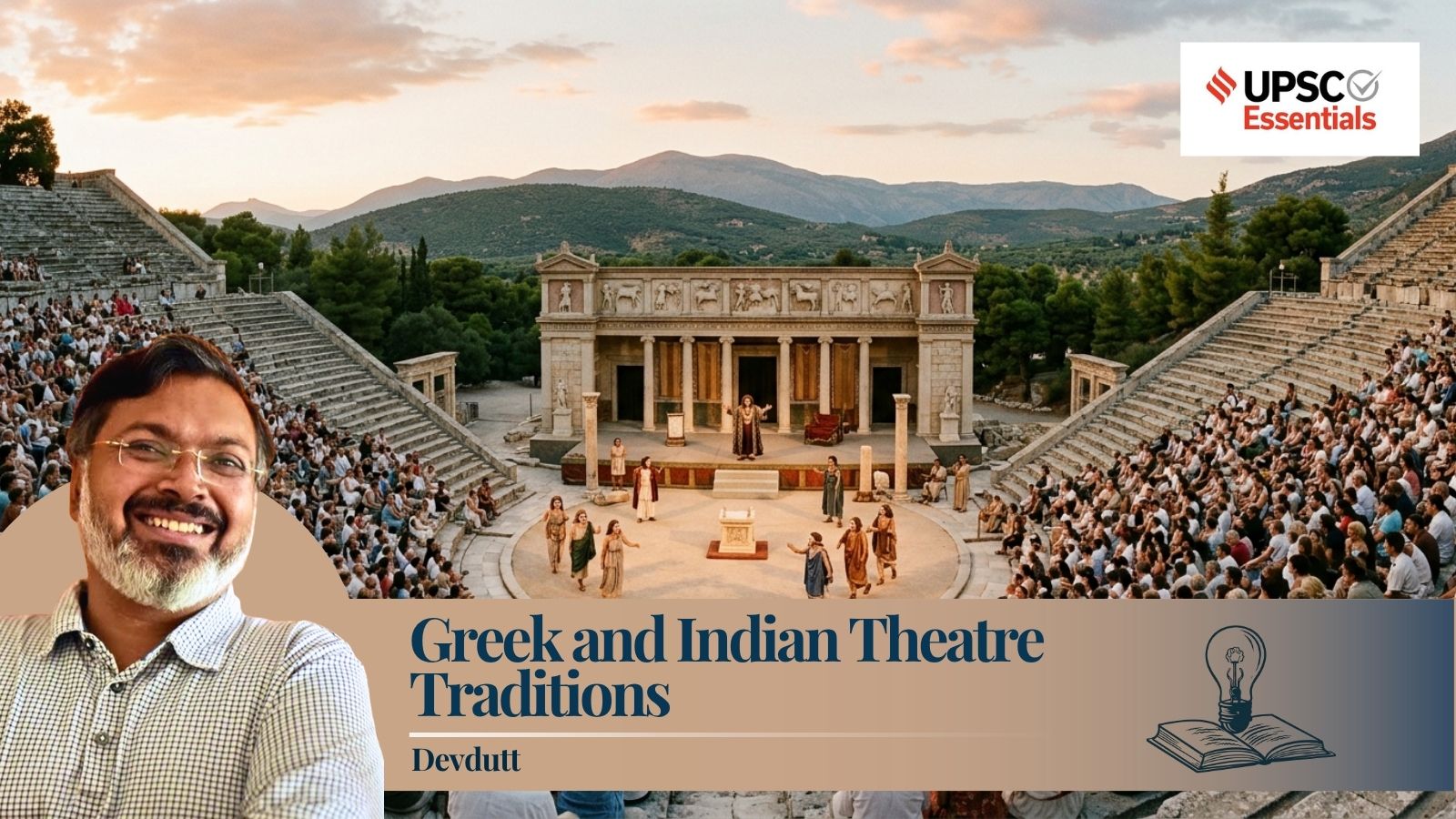
Scholars continue to debate the extent of Greek influence on Indian theatre, but there is little doubt that cultural exchange took place. (Image created by Google Gemini)
The history of theatre is often told through two great classical traditions: the theatre of ancient Greece and the theatre of ancient India. Both developed sophisticated ideas about storytelling, performance, music, and human emotions.
Although they emerged independently, there were moments of contact between them, especially after the arrival of Greeks in northwestern India following the campaigns of Alexander the Great in the fourth century BCE. Scholars continue to debate the extent of Greek influence on Indian theatre, but there is little doubt that cultural exchange took place.
Examples of cultural exchange
One of the most visible examples of this exchange is the stage curtain. In Sanskrit theatre, the curtain is known as the Yavanika. The word is derived from Yavana, the ancient Indian term used for Greeks and people of Hellenistic origin. Many historians therefore suggest that the curtain, which separated the backstage area from the acting space, may have been introduced through contact with Greek theatrical traditions.
Significantly, in Gujarati Vaishnav Haveli culture, the deity has a backdrop called ‘Pichwai’ painted with images of Vrindavan. This may have theatre origins too, as the deity is seen as ‘ranga-natha’ or the ‘lord of theatre’ who plays games ‘leela’.
Opportunities for such exchange increased after the formation of Indo-Greek kingdoms in regions such as Bactria and Gandhara and the emergence of trade routes. Gandharan art itself demonstrates a remarkable fusion of Greek and Indian styles, and theatre may have experienced similar interactions.
Catharsis and rasa: Different philosophical goals
Despite these contacts, Greek and Indian theatre remained fundamentally different in their goals and structure. The most important difference lies in what each tradition hoped to achieve in the minds of its audience.
Story continues below this ad
Greek theatre, especially as described by Aristotle in his work Poetics, aimed at catharsis. The audience was expected to experience powerful emotions such as pity and fear and then be emotionally purified through the dramatic experience. Tragedy was therefore one of the highest forms of Greek drama.
Indian theatre, as described in the Natyashastra, pursued a different goal known as rasa. The word rasa literally means “flavour” or “essence”. The audience was expected to savour emotions aesthetically rather than be overwhelmed by them. The ideal spectator was calm and detached, appreciating the emotional experience much as one enjoys the taste of a well-prepared meal. The purpose was not emotional release but aesthetic delight and insight.
This difference explains why tragedy occupies such a central place in Greek theatre but is largely absent in classical Sanskrit drama. Greek heroes such as Oedipus or Agamemnon often face unavoidable disaster. Their downfall forms the climax of the story.
In contrast, Sanskrit plays generally avoid tragic endings. The Natyashastra recommends that harmony and order be restored at the conclusion. Even when characters suffer hardships, the ending usually re-establishes dharma, social balance, and hope. Greek theatre creates anxiety and seeks transformation. Indian theatre provides delight with insight.
Story continues below this ad
Contrasting structures and narrative techniques
The structure of the plays also differs greatly. Greek drama often follows the famous three unities: unity of time, place, and action. Events typically occur within a short period, in a single location, and revolve around one main plot. Sanskrit drama is much more flexible. A play may span many years, move across kingdoms, forests, heavens, and palaces, and weave together several storylines.
Another important difference concerns narration. Greek plays rely heavily on the chorus, a group of performers who comment on events, advise characters, and express public opinion. The chorus acts as a bridge between the audience and the drama.
Sanskrit theatre generally does not use a chorus. Instead, it employs a Sutradhara, or stage manager-narrator, who introduces the play and guides the audience. Many plays also feature the Vidushaka, a comic companion who provides humour and practical commentary.
Story continues below this ad
Language use reveals another contrast. Greek drama was generally performed in a single literary language. Sanskrit drama, however, was consciously multilingual. Kings, sages, and gods usually spoke Sanskrit, while women, servants, merchants, and commoners often spoke various forms of Prakrit. This linguistic diversity reflected the social realities of ancient India and added layers of characterisation.
Where the two traditions meet and diverge
Yet there were also striking similarities. Both traditions valued poetry, music, gesture, costume, and stylized movement. Neither aimed at strict realism in the modern sense. Actors used codified expressions and symbolic actions to communicate emotions and ideas. Theatre was not merely entertainment; it was a vehicle for education, morality, religion, and social reflection.
In conclusion, Greek and Indian theatre shared certain performance techniques and may have influenced each other through cultural contact. However, they remained distinct in their philosophical goals. Greek theatre sought catharsis through conflict and tragedy, while Indian theatre pursued rasa through aesthetic experience and emotional balance. Together, they demonstrate the remarkable diversity of human approaches to storytelling and performance.
(Devdutt is a renowned mythologist who writes on art, culture and heritage.)
Story continues below this ad
Post read questions
1. Although Greek and Indian theatres emerged independently, there were moments of contact between them. What are the most visible examples of this exchange?
2. How do the differing endings of Greek tragedy and Sanskrit drama reflect the broader philosophical outlooks of ancient Greece and ancient India?
3. What is the concept of rasa in the Natyashastra? How does it differ from Aristotle’s concept of catharsis?
4. Examine the structural and narrative differences between Greek and Sanskrit drama with suitable examples.
Story continues below this ad
Share your thoughts and ideas on UPSC Special articles with [email protected].
Click Here to read the UPSC Essentials magazine for July 2026. Subscribe to our UPSC newsletter and stay updated with the news cues from the past week.
Stay updated with the latest UPSC articles by joining our Telegram channel – IndianExpress UPSC Hub, and follow us on Instagram and X.
View original source — Indian Express ↗
Related stories

The Verge
TechnologyJul 17, 2026 · 1 min
Florida man arrested for allegedly stealing over $200,000 in crypto using Steam game malware
The Verge

TechCrunch
TechnologyJul 17, 2026 · 1 min
Amazon fixing bug that billed some AWS customers billions of dollars
TechCrunch

TechRadar
TechnologyJul 17, 2026 · 1 min
HP's 20-core Elite Mini 800 G9 is a heavy-duty desktop replacement — and it’s $700 off at Amazon
TechRadar

TechCrunch
TechnologyJul 17, 2026 · 1 min
Patreon stops asking AI bots not to scrape — and starts blocking them
TechCrunch