CNA
Why Lecce deserves a spot on your Italy itinerary
Come summer, global vacationers pack the powdery sands, rocky coves and other sublime seafronts that surround Puglia, Italy’s heel. Just inland, however, the beautifully preserved baroque city of Lecce offers ample rewards for anyone seeking a beach break. Awash in sun-bleached squares, palazzos and churches — most crafted from a butter-yellow stone known as pietra Leccese — the city’s historical core feels like a film set for a 17th-century period piece. But Lecce is more than a fetching fossil. Part of the city walls and a defensive bastion have been reborn as a museum and exhibition venue, while many centuries-old edifices have filled up with sumptuous hotels, contemporary art galleries and specialty wine bars.
FRIDAY
4pm | Look down on Lecce
Lecce’s most dramatic square, Piazza del Duomo, offers both an introduction to the city’s baroque architecture and panoramic views from atop the cathedral. Inside the Antico Seminario, a former religious school that now contains a ticket office (and a museum of religious art), you can purchase a LeccEcclesiae ticket (€21, about US$24 or S$31), which grants admission to the museum, the cathedral’s bell tower and several nearby churches. The box office also sells tickets for a sound and light experience in Lecce’s Santa Croce basilica (€15) and a guided tour of multiple Lecce churches (€20). Then cross the square, ride the elevator to the top of the 236-foot tower and gaze at the church towers, orange-tile roofs and blue of the Adriatic Sea, roughly 7 miles away.
6pm | Sip a history-rich aperitivo
In balmy Lecce, an early evening drink supplies both refreshment and a brush with history. The outdoor patio of Tranquillo, a sleek modern bar and restaurant, provides Negronis (€8) and front-row seats overlooking the stone arches and seats of the first-century Roman amphitheatre. To fly higher, the cushioned chairs and couches of the softly lit Sira rooftop bar are ideal for enjoying an Aperol Spritz (€15) or signature cocktail like Red Passion (Negroamaro rose, Chambord and soda; €16) while admiring the intricately chiselled saints, symbols, strange characters and creatures adorning the baroque facade of Basilica di Santa Croce across the street. If you’re already hungry, the bar serves an aperitivo-hour assortment of six canapes — from shrimp tartare to smoked burrata — with a choice of cocktail (€50 euros).
8pm | Eat the Adriatic
Service can be slow at Blunotte, a warmly decorated seafood restaurant with stone walls, wrought-iron lamps and velvety chairs. But all is forgiven when the sublime signature pasta (€22) arrives. Composed of spelt-barley linguine and topped with burrata, pistachios, raw shrimp, lime juice and Parmesan sauce, the mix is a chewy-creamy-crunchy-citrusy delight. Grilled tuna strips (€18), thick and tender as filet mignon and dusted with crumbled pistachios, are also exquisite. Oysters (€7), mussels gratin (€12) and fresh daily catches also abound.
10pm | Toast the newcomers
Since 2013, Quanto Basta has been the star of Lecce nightlife, garnering awards — including Italy’s best cocktail bar — for the wondrous concoctions (€10) served at its jam-packed outdoor tables. (The LED cocktail is a prime example: tequila, mezcal, blue coconut liqueur, salted pineapple syrup, fennel cream and something called “fake lime.”) Lately, two ambitious new watering holes have further boosted Lecce’s nightlife profile and expanded its offerings. On a twinkling rooftop, the sophisticated and sultry Folia specialises in fermented drinks — craft beers, house kombuchas, natural wines from Puglia — and original cocktails like the Whisk It All (Bulleit rye, semidry Marsala, fig-leaf cordial and hazelnut bitters; €9). More loose and lively, Filiera uncorks scores of natural wines from Puglia and beyond — including a light Primitivo (€7) by Masseria La Cattiva — for the oenophiles lounging in its outdoor chairs.
SATURDAY
10am | Go to church
Start with Caffe Leccese (coffee with almond milk over ice; €2.30) and pasticciotto (a local oval-shaped pastry containing custard cream; €1.80) in busy Piazza Sant’Oronzo at Martinucci cafe and bakery, which overlooks the column and statue of St Oronzo himself. Then use your LeccEcclesiae ticket to access more Barocco Leccese style. Chiesa di San Matteo features an ornamented facade and flamboyant gilded interior columns, while Chiesa di Santa Chiara, another highly decorated church, bursts with chubby sculpted cherubs. A 15-minute walk outside the Centro Storico, Chiesa dei Santi Niccolo e Cataldo has ceilings painted with dazzling frescoes.
1pm | Try a Lecce lunch
With its stone ceiling, tile floor and caned chairs, La Vecchia Osteria da Totu draws Lecce families and couples for its rustic atmosphere and traditional local specialties, particularly horse steaks and stews, which have been eaten in southern Puglia for centuries. Starters include classics of cucina povera (“food of the poor”) from the surrounding Salento region, like fave e cicoria (a fava-bean puree with chicory; €10) and ciceri e tria (boiled pasta, fried pasta and chickpeas; €10). Among pastas, the sagne ’ncannulate (twisted loose noodles in thick tomato sauce with goat cheese ricotta; €8) rate special mention; likewise the fatty-crispy slabs of grilled pork neck capocollo (€9).
3pm | Tour the museums
Family-owned art museums have been popping up in the northern Centro Storico. Opened in 2018, Fondazione Biscozzi Rimbaud (€8 admission) features postwar abstract art by the likes of German-born painter Josef Albers, a key Bauhaus figure, along with Italian pioneers like Alberto Burri, a founder of the arte povera movement. (Unrelated to cucina povera, this movement began in northern Italy in the 1960s and championed the use of discarded fabrics, scrap metal and other detritus in sculptures, installations and additional art forms.) Nearby, the two-year-old Fiermonte Museum (€10) showcases prewar and mid-century works by Puglia-born artist Antonia Fiermonte and her two successive French husbands, Rene Letourneur and Jacques Zwobada, important members of the Paris art scene who were known for their powerful, poetic sculptures.
6pm | Shop for summer threads
A stylish summer wardrobe awaits in the street called Vico Giuseppe Palmieri. Sewing machines and rolls of deadstock fabrics testify to the all-handmade ethos of designer Francesca Iaconisi and her shop, Silente. Her creations include a shiny padded purple poncho (€230) and a mauve cashmere sleeveless jacket (€250). For chic womenswear with expertly hand-sewn fringes, draping, embroidery and filigree, browse Ijo Design, the boutique of designer Annalisa Surace. Mile vintage shop, meanwhile, awaits with Armani ties (€45), Ferragamo scarves (€180) and tons more.
8pm | Sit down to a modern meal
After stints at renowned restaurants in Melbourne, Australia, and London, Lecce-born chef Antonio Camilli opened Santavoglia, a sleek, gallerylike restaurant, in 2023. A trained musician, Camilli creatively remixes modest cucina povera ingredients — turnips, chicory, chickpeas, pork — into contemporary compositions. To wit: chunky crushed potatoes overlaid with charred chicory and vinegar-marinated mussels (€16); capacollo scaloppine covered in shaved Middle Eastern black lemon alongside dill Bearnaise sauce (€21); and confit of red croaker, a mild, firm-fleshed white fish, with wakame alongside a chickpea stew (€23). Pear compote with Gorgonzola ice cream is the standout dessert (€7).
10pm | Get your last licks
Via Salvatore Trinchese, a central boulevard lined with big international chain stores, is also home to two excellent ice cream parlours that stay open late on Saturdays, after the shops have shuttered and the evening crowds disperse. Nearly 50 years old, the big, bright Natale pastry shop is the old-school favourite, thanks partly to chocolate flavours that incorporate embellishments from rum to peppercorns to dried orange (cups and cones from €3.50). Tiny and friendly, Settimo Cielo creates gelato versions of internationally beloved sweets, including Oreo cookies, Snickers bars and Baci chocolate mounds. They also serve classic flavours like Stracciatella (a cheese made with cream-soaked mozzarella curds) and cassata Siciliana, inspired by a Sicilian cake topped with marzipan and dried fruits. Cups and cones start at €3.
WHERE TO STAY
La Fiermontina Palazzo Bozzi Corso occupies a majestic 18th-century edifice with a garden, private rooftop bar, artwork-filled salon and games parlour with a chess board and card table. The 10 rooms mix white marble, parquet floors, Moroccan carpets and original art. Rooms from €391 euros.
The elegant Palazzo Zimara opened two years ago in a 1500s mansion. In addition to 16 airy, uncluttered rooms, the hotel features a bar-restaurant serving wines from the proprietors’ own vineyards. Rooms from €241.
A five-minute walk from the Centro Storico’s walls, Glass House is a modern hotel with 20 angular, minimalist rooms and a rare bonus: parking spots. Rooms from €89.
Collapse
Expand
SUNDAY
10am | Survey the market
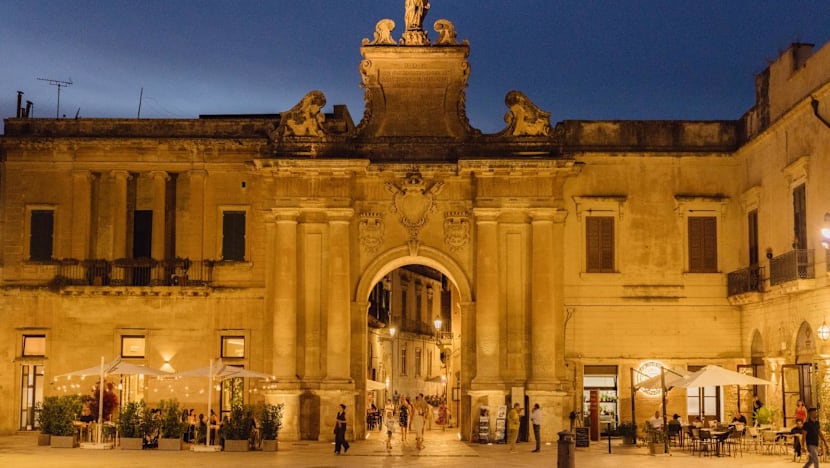
Adorned with neoclassical columns and statues, the 1703 city gate known as Porta Rudiae is a lovely backdrop while you sip cappuccino (€1.80) and munch fruttone, a chocolate-topped pastry filled with marmalade (€2), at the outdoor tables of Caffe Rudiae, a delightfully dowdy repository of gramophones, model ships and other relics. Next door, Mercatino Porta Rudiae houses market stalls selling Pugliese specialties like cooked pork rolls (around €1.50 each), anchovy filets (€3.49 per 100 grams) and caciocavallo cheese (€1.99 per 100 grams) for a makeshift lunch later on. To glimpse another grand gate, walk up Viale dell’Universita and behold Porta Napoli, a monumental 16th-century arch.
11.30am | Discover Jewish Lecce
Jewish communities in Puglia date to the Roman Empire, reaching their height during the Renaissance. In Lecce, the community plied diverse trades — dyeing, tanning, metalwork — before Jews were expelled from southern Italy in 1541. One of several iterations offered on Sundays, the 11.30am guided tour of the Jewish Museum, or Museo Ebraico (€25) — a barrel-vaulted underground space on the site of a former synagogue — imparts stories of Lecce’s Jews through photo exhibits, virtual-reality experiences and a walk through the former Jewish quarter.
Source: New York Times/bt
Related stories

The Punch
WorldJul 17, 2026 · 1 min
Police arrest four over mob killing in Akwa Ibom
The Punch
The Punch
WorldJul 17, 2026 · 1 min
Two Nigerians, one other jailed in UK for £4m crypto fraud
The Punch
The Punch
WorldJul 17, 2026 · 1 min
Venezuela quake death toll exceeds 5,000 — Official
The Punch

Philippine Daily Inquirer
WorldJul 17, 2026 · 1 min
Landslide in China's Chongqing kills at least 8; 34 missing
Philippine Daily Inquirer