VnExpress
Long Thanh airport access faces gridlock threat as HCMC expressway interchange delayed again
With its completion date pushed to 2027, the An Phu Interchange in Ho Chi Minh City could become a major bottleneck in the transport corridor linking the city and Long Thanh International Airport when the latter opens later this year.
Leaving a residential area on Tran Nao Street at 6 a.m. on a weekend, 37-year-old Van Phong and his family took nearly an hour to travel less than four kilometers without reaching the HCMC–Long Thanh–Dau Giay Expressway that goes to Dong Nai, home to Long Thanh, scheduled to start commercial operations in December as Vietnam' largest airport.
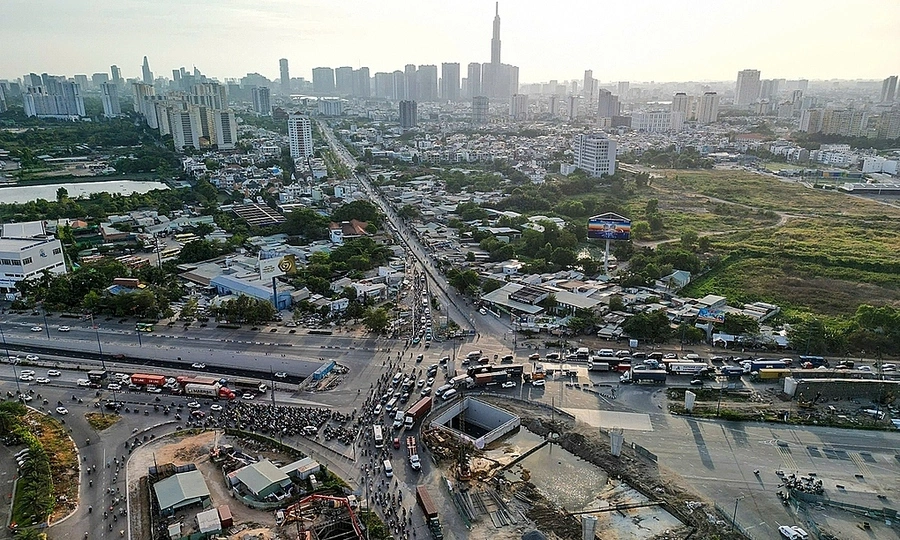
Their SUV crawled along Luong Dinh Cua Street amid dense traffic waiting to pass through the An Phu Interchange alongside under-construction overpasses.
An aerial view of part of the An Phu Interchange in Ho Chi Minh City in July 2026. Photo by VnExpress/Quynh Tran
Phong said: "Traffic heading onto the expressway is always heavy on weekends. Luong Dinh Cua Street is narrow, red lights last more than two minutes while green lights are only a few dozen seconds, therefore many vehicles have to wait through five or six signal cycles to go past the intersection."
There are days when he has to spend half an hour at the interchange, almost half the time it takes to drive from HCMC to Dau Giay.
The interchange is not only the largest in the city but also the most complex with its multi-tier design, unprecedented structural components, and high-volume traffic meeting points.
When finished, it will be a massive three-level structure where the expressway and Mai Chi Tho, Dong Van Cong, Nguyen Thi Dinh, and Luong Dinh Cua streets meet.
Luong Dinh Cua Street is the site of the N1.2 bridge ramp that will enable vehicles to go above Mai Chi Tho Boulevard directly to the expressway, avoiding traffic lights.
Another ramp, N1.1, on Mai Chi Tho will separate traffic turning left into the expressway.
Both ramps are unfinished, forcing vehicles to stop for signals at the interchange and often cause congestion.
Construction of the An Phu Interchange began in late 2022 at a budgeted VND3.4 trillion (US$130 million).
There are also a completed underpass and overpass connecting the expressway with Mai Chi Tho and a ramp to Dong Van Cong Street.
Besides Dong Nai City and the under-construction airport, the interchange also serves as a gateway to Cat Lai Port, the largest and busiest container port in all of Vietnam.
It has already missed two deadlines for completion, with the third now extending it from the end of 2025 to the third quarter of 2027.
Meanwhile, work to widen the expressway at two places is expected to be completed between the end of this year and the first quarter of 2027.
With Long Thanh International Airport scheduled to begin commercial operations this December, traffic through eastern HCMC is expected to surge, causing concerns that An Phu will be the weakest link in the entire route.
Bui Van Quan, chairman of the HCMC Cargo Transport Association, said the interchange has long been a congestion hotspot also because of the large number of container trucks traveling to Cat Lai Port.
The pressure has only intensified following the recent opening of the Nhon Trach Bridge and sections of the Bien Hoa–Vung Tau Expressway, adding new links between HCMC, Dong Nai City and the former Ba Ria–Vung Tau Province, he said.
"When Long Thanh Airport becomes operational, traffic volumes will increase even further. If the expressway is expanded but the An Phu Interchange is not completed, it could easily become a bottleneck because all vehicles will still have to pass through it to access the expressway."
Now, following the deadline change, the city should closely monitor the progress of each component to prevent further delays, he said.
An artist's impression of the completed An Phu Interchange project, with an overpass ramp connecting to Luong Dinh Cua Street (circled in red) still delayed by unresolved site clearance. Illustration by TCIP
Officials from the HCMC Traffic Works Construction Investment Project Management Board (TCIP), which manages transport infrastructure, said the delay is mainly due to unresolved issues involving more than 2.2 hectares of land on Luong Dinh Cua needed for the widening street and construction of the ramp.
TCIP has estimated that 64 households and organizations will have to be paid compensation and helped with relocation.
Legal issues that have dragged on for more than a decade have prevented acquisition of the lands.
But the city People's Committee has approved a compensation, support, and resettlement plan that has a deadline of Nov. 30 this year.
Binh Trung Ward authorities estimate the compensation costs at around VND2.085 trillion and are finalizing the process.
According to TCIP, once the cleared lands are handed over, contractors will begin construction of the Luong Dinh Cua ramp and widening of the street.
That work is expected to take five months, with the entire interchange slated for handover in the third quarter of 2027.
Meanwhile, work is continuing on unaffected sections.
By the end of this month, the N4 ramp allowing vehicles to turn from Dong Van Cong Street onto Mai Chi Tho Boulevard is expected to open.
By early October, the N1.1 ramp enabling vehicles traveling on Mai Chi Tho to turn left into the expressway is scheduled for completion. Once they are able to access the expressway without stopping at lights, congestion will reduce at the interchange and pressure will ease on Luong Dinh Cua, which is often overwhelmed.
View original source — VnExpress ↗
Related stories

The Punch
WorldJul 18, 2026 · 1 min
Nigeria tops porn charts but nobody admits watching them — Seyi Hunter
The Punch
The Punch
WorldJul 18, 2026 · 1 min
Five rights you have when arrested by police
The Punch
The Punch
WorldJul 18, 2026 · 1 min
Nigerian Center to hold cultural festival in US
The Punch
The Punch
WorldJul 18, 2026 · 1 min
Entrepreneur starts project on Nigerian, Scottish cultural outfits
The Punch