Indian Express
PM Modi flags off India’s first hydrogen train: 2-hour Jind-Sonipat travel, 14 halts and zero emission
5 min readJindJul 18, 2026 06:05 AM IST
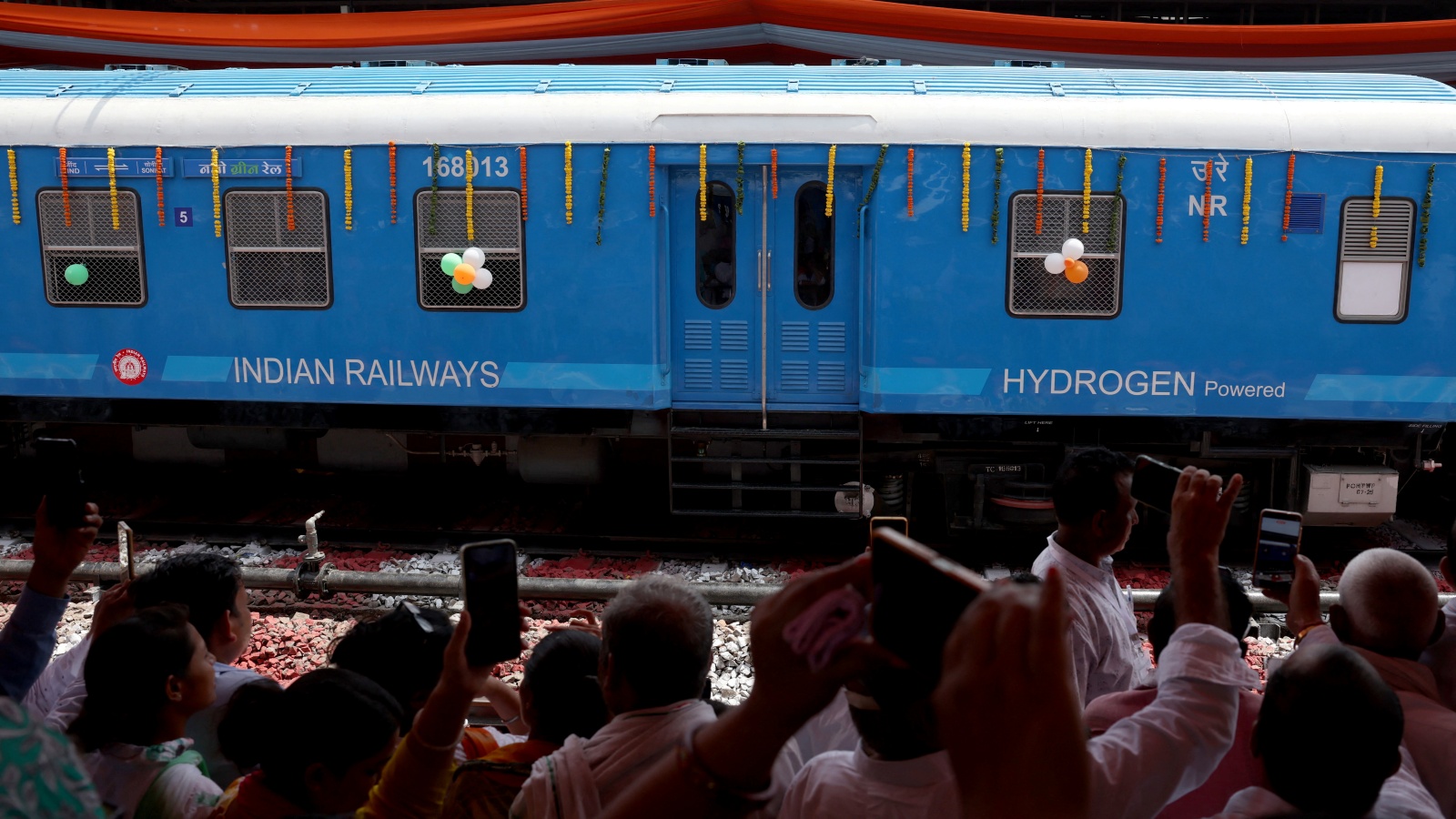
During the flag-off ceremony of India’s first hydrogen-powered train in Jind on Friday. (Reuters)
India joined a select group of nations on Friday as Prime Minister Narendra Modi flagged off the country’s first hydrogen-powered train connecting Jind and Sonipat in Haryana — a significant achievement for the Indian Railways in the use of zero emission, clean fuel technology.
The first hydrogen-powered non-AC passenger train will cover the 89-km Jind-Sonipat railway section in around two hours, running at a maximum operational speed of 75 kmph. The journey includes halts at 14 stations. The Northern Railway is expected to soon announce the date for the commencement of commercial operations.
After flagging off the train from Jind, Modi said, “Even today, we read that India’s first train ran between Bombay — now Mumbai — and Thane [in 1853]. Similarly, whenever hydrogen trains are mentioned in the future, the names of Jind, Sonipat and Haryana will inevitably be mentioned.”
“If we look at the history of railways, the 19th century was defined by steam engines. The 20th century was characterized by diesel and electric trains, and now, the 21st century belongs to hydrogen-powered trains. Today, Indian Railways has taken a major step forward with this 21st century technology,” said Modi.
The train was essentially created by replacing the diesel engines on old diesel electric multiple unit (DEMU) rakes with a zero-emission hydrogen-electric propulsion system. The train will make two round trips a day, covering 356 km and consuming around 300 kg of hydrogen. For refuelling, a 3,000-kg hydrogen capacity storage plant has been developed in Jind.
The Prime Minister said there are immense possibilities of expansion. “We will continue researching how to reduce costs, how to increase efficiency, and step by step, after thorough investigation, we will keep moving forward. Hydrogen trains have only recently come into existence in the world only around 7-8 years ago. Currently, only three or four countries in the world have the capability to run hydrogen trains. And even in those countries, hydrogen trains are still in their early stages,” he said.
With 3200 horsepower (HP), the 10-coach train — eight passenger and two driving power cars — can carry a maximum of 2,600 passengers. It is equipped with 15 hydrogen leak detectors, seven heat detectors and three flame detectors.
Story continues below this ad
“Not only the most powerful, India’s hydrogen train is also the longest. In other countries, hydrogen trains run with three or four coaches. But India, in its very first attempt, has run a 10-coach hydrogen train,” the PM said. Chandrakant Kumar, the train’s additional loco pilot, said he underwent training in Shakurbasti in Delhi and Integral Coach Factory in Chennai, but added that “there is not much of a difference between driving the hydrogen train and DEMU train”.
“Since hydrogen is very flammable, the safety standards in the train are very high. Leak detectors have been installed in the train and the system will shut down automatically in case of such an incident,” said Kumar.
“There is 440 kg of hydrogen at a 350 bar pressure on the train — 220 kg in each driving power car — from where the fuel cell will take the hydrogen to produce electrical energy. It will take around four hours to refill the hydrogen cylinders on board from the plant. There are eight fans and six CCTVs in each driving power car. The hydrogen leak detectors and flame detectors are installed at the plants as well.”
Nitin Parikh, a train manager on board, said the primary job is to run the train safely and on time. “However, it is great that we have accepted the new and clean technology for Railways. It will help in cutting down the emission significantly. In this train, the emission is only the water vapour. This is not the main line, but the branch line and number of passengers are higher.”
Story continues below this ad
On board the country’s first hydrogen train were students of Nav Vidya Senior Secondary School, Jind. “It is a beautiful train. I am a Class 9 student and I have learnt how electrolysis splits water into hydrogen and oxygen. I have not travelled very far by train yet. I want to travel to Delhi by train,” said Alisha, as the train chugged off from Jind.
Other projects
Modi also inaugurated the Haryana section of the Delhi-Amritsar-Katra Expressway (158 km), the Jind-Gohana National Highway (40.60 km), Ambala-Kala Amb four-lane highway (33.81 km) and Sikh museum in Kurukshetra. The PM laid the foundation stone and inaugurated various projects worth around Rs 14,700 crore in Jind.
Referring to the West Asia conflict, he said that due to 99% electrification of Railways, trains ran continuously despite the oil crisis in the wake of the Strait of Hormuz situation.
Dheeraj Mishra is a Principal Correspondent with the Business Bureau of The Indian Express. He plays a critical role in covering India's massive infrastructure sectors, providing in-depth reporting on the connectivity lifelines of the nation.
Expertise & Focus Areas: Mishra’s journalism is focused on two of the country's most capital-intensive and public-facing ministries:
Ministry of Railways: Tracking the operations, safety, and development of India's vast railway network.
Ministry of Road Transport & Highways: Covering policy decisions, infrastructure projects, and highway development.
What sets Mishra apart is his rigorous use of the Right to Information (RTI) Actas a primary tool for news gathering. By relying on official data and government records, he ensures a high degree of accuracy and trustworthiness in his reporting. This data-driven approach has resulted in numerous impactful reports that hold public institutions accountable and bring transparency to government operations.
Find all stories by Dheeraj Mishra here ... Read More
Stay updated with the latest - Click here to follow us on Instagram
Tags:
Narendra Modi
View original source — Indian Express ↗
Related stories
ABC News
WorldJul 18, 2026 · 1 min
Man charged over law firm fire and tobacco shooting in Melbourne's west
ABC News
Dawn
WorldJul 18, 2026 · 1 min
Afghanistan’s lost peace
Dawn

Indian Express
WorldJul 18, 2026 · 1 min
Parents win Rs 10 lakh from luxury Goa hotel after faulty lock traps kids in smoky room
Indian Express
Indian Express
WorldJul 18, 2026 · 1 min
The Catcher in the Rye at 75: A Bhagavad Gita-reading recluse and the Buddhist soul of an American classic
Indian Express