VnExpress
12yo girl builds AI receptionist that runs entire front desk with Claude, ChatGPT
A 12-year-old in British Columbia has built an AI receptionist that has already handled hundreds of calls for small businesses, writing the code herself with help from ChatGPT and Claude.
Mana Jampala launched Voxa in November 2025 and is still working to sign her first paying customer, she told Business Insider, which profiled her on July 8 for its Young Geniuses series.
The idea came from her father's workplace. She was 11, sitting in an office where a small team was too busy to pick up the phone, and calls went ignored or unnoticed.
A handful of missed calls costs a small business little. Across a year, the lost revenue compounds.
Voxa answers calls around the clock, books staff appointments, records restaurant orders, manages missed calls and writes a summary after each conversation. Storyboard18 reported that she has since expanded into Voxa Agents, a second platform that builds AI agents from plain-language prompts, without writing code.
She started in ChatGPT, asking OpenAI's model for small pieces of code and reading each one before moving on. She switched to Anthropic's Claude when she found it more helpful, according to Business Insider.
She never asked either model for the whole code base at once. She requested snippets short enough to read, test and debug herself, and says she trusts the system because she has checked every part of it. She told the Economic Times she never relied on the models to generate the product outright.
Her agents originally ran on third-party infrastructure. She now runs a backend she wrote herself, which took two weeks in its basic form and has been under continuous repair and expansion since, Business Insider reported.
Pitching businesses in person produced questions about how old she was and whether a parent was doing the work. Online, Storyboard18 reported, the same pitch drew responses about the product rather than the founder.
Jampala has switched to warm introductions from her network, including a call with the CEO of her city's Chamber of Commerce, and says referrals convert better than cold outreach.
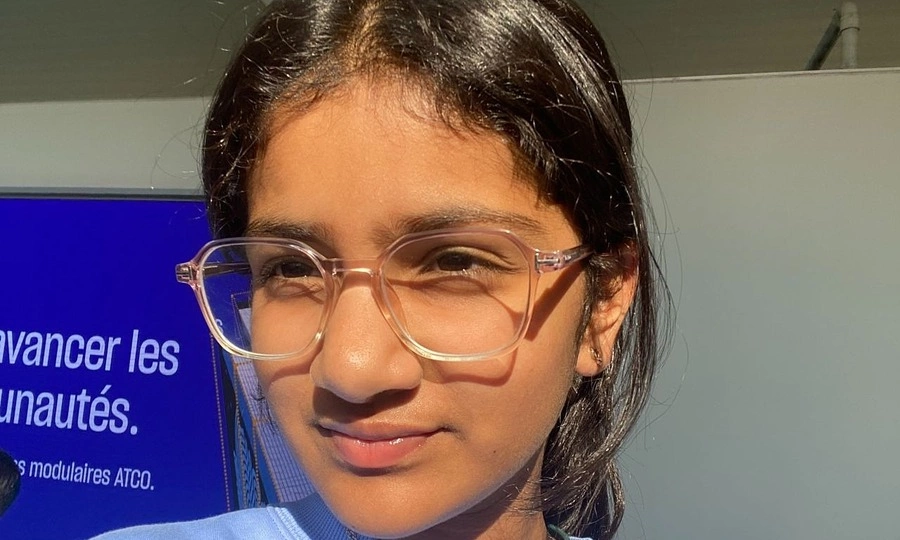
Mana Jampala, a young tech founder based in British Columbia, Canada. Photo courtesy of LinkedIn
The Economic Times, citing her LinkedIn profile, reported that Voxa is in use in Canada, India and Cambodia, concentrated in restaurants, pharmacies and other businesses that lose money when a phone rings out. The claim is self-reported and has not been independently verified.
Her plan is to bootstrap for another year or two, get into an accelerator such as Y Combinator or a16z, hold growth steady, then raise venture capital, she told Business Insider.
Jampala became interested in AI at 9. She went through Scratch coding camps, learned Python, won a special prize at a collegiate-level science competition while visiting India, and took a grant from the 1517 Medici Project, which funds high school and college students and dropouts building startups.
She has friends and plays sports, and says the startup work is mostly solitary. "I really like it, but sometimes it does feel isolating," she told Business Insider. She has found other young founders on Discord instead, including 13-year-olds running their own companies.
The average age of an AI unicorn founder fell from a peak of 40 in 2020 to 29 in 2024, Fortune reported, citing "The Anatomy of Greatness," a report the venture capital firm Antler released Jan. 7. Founder age everywhere else moved the opposite way, climbing from about 30 to 33 over the past decade.
Antler analyzed 1,629 unicorns, companies valued at $1 billion or more, and 3,512 founders worldwide between 2014 and 2024, CNBC reported. AI companies reached that valuation in 4.7 years on average, roughly two years faster than the rest of the market.
Business Standard reported that unicorn creation has accelerated nearly fortyfold over the past decade, from about four companies a year between 2003 and 2013 to 148 a year between 2014 and 2024.
"We're seeing that potentially 25 is the new 30," Fridtjof Berge, Antler's co-founder and chief business officer, told Fortune. Smart founders can now use the tools placed in front of them and rely less on networks or sector-specific expertise, he said.
Berge told CNBC that the willingness to experiment now counts for more than years in an industry or knowing the traditional playbook for scaling a company. Long experience building conventional companies can work against a founder, he said, by making it harder to think from a blank slate.
Jampala expects the resistance she meets to fade. Owners worry their customers will feel ignored, she told Business Insider, but she thinks people will be comfortable with an AI answering the phone within a year, because plenty of businesses are already doing it.
View original source — VnExpress ↗
Related stories

Euronews
TechnologyJul 18, 2026 · 1 min
Why has Austria become Europe's hottest AI market this year?
Euronews

Wired
TechnologyJul 18, 2026 · 1 min
SteelSeries Coupon Codes: 15% Off in July 2026
Wired

TechCrunch
TechnologyJul 18, 2026 · 1 min
Neil Rimer thinks the AI money is coming back out
TechCrunch
ABC News
TechnologyJul 18, 2026 · 1 min
Arrival of huge US thrift chain Savers unsettles Geelong op shops
ABC News