BBC
Mum was sent photo of dead baby: NHS trust's mortuary failings explained
Warning: Some of the details in this story may be distressing to readers
For many of the hundreds of families involved in the largest maternity scandal in NHS history, the suffering did not end with the loss of a baby or loved one.
A key element of Donna Ockenden's review into Nottingham University Hospitals (NUH) NHS Trust, published last month, not only found that mothers and babies suffered potentially avoidable harm - but also revealed a litany of failures in its mortuary service.
The review found mothers and babies "lost dignity" in a series of cases highlighted, including one baby who was disposed of as clinical waste and another who was placed in a mortuary space already occupied by a deceased adult. In a third case, the wrong baby was released to funeral directors.
This poor care is far from historic. In March, eight bodies were found in a state of "advanced deterioration" in the mortuary at the trust after hospitals ran out of freezer space.
So what do we know about the failings in post-death care and the mortuary service?
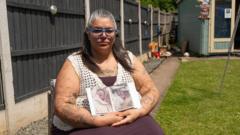
Bereaved parents Natalie and David Needham's trauma of losing their baby Kouper was compounded when a disc containing graphic colour photos of their son's post-mortem examination was sent to the family home, accompanied with a letter outlining the costings involved with his death.
"I'd always wanted my last image of Kouper to be when I was holding him in hospital while he was still breathing," Natalie said.
"That was taken away from me - because my last image of him now is those mortuary pictures."
So serious were Ockenden's concerns about mortuary care at NUH that she launched a full review into post-death care at the trust, which included 17 babies and one adult.
"Many incidents involving poor post-death care share striking similarities, showing a marked lack of learning," Ockenden concluded.
The report also highlighted a "siloed way of working" described by some families between the bereavement service, mortuary and funeral directors.
The review also found some clinicians had used "dehumanising" language about people's babies, such as "fetus", a "sample" or "specimen".
The 381-page report into NUH - which runs two main hospitals, the Queen's Medical Centre (QMC) and City Hospital - outlined harrowing details of care in the mortuaries spanning from 2008 to 2025.
Natalie's son Kouper died of respiratory complications in July 2019 in a Moses basket in the family living room, when he was just 24 hours old.
He had been discharged from Nottingham City Hospital about 14 hours after he was born.
The family's trauma was worsened when the letter arrived, without warning, in February 2020.
"The letter itself read 'dear Doctor', so it wasn't actually written to me," Natalie said.
"There was a full itemised list of Kouper's death, including how much it cost for the incubation tubes, the cost of sending an ambulance and an air ambulance.
"The last item on the list was that it cost the NHS £57 for a nurse to come and tell me that my son was dead.
"On the disc was all his post-mortem images where he was put upon a mortuary slab. It's something I never, ever imagined having to see. That's the last thing I saw of him."
Natalie recalled calling the number on the letter after she opened it.
"Within about an hour of me contacting them, somebody was at my door from the hospital asking for the paperwork back. I refused to give it to them," she said.
"They then wrote to me, and said that if I refused to send it back, they'd issue court proceedings because I was withholding information that was rightfully theirs."
Natalie said she refused to hand over the documents, and still has them. NUH was asked about this incident, but the trust did not directly respond.
When Natalie later raised the case with the new NUH chief executive Anthony May in 2022, he told the family that after an investigation, the letter was sent as part of her subject access request (SAR) - a formal right under data protection laws that allows you to ask an organisation if they are using or storing your personal information.
Ockenden's review team also investigated what happened, and said the documents were sent to Natalie in response to her SAR.
A letter to the Needhams said "the disclosure of these items was completely unacceptable in every way".
"The sending of such graphic images and financial information to a grieving family who have already been through a very traumatic experience is incomprehensible," it concluded.
But Natalie said she did not believe the letter came as part of her SAR, and added she was still searching for answers.
"Somebody has done that. You don't type up a letter with someone's address on it, address it to the trust and send it. I feel like it was done on purpose," she said.
In response, Tracy Pilcher, NUH chief nurse, said: "I would like to apologise to Natalie Needham and her family for the mistakes we made in handling her subject access request (SAR).
"Following this incident, a thorough investigation was conducted into the images that were shared with Natalie after she received her SAR, which identified areas where our quality assurance processes fell short of the standards we expect.
"Actions have been taken to strengthen these processes and reduce the risk of such an incident happening again."
Concerns were first raised about mortuary care by Jack and Sarah Hawkins, the parents of Harriet, who was stillborn in 2016.
Ockenden's report outlined the "exemplar case", which led to the review into post-death care at the trust.
She said: "The first very serious mortuary case the review became aware of occurred in 2016, that of the complete failure of the after-death care and treatment of Harriet Hawkins and concerns have continued to the current time.
"Sarah and Jack were under the impression at this point that Harriet was being kept in a preserved condition, meaning further investigations could be performed as necessary. However this was not the case."
They later discovered her body had been allowed to decompose so badly that it had to be triple-bagged for her funeral.
Last month, after it was revealed eight bodies were found in a state of "advanced deterioration" in the mortuary, NUH chief executive Anthony May told the BBC he took "responsibility and accountability" for the shortfalls that "happened on my watch".
It followed an investigation by the Human Tissue Authority (HTA), which regulates mortuary care in England, Wales and Northern Ireland.
Manjeet Shehmar, NUH medical director, added the trust had met the HTA "to talk through their concerns and how we can improve".
NUH said it had set up "a new daily mortuary capacity and flow meeting" - to manage capacity and reduce deterioration, expand its storage capacity, adding it had retrospectively submitted a list of incidents to the HTA for "additional oversight".
Nottinghamshire Police arrested two men last month on suspicion of misconduct in a public office over the trust's mortuary practices.
The arrests were carried out as part of Operation Perth - but they relate to an investigation that is separate to the force's corporate manslaughter investigation into NUH.
The arrested men, 55 and 59, remain on bail.
Meanwhile, Natalie has said she will not stop fighting for answers.
"I really would love to get answers, because there needs to be accountability," she said.
"Then I wouldn't have to live the rest of my life with the 'what ifs' and the 'whys'."
Related stories

The Punch
WorldJul 18, 2026 · 1 min
NUPRC tasks fresh licence holders on rapid field development
The Punch

Philippine Daily Inquirer
WorldJul 18, 2026 · 1 min
Philippine Franchise Association launches first-ever Visayas Franchise Conference 2026, Igniting Growth
Philippine Daily Inquirer

Philippine Daily Inquirer
WorldJul 18, 2026 · 1 min
LOOK: Family, friends honor Baterbonia on 40th day since his death
Philippine Daily Inquirer
Indian Express
WorldJul 18, 2026 · 1 min
3 killed as US bombs Iran’s underground weapons storage in 7th night of strikes; Tehran hits back
Indian Express