Indian Express
Smoke, stench and a protest: How Pune students fought riverside garbage dumping
4 min readJul 18, 2026 10:06 AM IST
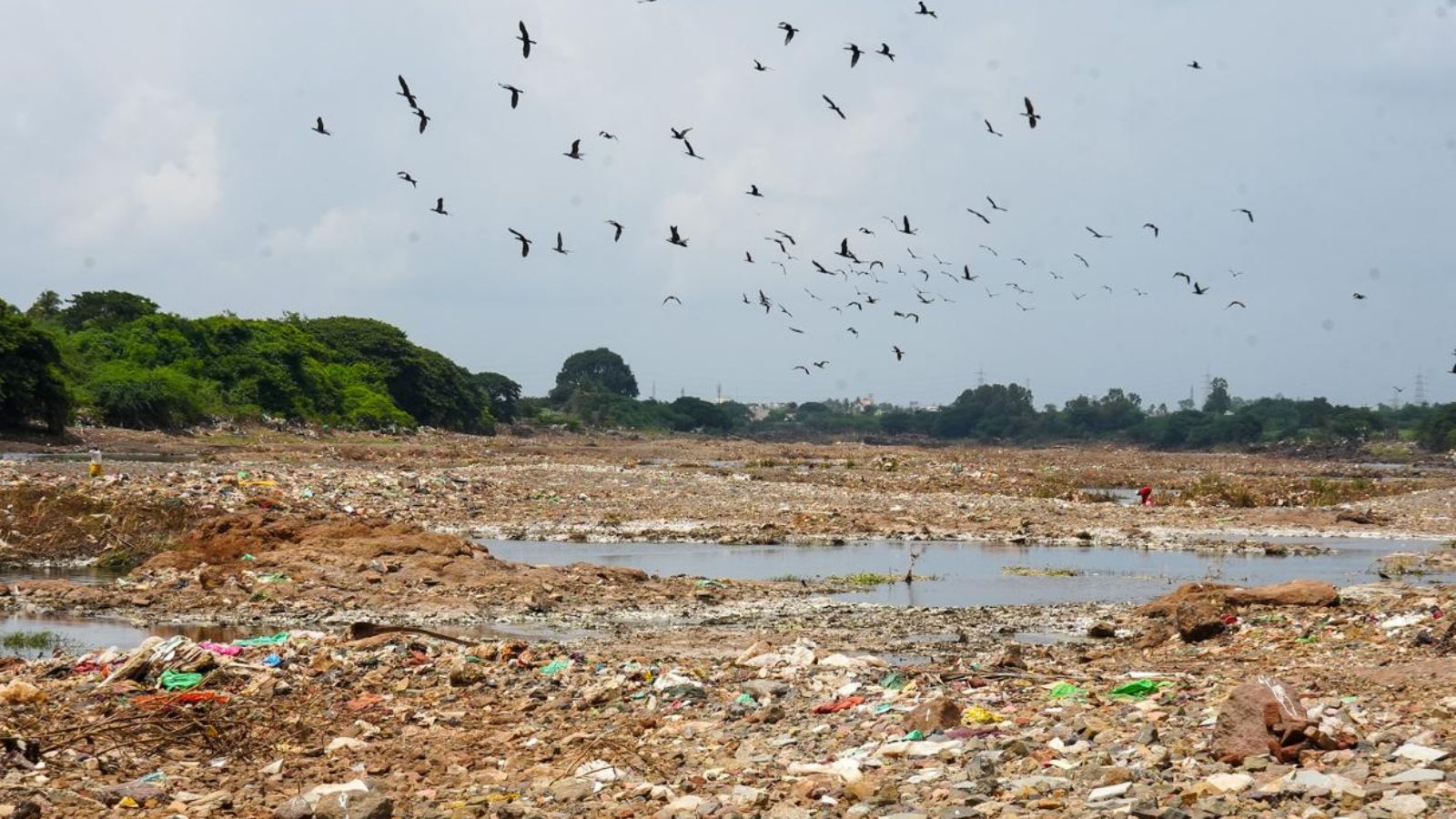
More than 50 per cent of the river near Loni Kalbhor was covered with tonnes of garbage.
When garbage trucks continued to dump waste on the banks of the Mula-Mutha river despite repeated complaints, students at MIT-ADT University and MIT Vishwashanti Gurukul World School decided to take matters into their own hands.
In March this year, school and college students staged a series of protests and blocked trucks carrying garbage through the university campus to the dumping site. The agitation eventually forced the gram panchayats of Loni Kalbhor and Kadamwak Wasti to stop dumping waste there. The two panchayats were later allotted alternate government land as a temporary dumping site until permanent waste management facilities are developed, said Trupti Kolte Patil, Tehsildar of Loni Kalbhor.
The protests came after years of dumping on the riverbank. Trucks carrying garbage from the two gram panchayats routinely unloaded waste on government land along the Mula-Mutha. Satellite images show that more than 50 per cent of the river near Loni Kalbhor was covered with tonnes of garbage. Waste had also accumulated along a 250-metre stretch of the nullah flowing from the village into the river.
The dumping site was located immediately next to the MIT-ADT University campus in Loni Kalbhor. According to university authorities, more than 18,000 students study on the campus, apart from those enrolled in the MIT group schools located there. Students had to endure a foul stench for years, while frequent fires at the dumping site posed a recurring hazard.
The issue reached a tipping point in late February 2026 when a massive fire broke out at the dump. Smoke engulfed the campus, filling the rooms of boarding students at MIT Vishwashanti Gurukul World School and forcing them to be shifted out. University authorities said several students had to be hospitalized due to smoke inhalation, while firefighters and university staff took four days to extinguish the blaze.
For many students, that fire became the turning point.
Awanti Narwade and Chiransh Thakur, students at the school, said they initially gave the gram panchayats 10 days to stop the dumping after their first protest.
“But even after 10 days, the garbage trucks didn’t stop. They kept coming. So then we just shut all the gates so that no vehicle could enter,” Narwade said.
Story continues below this ad
Kolte Patil said the dumping had initially been permitted on government land, but subsequent inspections revealed that a large portion of that land had been washed away due to flooding.
“The dumping was happening on government land. However, we found that much of the government land had been swept away during floods. Half of it was washed away, so the garbage dumping was happening in the river,” she said.
The university also approached the National Green Tribunal (NGT). In its submission to the tribunal, the Maharashtra Pollution Control Board said a huge quantity of municipal solid waste was being dumped into the river in an unscientific manner. On June 12, the NGT restrained the two gram panchayats from dumping any more waste at the site.
Mahesh Chopade, Registrar of MIT-ADT University, said the institute had spent Rs 25-30 lakh to clear the accumulated waste and transport it to Hadapsar after the dumping stopped.
Story continues below this ad
“Right now, PMRDA has said it will not allow any dumping on the riverbank. However, governments change every five years and new officials may not be aware of the history of the issue. The government should find a permanent solution,” Chopade said.
The dumping had also taken a toll on nearby residents.
“There was so much garbage. Before the dumping, there used to be trees on the riverbank. Breathing became difficult because of the smell and the smoke. Our children would also fall ill. The fish also suffered because the river was polluted,” said Rohit Kanche, a lifelong fisherman.
Soham Shah is a Correspondent with The Indian Express, based in Pune. A journalism graduate with a background in fact-checking, he brings a meticulous and research-oriented approach to his current reporting.
Professional Background
Role: Correspondent coverig education and city affairs in Pune.
Specialization: His primary beat is education, but he also maintains a strong focus on civic issues, public health, human rights, and state politics.
Key Strength: Soham focuses on data-driven reporting on school and college education, government reports, and public infrastructure.
Recent Notable Articles (Late 2025)
His late 2025 work highlights a transition from education-centric reporting to hard-hitting investigative and human-rights stories:
1. Investigations & Governance
"Express Impact: Mother's name now a must to download birth certificate from PMC site" (Dec 20, 2025): Reporting on a significant policy change by the Pune Municipal Corporation (PMC) following his earlier reports on gender inclusivity in administrative documents.
"44-Acre Mahar Land Controversy: In June, Pune official sought land eviction at Pawar son firm behest" (Nov 9, 2025): An investigative piece on real estate irregularities involving high-profile political families.
2. Education & Campus Life
Faculty crisis at SPPU hits research, admin work: 62% of govt-sanctioned posts vacant, over 75% in many depts (Sept 12, 2025): An investigative piece on professor vacancies at Savitribai Phule Pune University.
"Maharashtra’s controversial third language policy: Why National Curriculum Framework recommends a third language from Class 6" (July 2): This detailed piece unpacks reasons behind why the state's move to introduce a third language from class 1 was controversial.
"Decline in number of schools, teachers in Maharashtra but student enrolment up: Report" (Jan 2025): Analyzing discrepancies in the state's education data despite rising student numbers.
3. Human Rights & Social Issues
"Aanchal Mamidawar was brave after her family killed her boyfriend" (Dec 17, 2025): A deeply personal and hard-hitting opinion piece/column on the "crime of love" and honor killings in modern India.
"'People disrespect the disabled': Meet the man who has become face of racist attacks on Indians" (Nov 29, 2025): A profile of a Pune resident with severe physical deformities who became the target of global online harassment, highlighting issues of disability and cyber-bullying.
Signature Style
Soham is known for his civil-liberties lens. His reporting frequently champions the rights of the marginalized—whether it's students fighting for campus democracy, victims of regressive social practices, or residents struggling with crumbling urban infrastructure (as seen in his "Breathless Pune" contributions). He is adept at linking hyper-local Pune issues to larger national conversations about law and liberty.
X (Twitter): @SohamShah07 ... Read More
Click here to join Express Pune WhatsApp channel and get a curated list of our stories
Tags:
garbage
Pune Garbage Crisis
View original source — Indian Express ↗
Related stories

Euronews
PoliticsJul 18, 2026 · 1 min
Why the EU’s so-called Chat Control law has privacy experts up in arms
Euronews
ABC News
PoliticsJul 18, 2026 · 1 min
'Failed' university scheme hurting home ownership prospects
ABC News

Philippine Daily Inquirer
PoliticsJul 18, 2026 · 1 min
5 wounded in Shariff Aguak grenade blast amid BARMM election gun ban
Philippine Daily Inquirer

The Guardian
PoliticsJul 18, 2026 · 1 min
Trump, not Iran, is the world’s greatest danger. He’s a one-man weapon of mass destruction | Simon Tisdall
The Guardian