Indian Express
Skyroot’s Vikram-1 to launch delayed, lift off shortly
4 min readUpdated: Jul 18, 2026 12:56 PM IST
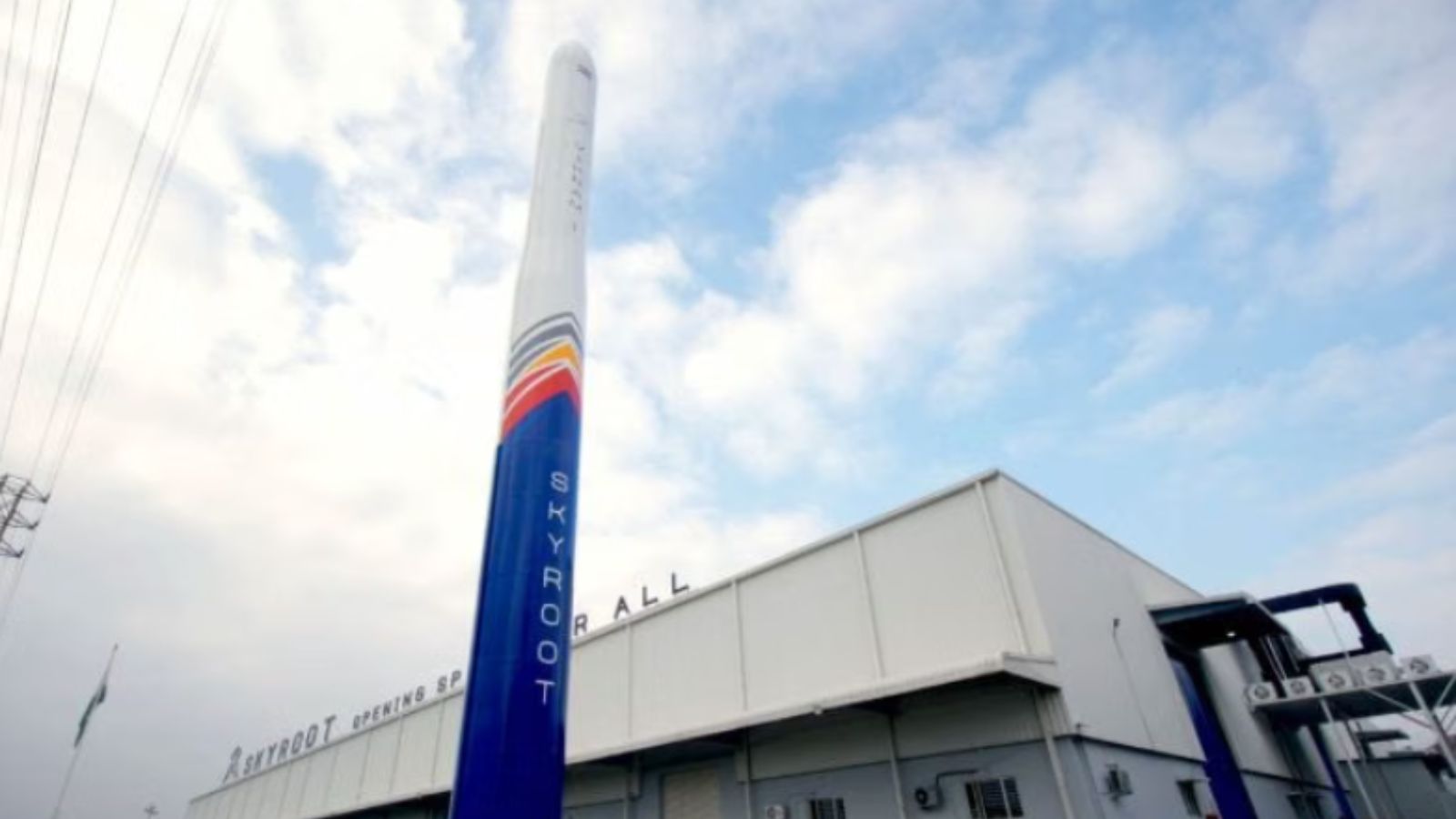
Vikram-1 before the launch at Satish Dhawan Space Centre, Sriharikota.
Hyderabad-based Skyroot Aerospace on Saturday launched Vikram-1, India’s first privately developed orbital-class rocket, from the Satish Dhawan Space Centre in Sriharikota, Andhra Pradesh. The mission, named ‘Aagaman’, is the first ever flight of Vikram-1, India’s first privately developed orbital-class rocket.
The lift-off was initially planned for 11:30 AM but was pushed back to 12.05 PM. Skyroot was ready for its first orbital launch of Vikram-1 on a cloudy Saturday morning. “All pre-flight tests last night and weather conditions this morning were okayed. Automatic launch sequence was started at T-12 minutes but was halted at T-4:59 minutes. This is a planned hold,” said Skyroot.
The mission is aimed at validating the performance of Vikram-1 and its key technologies in flight. Skyroot has said the test will generate data that will be used to refine future missions and help establish a regular launch cadence.
The development comes nearly three years after Skyroot successfully launched Vikram-S, the first privately built rocket to reach space from Indian soil, on November 18, 2022.
https://t.co/3Cjjnu9BVc
— Skyroot Aerospace (@SkyrootA) July 18, 2026
https://platform.x.com/widgets.js
What is Vikram-1?
Vikram-1 is a 24-metre-tall, three-stage orbital launch vehicle, capable of carrying payloads weighing up to 350 kg to a 450-km Low Earth Orbit (LEO) at a 60-degree inclination. The maiden mission also carries an orbital adjustment module that can deploy satellites into their designated orbits after launch.
Unlike ISRO’s launch vehicles, Vikram-1 has been developed by a private company from design to manufacturing, making it the first Indian private orbital rocket to attempt such a mission.
How is the rocket different?
One of Vikram-1’s distinguishing features is its all-carbon composite structure, which significantly reduces weight while improving structural strength.
Story continues below this ad
The vehicle is powered by three solid-fuel stages and an orbital adjustment module. Skyroot has also incorporated several technologies developed in-house, including metallic 3D-printed liquid rocket engines and a proprietary pneumatic stage-separation system.
According to the company, additive manufacturing has reduced engine complexity by replacing hundreds of individual components with single-piece printed engines, shortening production timelines.
Former ISRO scientists to Skyroot founders
Founded in 2018 by former ISRO scientists Pawan Kumar Chandana and Naga Bharath Daka, Skyroot Aerospace set out to build affordable launch vehicles for the global satellite industry. The company achieved a major milestone in November 2022 when Vikram-S became the first privately built Indian rocket to fly to space on a suborbital mission.
The latest mission is the company’s first attempt at an orbital launch, a substantially more complex operation involving multiple rocket stages, precise orbital insertion and payload deployment.
Story continues below this ad
Among the payloads aboard the maiden mission is Diamond Lotus, a lab-grown diamond payload developed by Bengaluru-based Cosmos Diamonds. Besides, it will also deploy a micro-art payload and a handwritten postcard from Prime Minister Narendra Modi bearing the message “Vande Mataram”, along with postcards from engineers, scientists, and Indian astronauts.
After its ascent, the primary payloads — technology demonstrators from Grahaa Space, Cosmoserve, DCubed, and Skyroot’s SCOPE — will be deployed into a 450 km LEO.
Taking part in the launch, Union Minister for state for space praised the innovation and creativity of the makers and said the programme could not have been witnessed if Prime Minister had not opened space sector.
‘If the PM had not opened the space sector we would not have witnessed this. This marks India’s entry into the highly competitive global space sector. For India, sky is no longer the limit,” Singh said
Sudhakar Singh is a Senior Sub-editor at indianexpress.com. An alumnus of the Indian Institute of Mass Communication, he writes primarily on books, literature, and culture. An avid reader with a keen interest in literature and cinema, he is particularly drawn to stories that explore society, politics, and lived experiences.
He can be contacted at [email protected] ... Read More
Anonna Dutt is a Principal Correspondent who writes primarily on health at the Indian Express. She reports on myriad topics ranging from the growing burden of non-communicable diseases such as diabetes and hypertension to the problems with pervasive infectious conditions. She reported on the government’s management of the Covid-19 pandemic and closely followed the vaccination programme.
Her stories have resulted in the city government investing in high-end tests for the poor and acknowledging errors in their official reports.
Dutt also takes a keen interest in the country’s space programme and has written on key missions like Chandrayaan 2 and 3, Aditya L1, and Gaganyaan.
She was among the first batch of eleven media fellows with RBM Partnership to End Malaria. She was also selected to participate in the short-term programme on early childhood reporting at Columbia University’s Dart Centre. Dutt has a Bachelor’s Degree from the Symbiosis Institute of Media and Communication, Pune and a PG Diploma from the Asian College of Journalism, Chennai. She started her reporting career with the Hindustan Times.
When not at work, she tries to appease the Duolingo owl with her French skills and sometimes takes to the dance floor. ... Read More
Tags:
rocket launch
View original source — Indian Express ↗
Related stories

The Punch
WorldJul 18, 2026 · 1 min
Habila’s death: Ohanaeze backs probe, rejects calls for Umahi’s resignation
The Punch

Philippine Daily Inquirer
WorldJul 18, 2026 · 1 min
Traveling abroad this July? A step-by-step guide for Filipinos
Philippine Daily Inquirer

CNA
WorldJul 18, 2026 · 1 min
Approved fosterers may keep up to 6 cats in HDB flats, 10 in private homes under new pilot scheme
CNA
Indian Express
WorldJul 18, 2026 · 1 min
Bar Council asks law schools to enforce social media rules; students to sign compliance undertakings
Indian Express