Indian Express
‘Can’t fill the form… help us’: Race against time for BLOs in East Delhi where digitisation average is among the worst
4 min readNew DelhiUpdated: Jul 18, 2026 12:37 PM IST
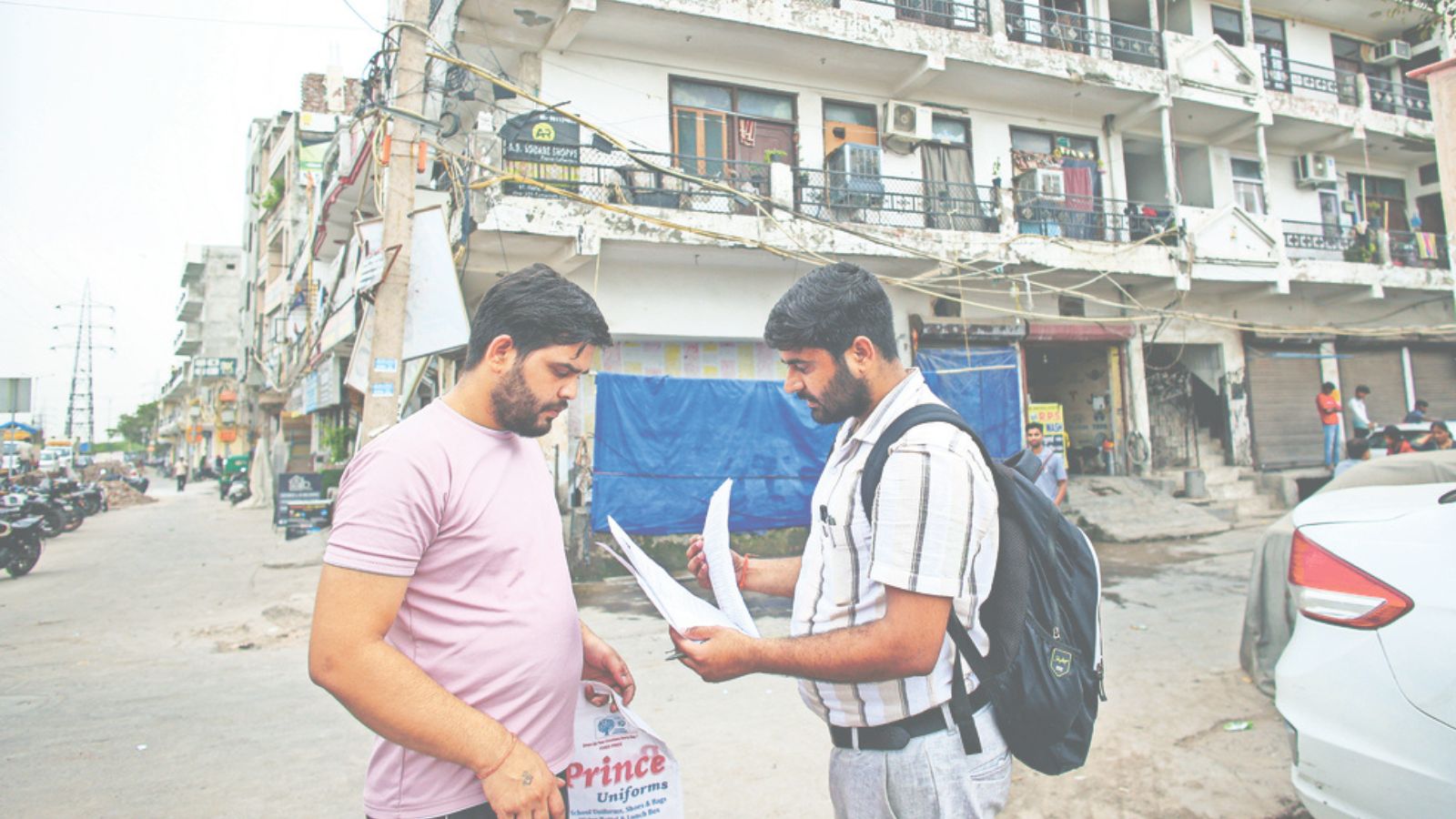
BLOs Vivek and Vinay during the ongoing SIR drive. (Praveen Khanna)
With just 13.81% of forms digitised, East Delhi is among the worst performing districts in the Capital in terms of digitising the enumeration forms filled out by electors as the Election Commission holds the Special Intensive Revision (SIR) exercise in the city. Digitisation average across districts in Delhi is pegged at around 21%, according to the data provided by the Chief Electoral Office (CEO).
From unnumbered houses, confusing addresses to an average elector’s inability to fill the form — booth level officers or BLOs in the East Delhi district say that they are facing a race against time to make sure no eligible electors are left out.
The Election Commission of India earlier this week extended the deadline for the ongoing door-to-door visits to August 8, giving BLOs more time to distribute and collect enumeration forms in Delhi.
It’s a humid July afternoon. As Vivek Kumar, an English teacher and BLO of Mangal Bazaar’s Block F in East Delhi, enters the street where he is supposed to distribute enumeration forms, he seeks help from passersby to locate the addresses on his list.
Vivek Kumar, an English teacher, is working as a BLO of Mangal Bazaar’s Block F in East Delhi.
As he enters one of the houses, he sifts through hundreds of enumeration forms in his backpack. He puts his register, in which he notes all necessary details, and other stuff on the floor.
Explaining the process to the residents, he gives a suggestion, “Please get the forms photocopied so that you can make mistakes.” Most enumeration forms he gets, he adds, are riddled with mistakes. To place the residents of the house, he scans the list — the woman in the house is on Page 18 of his list, while her son is on Page 31. Around 45 minutes have passed and they realise that the woman’s husband is assigned to another BLO.
Eyes on the list, Vivek is explaining to another resident on a call on how to find his father’s details on the Election Commission Information Network or ECINET app. Multitasking has become necessary during hectic routines. He packs his stuff and makes way to the next home. Annie Gomes, the next elector on the list, is not at her house, and the neighbours are not sure if she lives here or not. “We get a lot of such cases where the owner of the house has moved, but their vote is still registered here,” says Vivek.
Story continues below this ad
Around 10 km away is the Chilla Village near the Yamuna. A foul stench pervades the entire colony as open drains remain clogged with garbage. BLO Vinay Kumar is also facing a slew of challenges. As he knocks on the door of the house of 55-year old Brahm Chand to collect the form he had given a couple days back, the resident gives a confused look. “Humse nahi bhara jaave form, tu bharde humara. (We are not able to fill this… you please fill on our behalf).”
A tired Vinay sits inside the house and ends up spending more than 30 minutes as he fills the forms of the family of five. The 31-year old explains that most people in the village don’t have fixed addresses. “While villagers might know each other, so many people are tenants. Sometimes, 15 families are renting out different rooms in one house… it gets very confusing,” Vinay says, adding he has to fill out the forms of most people since they don’t know how to read or write. Next, he goes and sits at the verandah of the house — a lot of people come to clear doubts. “If I can’t place myself on electoral rolls, will I be sent to Bangladesh?” asks 60-year old Anisha Khatum, who has a voter ID, but is not able to find herself or any relative in the 2002 electoral list. A neighbour tells her not to worry. She can show her widower’s pension slip when she is sent a notice, she is told.
An election official explains, “In areas like Chilla Village and Kotla Village, a lot of the electors are labourers who are uneducated and don’t understand the process. Also, many of them don’t have any proof of where their parents lived since they even moved around and lived on rent.”
Devansh Mittal is a Correspondent at The Indian Express, based in the New Delhi City bureau. He reports on urban policy, civic governance, and infrastructure in the National Capital Region, with a growing focus on housing, land policy, transport, and the disruption economy and its social implications.
Professional Background
Education: He studied Political Science at Ashoka University.
Core Beats: His reporting focuses on policy and governance in the National Capital Region, one of the largest urban agglomerations in the world. He covers housing and land policy, municipal governance, urban transport, and the interface between infrastructure, regulation, and everyday life in the city.
Recent Notable Work
His recent reporting includes in-depth examinations of urban policy and its on-ground consequences:
An investigation into subvention-linked home loans that documented how homebuyers were drawn into under-construction projects through a “builder–bank” nexus, often leaving them financially exposed when delivery stalled.
A detailed report on why Delhi’s land-pooling policy has remained stalled since 2007, tracing how fragmented land ownership, policy design flaws, and mistrust among stakeholders have kept one of the capital’s flagship urban reforms in limbo.
A reported piece examining the collapse of an electric mobility startup and what it meant for women drivers dependent on the platform for livelihoods.
Reporting Approach
Devansh’s work combines on-ground reporting with analysis of government data, court records, and academic research. He regularly reports from neighbourhoods, government offices, and courtrooms to explain how decisions on housing, transport, and the disruption economy shape everyday life in the city.
Contact
X (Twitter): @devanshmittal_
Email: [email protected] ... Read More
Stay updated with the latest - Click here to follow us on Instagram
Tags:
delhi
Election Commission
View original source — Indian Express ↗
Related stories

The Punch
WorldJul 18, 2026 · 1 min
Fubara condoles ex-Rivers governor Amaechi over mother’s death
The Punch
The Punch
WorldJul 18, 2026 · 1 min
Substation explosion plunges parts of Enugu into blackout
The Punch

Lovin Malta
WorldJul 18, 2026 · 1 min
Lawyers Sue Bernice Cassar’s Family Over Alleged €55,000 In Unpaid Legal Fees
Lovin Malta

Portugal Resident
WorldJul 18, 2026 · 1 min
Young professionals: Portugal’s biggest export?
Portugal Resident