‘We’ve actually been using the Harman Curve incorrectly’
Audio engineer Cameron Oatley is better-known as 'GoldenSound'
He's teamed up with Status to add a special tuning profile to its Pro X buds
The result is Pro X GoldenSound; the fruit of impressively extensive labor
Sometimes in this job (as TechRadar's Audio Editor), I just get sent a set of earbuds and a press release. Sometimes, I'm invited to an online briefing so that a marketing rep can explain key terminology before I start my review process.
Rarely am I invited to a lovely pub in London, lulled into a false sense of security with a drink and a comfy chair and then taken through a brief but intense Doctorate in audio engineering.
I jest, of course. But if you've ever come into contact with either Status Audio (see the Status Audio Between 3ANC or Status Audio Pro X for previous examples of greatness) or Cameron Oatley, aka GoldenSound, you'll know that things are about to get decidedly audiophile. And given that this is a collab between the two, it's doubly so.
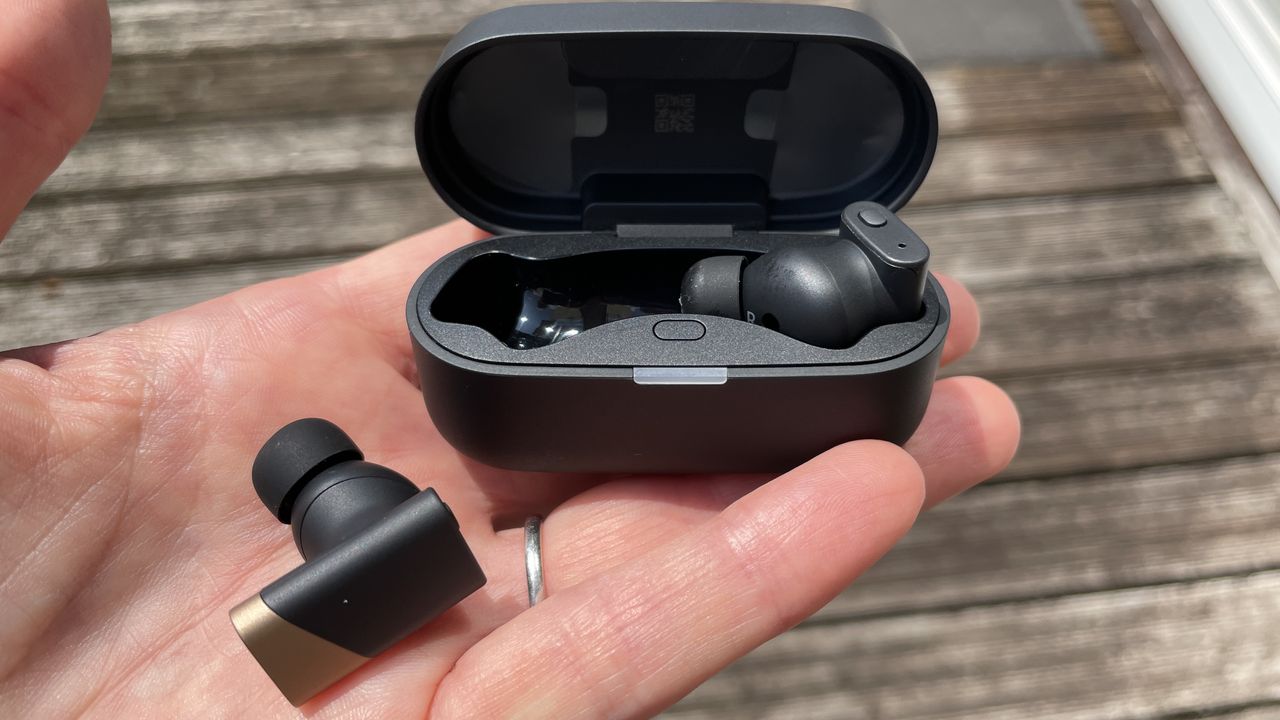
What you're looking at is the Status Pro X GoldenSound Edition. Yes, it's gold-tone on the top of the case and on the accents of the stems — but that's not all. Inbuilt here (and definitely not available in the non-GoldenSound variant) is a special new piece of software that Oatley thinks is the "most accurate tuning that a TWS product has ever had" and a "faithful recreation of real-world sound".
And this version will be $279 when it hits shelves in August (so $30 more than the current price of the Pro X, at $249) or around £209 / AU$400, give or take.
Status Audio Pro X GoldenSound: are listeners up for a Harmon Curve rewrite?
In terms of hardware, you're looking at everything built into the Status Audio Pro X, so two balanced armatures and a dynamic driver — something Status has been working with for some time and with no dearth of success.
But this time around, Oatley describes his granular approach to tuning thus: "What you measure is the IEM plus the impact of the rig" ie. your inner ear — albeit a metal tube to represent it with a mic at the end, for the purposes of his testing.
Sign up for breaking news, reviews, opinion, top tech deals, and more.
Oatley explains that the Harman Curve is often implemented incorrectly by audio engineers, because when it was developed in 2012 (and subsequently published in 2013, quickly becoming a trusted reference), true wireless earbuds hadn't yet been invented.
Because of this, the Harman Curve uses the pinna, or outer ear, as the reference point — ie. part of the "rig". But when developing in-ear products, from a purely sonic perspective (not including the creation of ANC antiphases) you can ignore the outer ear because the product starts within your ear canal. I know! Contrary to what we were taught as kids, the answer to 'My, what big ears you have!' isn't actually 'All the better to hear you with'…
How does all of this stack up against AirPods Pro 3?
I ask Oatley what he's most proud of with this project and he's surprisingly open: "Look, for ANC I think AirPods will always be tough to beat. But a lot of work has been done to make these sound better. These are for the user who wants the best possible sound in a true wireless design. I hope I've achieved that".
He then points me to a graph that's like the Harman Curve, but different. It's what he was able to achieve with the GoldenSound Edition. He's particularly proud of the graceful line between 80Hz and 100Hz, juicy bass frequencies he feels are more accurately relayed in the Pro X GoldenSound Edition. And I have to agree: in this area, these earbuds glitter like gold.
Let's get to the meat of the thing: listening. Both Status and GoldenSound actively encourage me to do this, and even set me up with a Qobuz screen, an LDAC source device and some AirPods Pro 3 for comparison. Oatley adds, "something tuned perfectly on a low codec is still better than something tuned badly on a higher codec", and while we all know you won't get LDAC out of AirPods, it's a very valid point.
Billie Eilish's Bad Guy is expansive and clean, with a snappy, impactful low end. Dire Straits' Money for Nothing is as brooding, snaking and exciting at the outset as you'd ever want it to be. ACDC's Back in Black? A head-nodding and beautifully regimented, cohesive mix.
What's gone are the… I hesitate to call them 'parlor tricks', but that typical V-shaped augmented treble one so often hears in designs of this type feels eased. And know this: the sound is altogether more open as a result.
It's not all glowing praise: during my limited time for an initial listen, you understand, I found Apple AirPods Pro 3's audio just marginally more woolly overall in direct comparison. That said, AirPods Pro 3 do have a slightly more soaring treble from the box. As such, some tracks sound more fun, forthright and zealous using the Apple product. It's the age old debate, isn't it: integrated hi-fi sound or fun, V-shaped in-ear mix?
I know my ear is keenly tuned to treble sounds (I've done the tests) but some listeners will love what's been achieved here. I spy an industry disruptor and no mistake. It's nothing if not interesting — and I'd say the industry standard was due a shake up.
I often find listeners might think they enjoy a certain tuning (typically, wearers might augment bass frequencies straight away) when in fact, if we play with their EQ settings, they actually prefer something quite different.
Here, Oatley hasn't given users the option to tweak his proprietary GoldenSound profile within the EQ settings, although you can select from 'Status Signature', 'Status Audiophile', 'Knowles Preferred' or 'Vocal Enhance' presets, or create your own using an 8-band tab set at neutral from the Status Hub app. Sadly, there's no similar visual for the presets so you really need to trust GoldenSound has done it right here. And given the extensive amount of work that's gone into them, I think your trust is well-placed.
This is not to be considered a full review, you understand. For that, I need more time. But what I can tell you right now is that the process won't be a hardship.
Follow TechRadar on Google News and add us as a preferred source to get our expert news, reviews, and opinion in your feeds.
Becky became Audio Editor at TechRadar in 2024, but joined the team in 2022 as Senior Staff Writer, focusing on all things hi-fi. Before this, she spent three years at What Hi-Fi? testing and reviewing everything from wallet-friendly wireless earbuds to huge high-end sound systems. Prior to gaining her MA in Journalism in 2018, Becky freelanced as an arts critic alongside a 22-year career as a professional dancer and aerialist – any love of dance starts with a love of music. Becky has previously contributed to Stuff, FourFourTwo and The Stage. When not writing, she can still be found throwing shapes in a dance studio, these days with varying degrees of success.
View original source — TechRadar ↗
Related stories

Teacher names 4 officials in WhatsApp note before killing his two children, dies by suicide

Overnight Ukrainian drone attack kills civilian in Elektrostal outside Moscow