Indian Express
How Erling Haaland became football’s first algorithm-made superstar
7 min readNew DelhiJul 18, 2026 03:27 PM IST
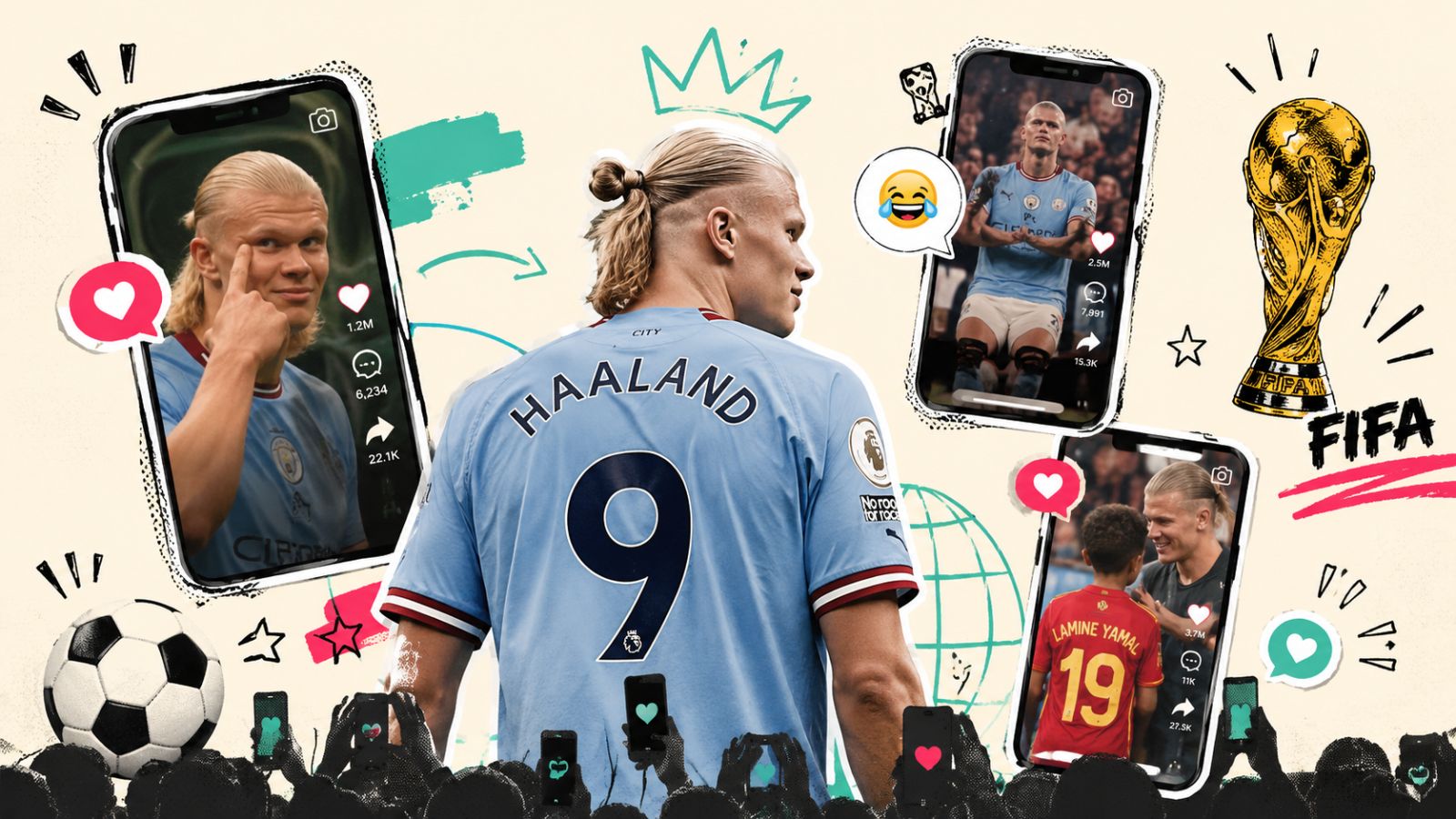
Haaland, the 25-year-old Norwegian striker, has been so much on the internet in the past few weeks that writing anything more about him can seem superfluous. (Image created with Canva)
Names of football stars, it seems, rise and fall just as swiftly as the spherical ball they kick around, especially about the time of the quadrennial World Cup. If before, it had everything to do with the game they played on the turf, now, in the age of reels and memes, it has also to do with their virality. The World Cup still creates stars, but social media now turns them into internet personalities — drawing in even those who don’t watch football. It will be difficult not to follow that line without the mention of Erling Haaland.
Haaland, the 25-year-old Norwegian striker, has been so much on the internet in the past few weeks that writing anything more about him can seem superfluous. He was already a celebrated player before the World Cup but grew into a mini legend this season with a historic seven goals in five games that put Norway in the quarter finals for the first time.
But his huge fan following is not made of only football fans, and this is what we are talking about. In the past few weeks, social media was suddenly flooded with videos about the antics of Haaland, a man with long golden hair, towering high across the football ground, casually kicking or heading the ball when he has to. There was the funny Haaland walk and the faces he made. Someone dug out an old banned German song called Moskau from 1979 and wrote a Haaland anthem to its tune: Ha-Ha-Ha-Haaland, Haaland.
But best of all were videos of him talking about joking around and “needing to enjoy the moment… because nothing lasts forever, and we have to just enjoy it while we are here.”
He was admirably modest when Norway beat Brazil 2-1 and Haaland said that Brazil deserved to be in the finals, it was a football country that he grew up watching. Finally, even Google gave him a token, with a ‘Viking Row’ tribute – Vikings marching on the screen when someone searched his name.
It is perhaps this mix of brilliance and relatability that has made Haaland’s appeal spill far beyond football fans.
It is perhaps this mix of brilliance and relatability that has made Haaland’s appeal spill far beyond football fans.
More than football, it’s the personality
Haaland’s is only one story of this phenomenon of growing popularity of celebrities – in sports or movies or television – not just for the work they do but also the off-screen, off-pitch persona they exhibit. There is Lamine Yamal from Spain, only 19, who literally grew up in the time Argentina’s Lionel Messi was making his way to becoming one of the greatest football players.
Story continues below this ad
A 2007 photo of the two of them has been going viral – in which Lamine as a baby in a tub is given a bath by a 20-year-old Messi, long-haired and at the doorstep of his famous career. It was taken as part of a charity photo-shoot and nearly two decades later, the two are about to face each other in the World Cup finals!
Lamine, the youngest to have represented Spain three years ago, is already a favourite of football fans.
But then he has got a following even among the non-fans, for the adorable reels with his toddler brother Keyne Yamal. The three-and-a-half-year-old is often spotted among the audience, cheering for his brother with a number 19 jersey (worn by Lamine), or else in videos with his brother, goofing around and dancing together and just being a little child.
Lamine’s on-field aggression is in direct contrast with his off-pitch playfulness when he is with the toddler. It is these glimpses, rather than goals alone, that travel furthest on social media, making footballers feel familiar even to those who have never watched a full match.
Story continues below this ad
When the algorithm creates fans
Both Haaland and Lamine are exceptionally good players, their massive fan following needn’t be surprising. What’s remarkable is the following they have among those who don’t watch the game, only because of the reels. The algorithm rewards personality just as much as performance, often making a footballer’s off-pitch moments as memorable as their goals. To understand this power of social media, you only need to look at the page of Tim Payne, a New Zealand defender who had about 4,000 followers before the World Cup.
And then, an Argentine influencer called Valen Scarsini (handle – elscarso) posted on Instagram about Tim Payne, saying he was the least-known player in the World Cup and urging people to follow him. It worked. Tim Payne now has over 5.5 million followers – four million more than Valen Scarsini! His team may have exited in the group stage, but the internet had already made him a winner. Not that it helped his team, New Zealand got eliminated in the group stage.
Another image that spread over the internet was England footballer Jude Bellingham’s celebratory pose after scoring a goal – arms outstretched (a gesture familiar to Shah Rukh Khan fans), facing the crowd, basking in the glory. The 23-year-old had a remarkable World Cup campaign with six goals in seven games, ending on July 15 when England was dismissed by Argentina 1-2 and Bellingham’s apparent spat with Messi on the ground went viral.
There are of course the all-time favourites like Messi and Cristiano Ronaldo (Portugal) and Neymar Jr (Brazil) who continue to rule the reel world as they do the real, with fan-made content and their own social media pages. Even old legends like Diego Maradona have their antics on the ground (funny warming-up rituals) floating on the internet.
Story continues below this ad
More than the players banking on their online popularity, the viral content seems to be just another way of reaching out. For many people today, a reel is the first introduction to a footballer and the match comes later.
There is something warm about the fact that such content can evoke the same kind of emotion among so many different people, across the globe, that it could so easily unite a world beyond sports and beyond boundaries. Perhaps that is the newest way fandom is born—not always in the stands or in front of the television, but somewhere in the endless scroll of a social media feed.
View original source — Indian Express ↗
Related stories

Philippine Daily Inquirer
SportsJul 18, 2026 · 1 min
Rene Baterbonia's mom repeats call for justice on 40th day of his death
Philippine Daily Inquirer

BBC Sport
SportsJul 18, 2026 · 1 min
World Cup winner Capdevila appeals to Trump after visa denial
BBC Sport

BBC Sport
SportsJul 18, 2026 · 1 min
Life after Kane - are England facing a false nine future?
BBC Sport

ESPNcricinfo
SportsJul 18, 2026 · 1 min
Bangladesh eye series win to finish forgettable tour
ESPNcricinfo