Indian Express
Swiss woman leaves corporate job to build free school in India: ‘Never felt richer’
When Sandra Lavie boarded a one-way flight to India 15 years ago, she wasn’t carrying a detailed plan for the future. She had left behind a successful corporate career, financial security and the comforts of life in Switzerland, hoping to find something that had long eluded her: purpose.
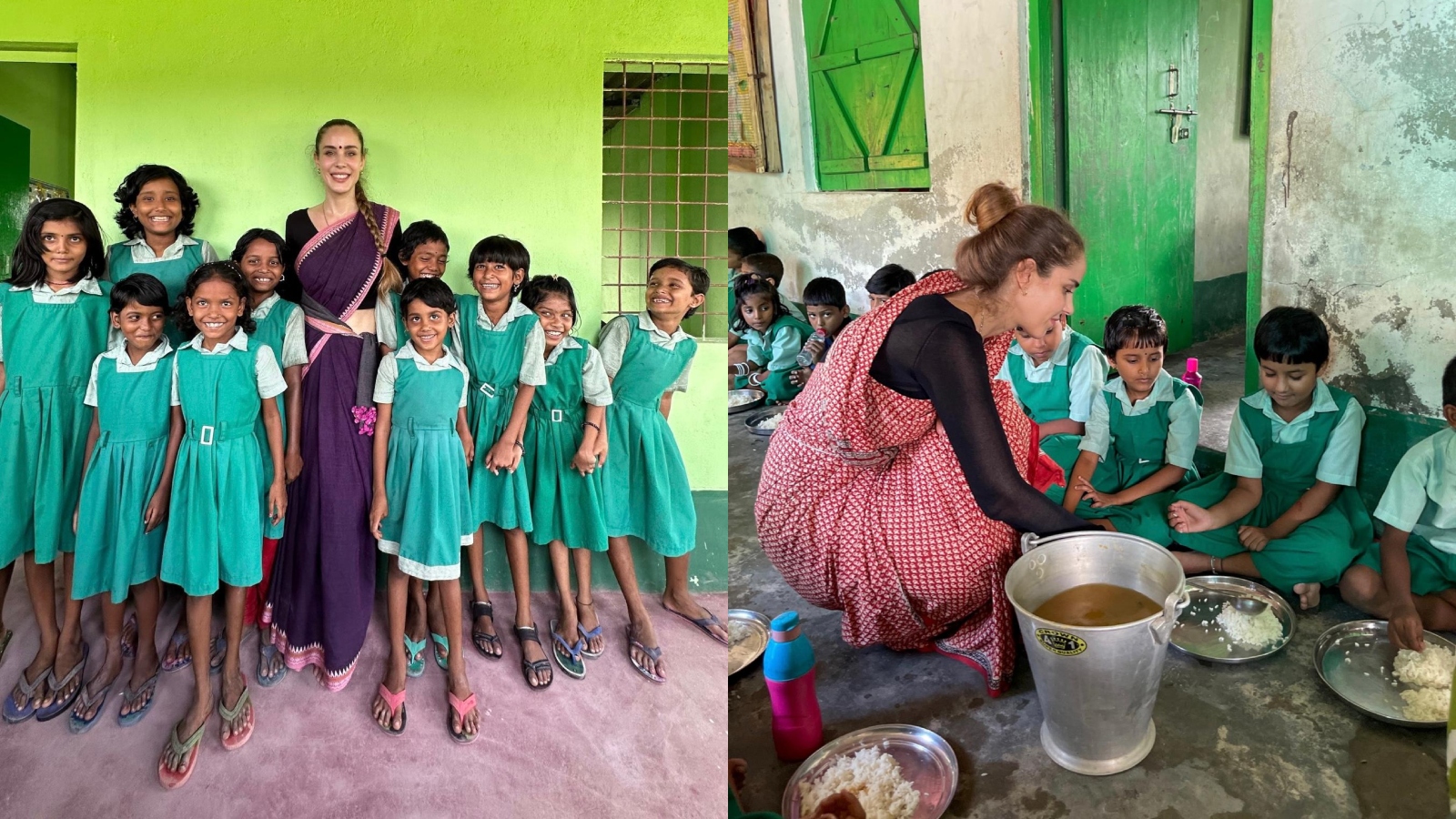
That journey led her to a remote village in West Bengal, where a free primary school she helped establish has become a catalyst for change. The school not only provides education to children who once had little access to it but also encourages them to speak out against child marriage, human trafficking, and domestic violence, turning students into young changemakers within their own communities.
Recently, Lavie’s story reached millions after she shared snippets of her life on Instagram, recounting how she traded corporate boardrooms for village classrooms. Speaking to indianexpress.com, she reflected on the choices that brought her here, the challenges of earning villagers’ trust, and why she believes meaningful change begins in India’s villages.
Growing up in Zurich, one of the world’s wealthiest cities, Lavie describes her childhood as happy and secure. Her parents ensured she never lacked opportunities, but they also gave her something she now considers equally valuable—the chance to see the world. “They gave me one of the greatest gifts imaginable: the opportunity to travel,” she says. “From an early age, I was exposed to cultures and realities very different from my own.”
One memory from those travels has stayed with her for decades. She remembers seeing a barefoot homeless girl and instinctively giving her own boots away before walking home barefoot herself. “Looking back, I think that was one of the first moments I understood what compassion and sharing truly meant.”
Before moving to India, Lavie built a career in the corporate sector, first in Switzerland and later in Dubai. By most measures, she had achieved what many aspire to: professional success, financial stability, and the freedom to travel the world.
Yet every trip left her with the same unsettling question.
Story continues below this ad
“The more I travelled, the more I questioned the inequalities I witnessed,” she says. “Why had I been given so much while others had so little?”
The question lingered until it changed the course of her life. “I realised that success had given me comfort, but not purpose. I wanted my life to contribute to something beyond myself.”
So she resigned from her job, packed just two shirts and two pairs of trousers, and bought a one-way ticket to India. “The contrast was intentional,” she says. “For the first time in my life, I felt completely free. I had very little, yet I had never felt richer.”
Her first days in India, however, were far from idyllic. She experienced culture shock almost immediately, was scammed at the airport and found herself staying in basic accommodation that bore little resemblance to the life she had left behind. “There were moments when I wondered what I had done,” she admits.
But amid the uncertainty, she also encountered remarkable generosity.
Story continues below this ad
“Complete strangers invited me into their homes, shared their meals and treated me like family.”
Over time, India stopped feeling like a country she was visiting and became home. She also found herself deeply influenced by the philosophy of Sanatana Dharma, whose emphasis on selfless service and duty reshaped her understanding of life.
“It continues to shape how I live my life today,” she says.
When Lavie first arrived, she intended to donate the money she had saved to charitable organisations. But as she travelled and volunteered with different NGOs, she found herself overwhelmed. “Everywhere I looked, there were people in need,” she recalls. “I kept asking myself, ‘Where do I begin?’”
Story continues below this ad
She washed clothes for children with disabilities, volunteered wherever she could and spent months understanding how grassroots organisations functioned. Initially, she thought supporting existing charities financially would be enough.
Instead, she encountered recurring problems.
“I saw financial mismanagement and projects that weren’t always addressing the real needs of communities,” she says. “That convinced me that if I wanted to create lasting impact, I needed to build something transparent, sustainable and community-led.”
Rather than deciding from afar where to work, she asked local people to take her to remote villages. “I believed the root causes of poverty often begin there. Families leave villages because opportunities are scarce, and many eventually end up in urban slums. If we want sustainable change, we have to invest where life begins.”
Story continues below this ad
Her search eventually led her to a remote island after a two-and-a-half-hour train ride followed by a one-hour boat journey. Instead of arriving with ready-made solutions, she spent her days listening. “I didn’t arrive with answers,” she says. “I arrived with questions.”
Those conversations laid the foundation for the school she established 15 years ago.
Winning villagers’ trust proved to be an even bigger challenge.
Lavie was a foreigner trying to convince families to send their children to school in a community where every extra pair of hands contributed to the household income. Many children accompanied their parents to collect shrimp eggs or worked in other occupations to help make ends meet.
Story continues below this ad
“It wasn’t easy,” she says. “I completely understood why people were cautious. Trust cannot be demanded—it has to be earned.”
With the help of her local team, she spent months going door to door, speaking to parents about the value of education. Even after children enrolled, many attended irregularly. Teachers would often visit homes each morning, persuading parents to send their children to class.
Slowly, perceptions began to change.
Parents saw that the school wasn’t a temporary project. Their children received quality education, nutritious meals and genuine care. The same families who had once turned Lavie away eventually began queuing to enrol their children. “Trust isn’t built through promises,” she says. “It’s built by showing up consistently.”
Building the school was only one part of the journey. Learning to adapt to India became another. Lavie says Switzerland taught her discipline and organisation, while India transformed her as a person.
Story continues below this ad
“My day used to begin around 5 am, and I always wanted everything to happen immediately,” she says. “In India, life followed a different rhythm. Meetings often started later, there were tea breaks, long lunches and a pace that initially frustrated me.”
There were times when the setbacks felt overwhelming, and she questioned whether she was the right person for the work. Looking back, however, those moments became some of her greatest lessons.
“Switzerland shaped how I work, but India shaped who I am,” she says. “It taught me patience, resilience, acceptance and the ability to let go of the need to control everything. Meaningful change takes time. You cannot rush trust, relationships or community development.”
Fifteen years later, the school’s impact extends far beyond academics. “The biggest change isn’t only in the children,” Lavie says. “It’s in the entire community.”
Story continues below this ad
One of the school’s most significant initiatives focuses on preventing child marriage, human trafficking, and domestic violence. Rather than relying solely on teachers, the programme trains young people to become educators and advocates within their own communities. “We never teach through fear,” Lavie explains. “We educate children about their rights in an age-appropriate way and encourage open discussion.”
The results have exceeded her expectations.
More than 100 youth leaders have been trained, reaching nearly 20,000 children, adolescents and adults across 30 villages through workshops and awareness campaigns. In some cases, teenagers have intervened to prevent child marriages by alerting teachers and local authorities.
“The most powerful part of the programme is that young people become the educators themselves,” she says. “Because the message comes from local young people rather than outsiders, it carries much greater credibility.”
For Lavie, those moments represent the true measure of success.
“Seeing former students helping protect the next generation—that’s when you know real change is happening.” Having spent 15 years in rural West Bengal, Lavie believes one of the biggest misconceptions people have about villages is that they are defined only by hardship. “People often see rural India only through the lens of poverty, but that’s only part of the picture,” she says. “Villages also offer something many modern cities have lost: community, simplicity, nature and peace.”
She remembers bringing her parents to the village for the first time. Rather than being struck by deprivation, they were captivated by its quiet beauty. At the same time, she is careful not to romanticise rural life. Limited access to quality education, absent teachers, child abuse and trafficking remain harsh realities in many areas. “For me, rural India represents both incredible beauty and significant challenges,” she says. “Recognising both is essential if we truly want to support these communities.”
Looking back, Lavie believes the greatest transformation has been her own.
“India has transformed me far beyond anything I ever imagined,” she says. “It has taught me patience, humility and acceptance.” The philosophy of Sanatana Dharma has become central to her life, changing how she views service itself. “It reminds me that service isn’t extraordinary—it is simply my duty.”
What once felt like a bold decision now feels like a privilege. “I no longer see this work as a sacrifice,” she says. “I see it as a privilege.”
For those inspired by her journey, Lavie offers simple advice. “Kindness begins exactly where you are,” she says. “Treat your family with love. Be respectful to strangers. Check on an elderly neighbour, rescue an injured animal, plant a tree. Listen more than you speak. Choose compassion over judgement.”
“We often think changing the world requires extraordinary actions, but lasting change is built through ordinary acts of kindness repeated every single day. If each of us made one person’s life a little better, our communities—and ultimately our world—would be transformed.”
View original source — Indian Express ↗
Related stories

The Punch
WorldJul 18, 2026 · 1 min
Bus crashes into market in Kwara
The Punch
The Punch
WorldJul 18, 2026 · 1 min
UK warns young travellers against accepting ‘free holidays’ from drug gangs
The Punch
The Punch
WorldJul 18, 2026 · 1 min
Outcry as Imo pupils sit for examinations in darkness after delays
The Punch

Portugal Resident
WorldJul 18, 2026 · 1 min
Countdown begins for Portugal’s biggest medieval festival
Portugal Resident