Mexico News Daily
Postcards from Mexico: On the Paseo de Montejo in Mérida
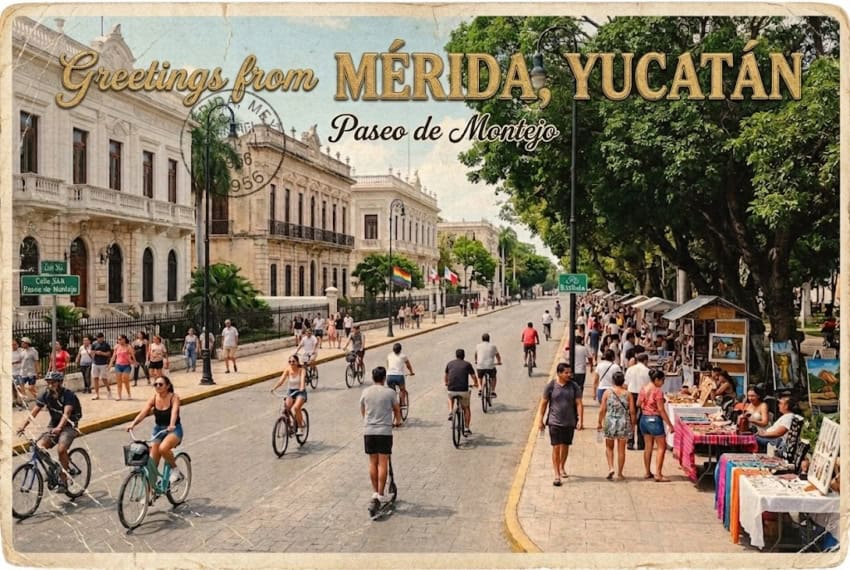
MÉRIDA, Yucatán, Dec. 7 — Mati’s the ringleader of a group of rambunctious children running around and tearing up the Paseo de Montejo sidewalk on their tricycles and two-wheelers. He’s 5 and already unbearable. No respect for caution or the rules, and heedless of his mother’s warnings, insistent on steering his bike like a dive bomber pilot. Predictably, he falls and faceplants after going down a ramp wildly, and now he’s crying.
It’s a little past 12:30 p.m. on a Sunday, so officially, the ciclovía is now closed, which, perhaps, explains why the boy repurposed a bistro’s wheelchair ramp into an X Games quarterpipe. It’s not my business to tell him how to live his life. But after witnessing about 10 near-misses wherein he and his Fury Road confreres narrowly avoided taking out passersby on the sidewalk, I can’t quite contain my schadenfreude.
A Sunday ciclovía in Mérida
Chief among those spared is a man in a yellow dress shirt, jeans and a straw hat playing acoustic guitar with a harmonica fixed to his mouth. He plucks away plaintively while rust-colored notes slowly wheeze from his mouth, one exhale at a time. Laid before him is an open guitar case that the kids in question whiz by, their parents visibly worn down from chasing them around and steering them away from such obstacles. Despite the distractions, the man continues to play stoically, ignoring the children just as passersby ignore him.
Doing so is quite the feat when considering the leisurely pace of Paseo pedestrians. On most days, it’s a street for a stroll, but on Sundays, it becomes a crawl. Of course, on cue, a barefoot man in a stained shirt passes by, power-walking, his arms swinging freely as he moves by Mati. But he’s the exception to the rule, inexplicably in a rush on a day when most establishments close shop. For the rest, the journey is the destination, which makes it hard to fathom how, moving at a snail’s pace, anyone could convincingly feign not hearing the man and his music.
Vendors and their looky-loos
To be fair, he’s not the only show in town. Vendors line the sidewalks, their plastic folding tables planted a few feet back from the curb. Seated and sweaty, they sell their wares: jewelry, macramé and portraits painted on canvas. Whatever they’ve been working on throughout the week. Others unfurl tarps on which they lay out rows of trinkets, like figurines, small sculptures and hand-carved kimbomba sets. It’s unclear how business goes. Probably tough when you’re shoulder to shoulder with block after block of artisans selling what you’re selling, but maybe with space restrictions, they don’t have much of a say. Still, with foot traffic passing by at the pace of a conveyor belt, they get more than their fair share of looky-loos.
Some of those aren’t even on foot. In what remains of the Sunday cycling road, the avenue is speckled with beach cruisers, scooters, stumbling rollerbladers and languidly pedaled bicycles hooked up to carriages like rickshaws. Whether they’d ever be able to get close enough to appreciate the craftwork displayed on the sidewalk is doubtful, but maybe they’ll see something they like and circle back later. If not them, then the city tour trolley that rolls by before unloading a sizable share of its passengers on the corner of 37th Street. Even without its Comic Sans lettering, rainbow-colored, zigzag stenciling and parade of international flags, it wouldn’t be hard to spot as a tourist tram. The people alighting give it away.
The always identifiable ‘gringos’
In and around El Centro, they’re always identifiable, clad in linen, straw hats and leather sandals if Mexican, and board shorts and tank tops if gringo. Bonus points on Paseo de Montejo for spotting the unfortunate souls who taxied to the wrong hotel and now lug their roll-aboard bags down a stretch of street as long as the Champs-Élysées. Perhaps they’ll partition their procession to buy a hand fan from the squat man wearing a white-collared shirt and socks with sandals, selling fans. Otherwise, best to slip into the shade, join the hordes lounging about at tables in outdoor bistros, sipping flat whites, eating overpriced croissants and people-watching. But enough about me.
A street scene unfolds
These and other musings are interrupted by a “Dele! Dele!”, an elderly man waving a towel anywhere there’s a parking space to be had. He pounces on an elderly lady, instructing her to move her car up a few feet even though she’s parked perfectly and there’s plenty of space elsewhere. For his unbidden service, he’ll request a few pesitos — “alguito pa’ las chelas” — the lady will oblige, and all will be right in the world.
I’m still not sold on his enterprising spirit. Near the curb, three friends pose for selfies in front of a phone they’ve set up in the crook of a tree. Surely, the man with the red towel, with his well-honed eye for angles, could step in and offer his services. Instead, he just paces, occasionally waving his towel at cars as they pass, and nodding to a woman pushing an empty baby stroller. She’s the one Mati’s been waiting for. At last, his ambulance has arrived.
Ethan Jacobs is a freelance writer and writing coach based in Playa del Carmen. He has written extensively in narrative and short fiction formats, and his work has received recognition both domestically and internationally in microfiction, short fiction and narrative essay formats.
View original source — Mexico News Daily ↗
Related stories

The Punch
WorldJul 18, 2026 · 1 min
NCDMB, Renaissance begin 12-month oil, gas training for 300 Nigerians
The Punch

The New York Times
WorldJul 18, 2026 · 1 min
U.S. Strikes Leave Iranians Isolated and Scared
The New York Times

Antara News
WorldJul 18, 2026 · 1 min
Indonesia, PNG strengthen border cooperation through power talks
Antara News

Euronews
WorldJul 18, 2026 · 1 min
Spain faces hottest week of summer with temperatures up to 45°C next week
Euronews