Times of Israel
Life-friendly world? In first, atmosphere found on Earth-like planet in habitable zone
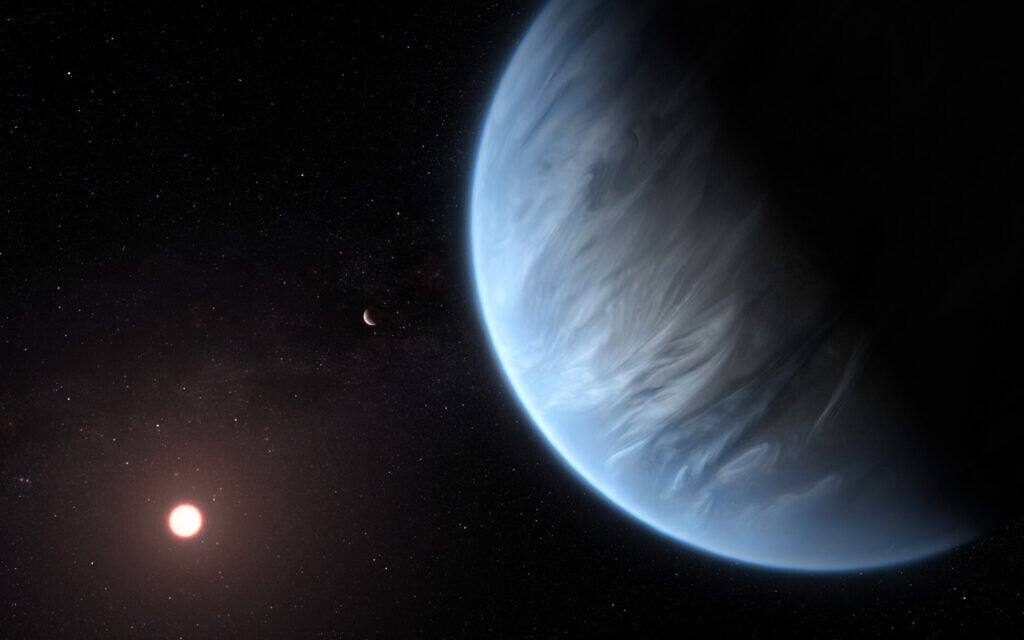
A team of scientists says they have, for the first time, discovered an atmosphere on an Earth-like planet that has the potential to harbor life.
A new study published this week in the peer-reviewed journal Science says the planet, located in the habitable zone of its solar system, has an atmosphere that contains helium. It is also located at a distance from its star that would allow liquid water to exist on its surface.
Known as LHS 1140b, the planet is in Earth’s neighborhood, cosmically speaking, at a distance of 48 light-years away — or more than 450 trillion kilometers (280 trillion miles).
It was first discovered in 2017, and has been thoroughly scrutinized since then. But it has only now been confirmed to have an atmosphere.
LHS 1140b is a rocky “super-Earth,” 1.7 times bigger than Earth, and with 5.6 times its mass. Its density also points to large quantities of water. It is gently warmed by its red dwarf star, which is one-fifth the size of the Sun.
Get The Times of Israel's Daily Edition
by email and never miss our top stories
By signing up, you agree to the terms
The exoplanet’s surface temperature is believed to be fairly similar to that on Earth and Mars.
Lead study author Collin Cherubim of Harvard University told the BBC that “this is the first time anyone has found an atmosphere on a rocky planet in the habitable zone of another star,” calling it “a big deal.”
The discovery of such a planet so close to home increases the possibility that many planets may have the conditions to support life.
Examining LHS 1140b, researchers were able to detect its atmosphere by observing data from the transit of its star. When the planet passes between its star and the Earth, advanced telescopes can detect minuscule changes in the characteristics of the light hitting their sensors, thus revealing many details about the planet and its composition.
“When the planet passes in front of the star, some of that starlight filters through the atmosphere of the planet,” Cherubim told Time Magazine. “If there are any molecules or atoms like helium in the planet’s atmosphere, they can absorb or block very specific wavelengths of light.”
The scientists discovered that the planet was leaking some helium into space, confirming the presence of an atmosphere.
The scientists stressed that they have no evidence at this time of life existing on LHS 1140b. But the conditions on its surface put it “at the forefront for studying astrobiology and habitability and looking for life outside the solar system,” Cherubim said.
Since the 1990s, scientists have discovered some 6,000 planets outside our solar system, but only a handful are in what is called the “Goldilocks zone” — neither too hot or too cold — that could host liquid water, a key ingredient for life.
The James Webb Space Telescope, which can see farther into the universe than anything before it, has turbocharged the search for planets beyond the Solar System since coming online in 2022.
AFP contributed to this report.
View original source — Times of Israel ↗
Related stories

CBC
ScienceJul 18, 2026 · 1 min
B.C. wildfire tally surges past 100 as barrage of lightning strikes transforms fire season in a flash
CBC
Indian Express
ScienceJul 18, 2026 · 1 min
Researchers build AI camera that reconstructs particle paths using handful of photons
Indian Express

CBC
ScienceJul 18, 2026 · 1 min
Doug Ford takes questions as Ontario battles wildfires and heavy smoke
CBC

BBC
ScienceJul 18, 2026 · 1 min
Crews making 'really significant' progress tackling Cairngorms wildfire
BBC