The Guardian
‘Where did they go?’: homeless people feel force of America’s brutality in World Cup clean-up
“A lot of our community has been pushed out by the World Cup. We’re not just dollar signs, we’re more than that. We’re people and we’re frustrated that they’ve chosen to treat us less than human.”
“They dropped me off there in the middle of the night. They call them Mormon centres or whatever, but it ain’t nothing but a warehouse of cops. It looked like a Fema camp. When I saw it, I left, I walked all the way back here. It’s because of the World Cup. They’re trying to make it look good for tourists. They don’t want the eyesores around.”
One week before the World Cup final Gianni Infantino flew from Miami to Qatar on a luxury private jet. Infantino was in Lusail to attend the funeral of the former Emir, Sheikh Hamad bin Khalifa Al Thani (“mentor, a visionary”) and was duly pictured frowning on a silver throne in full global statesman mode.
That same Sunday, Donald Trump made an official trip to his own golf complex in Virginia, home to a 50,000 sq ft clubhouse, Olympic-sized swimming pool and unobstructed views of the Potomac River, thanks to a renovation that involved chopping down 465 trees.
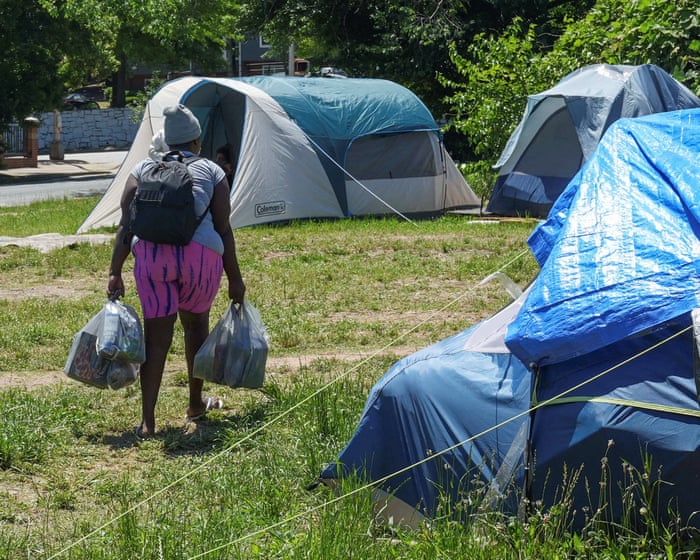
Also on the same day, the Guardian published a story about the homeless clearance at Freedom Park, less than a mile from one of Atlanta’s World Cup fan-watch areas. City employees had entered the park without warning and removed the tents, personal ID, medication and other belongings of people camping there.
A city official said Freedom Park was not an official encampment so rules over process were not applied. The sweep was described as “routine park maintenance”. A day before England’s semi-final against Argentina, the last of Atlanta’s eight World Cup matches, Freedom Park was almost entirely empty, a rolling green space surrounded by handsome suburban houses, with no mark of the tents and bags and chairs removed by the city.
The clearance of homeless people from host city centres has been a feature of the World Cup in the US, Canada and Mexico. Andre Dickens, the mayor of Atlanta, has been clear about why this is happening. “We want to make sure those unsheltered individuals don’t come anywhere near downtown and throughout the city of Atlanta, not just during the World Cup but now,” he said last year.
This is also Trump administration policy. “You should not have to cross the street in downtown Atlanta to avoid a crazy person yelling at your family,” the vice-president, JD Vance, told an event in Peachtree City last August, using language that was criticised for its hostility.
Atlanta launched a World Cup-centred plan called Downtown Rising, designed to remove homeless camps in the city centre before the tournament. The campaign has funding, a laudable set of aims, and claims to have housed 500 people.
Freedom Park suggests the city has also been heavy-handed in its actions at times, tragically so in one case. In January last year, Cornelius Taylor was sleeping in his tent on Old Wheat Street, in the historic black neighbourhood of Sweet Auburn, when council workers arrived to conduct a clearance of the street. Taylor was crushed to death in the street by a five-tonne bulldozer as he slept. His fiance would later describe finding blood and body parts inside his possessions. His death led to promises for greater care and the introduction of new protocols in the city, which is home to an estimated 3,000 unhoused people.
There is still uncertainty over how this has worked in practice. At the Centre for Health and Rehabilitation in Fulton County, just across from the Freedom Park trail, workers treat homeless people with mental health and addiction problems. One care worker said she had noticed a drop in numbers of people on the streets during the World Cup and had read stories of the homeless being housed for the duration, but had no clear idea where they had been taken or whether there had been any choice in their relocation.
“I haven’t seen evidence of what has occurred, but we do know the people are gone. So where did they go? A lot of those people definitely wanted to be where they were within that vicinity. And I don’t know where they were taken. So they could have been displaced well away.”
There is no official rehousing centre during the World Cup in Atlanta. One homeless man, Sirius, a visitor to the Crossroads Community Center close to Atlanta’s Fifa hotels and a 20-minute walk from the stadium, described being taken to a centre beyond the city’s West End.
“They dropped me off there in the middle of the night. They call them Mormon centres or whatever, but it ain’t nothing but a warehouse of cops. It looked like a Fema (Federal Emergency Management Agency) camp. When I saw it, I left. I walked all the way back here. It’s because of the World Cup. They’re trying to make it look good for tourists.
“They used to just drop you off in the middle of the street over there by Pryor Road, across from Gateway. Now they take you all the way up to Metropolitan on the far outskirts.”
Another homeless man, Drayvon Clark, expressed concerns at the way the World Cup has affected the city. “We feel like a lot of our community has been pushed out. We’re not just dollar signs, we’re more than that. We’re people and we’re frustrated with the fact that they’ve chosen to treat us less than human in a lot of the areas because of making money.
“Not saying that we don’t love soccer, we do love soccer, but it is traumatic. They went and got third-party park rangers, other organisations to try to push out people, our people. It doesn’t matter, black, white, even homeless. And we just want to get our voice heard.”
Homelessness is a profound social problem in the US. There are at least 770,000 unhoused people nationwide, according to official figures. This has been addressed by the passing of hundreds of new bills criminalising sleeping outside or lingering in public spaces in the past two years. The World Cup has supercharged that process in its host cities.
This has often been an issue around big sporting events. At the 1996 Atlanta Olympics, the city kept around 9,000 people in a de facto detention centre. Paris bussed its homeless out of the centre during the 2024 Olympics. Leading into this World Cup there have been various host city programmes, some of which seem genuinely geared towards addressing the problem by providing new housing.
In Los Angeles, homeless people have been put up in block-booked motels. In Dallas, an encampment of up to 200 tents close to the city hall has been cleared. Seattle’s recently elected mayor, Katie Wilson, made a pledge to build 500 new homes to help clear city centre homeless camps by the start of the World Cup. The actual number by that date was 50.
Despite these efforts, the presence of homeless people in host cities has been a constant reminder of how brutal this country can be, of the gap between rich and poor, and of how easy it is to fall between the cracks.
On the eve of the final there was even a homeless camp at the entrance to the bizarrely hyper-publicised Fanatics event in Manhattan. At moments like this America itself can feel like an act of violence, a place where the idea of a safety net or a support system is stretched to its finest point.
“This country is bred that way,” Sirius says. “We’re a war country. That’s what we do. All the people here are indoctrinated from their youth to be very aggressive, to be numb to it. It’s intentional. America is hard. Actual rights have been turned to paying privileges.
“I’m going to be honest. Black people in Atlanta don’t play football. So when you invited the world here, you invited the world to participate in a sport that these people are not even included in.
“The thing about this sport is it makes so much money, but we don’t. Are we going to unite the world? Are we going to fix the city? Until they level the playing ground and we can produce more soccer moms in my community, it’s going to be that way. It has nothing to do with us. We’re the only people that’s excluded from it.”
These problems look ever more jarring in the context of Fifa’s endless sloganeering about how football brings the world together. In reality the World Cup is a brutally administered entertainment leisure complex, and something that sounds in this context very much like an act of sportswashing.
“They always bring a big event that everybody’s blinded by,” Sirius adds. “You’ve seen Gladiator, it’s like the Games. That’s what it’s for. It’s a distraction. They treat us like trash and trampled over us. But that’s America for you, isn’t it? They’ve got to reckon with heaven and hell at the end of it. God bless America.”
View original source — The Guardian ↗
Related stories

ESPN
SportsJul 18, 2026 · 1 min
Green: Mets compliant on AI after report of usage
ESPN

Mexico News Daily
SportsJul 18, 2026 · 1 min
Mexico’s week in review: Sheinbaum keeps ICE deaths abroad in focus as US steps up claims of cartel-government ties
Mexico News Daily
CNA
SportsJul 18, 2026 · 1 min
Hydration breaks did not impact World Cup results but future undecided, says FIFA's Wenger
CNA

Sky Sports
SportsJul 18, 2026 · 1 min
Chelsea agree record £117m deal for Villa's Rogers
Sky Sports