The Guardian
There will be disagreement at next week’s Labor conference – but don’t expect the feuds of the past
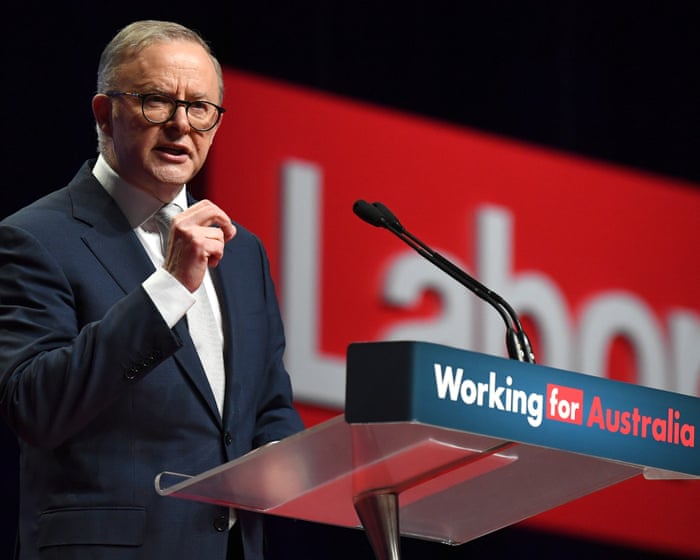
The Labor national conference has long been the stage for settling the party’s most vexed debates, a triennial family feud fought with resolutions, amendments and factional deals. In 1982, the battle was about whether to ban new uranium mines. The 2015 conference was headlined by an emotion-charged debate about asylum seeker boat turn-backs, which ended with Anthony Albanese’s left faction on the losing side.
In 2023, the party agreed to back the Aukus nuclear submarine program after an acrimonious debate that included shouts of “appeasement” from supporters to critics.
As Labor MPs, trade unions and rank-and-file members prepare to descend next week on Adelaide for the party’s 50th national conference, debates are expected about gambling advertising, artificial intelligence in the workplace, fuel rebates for mining companies, interest rates and Israel and Palestine.
The public arguments will expose internal divisions on contentious issues. But factional heavyweights don’t expect a repeat of the hugely divisive fights of past conferences, instead predicting a largely harmonious affair that showcases the “solidarity” of the Labor family during a period of major political disruption.
The demonstration of “constructive unity,” as one MP puts it, is deliberately designed to entrench a perception that – amid the rise of One Nation, the collapse of the Coalition and the stagnation of the Greens – Labor is the only stable party of the centre.
“Is it better to be boring than chaotic,” says another MP.
Platform signposts
The conference aims to update Labor’s national platform, which sets out the party’s core beliefs, values and policy priorities with broad-brush statements.
Albanese’s caucus is not bound to follow or immediately act on the platform or the resolutions passed at the three-day event.
Multiple iterations of the platform have, for instance, described dental care as the missing element of Medicare – yet the government has shown no appetite to add it to the universal health program.
But the document’s often benign and non-prescriptive language does set out the party’s direction, signposting where the parliamentary wing might – or might be pressured – to go.
The 126-page draft platform to be debated in Adelaide has been developed by Labor’s National Policy Forum, co-chaired by Albanese and outgoing president Wayne Swan. It includes a mix of federal MPs, trade unionists and branch members.
The direct involvement of the prime minister and many rounds of consultation on preliminary drafts means most of the language in the platform has already been settled, avoiding the need for messy contests on the conference floor.
Gambling pressure and AI fears
Nevertheless, debate is expected, including about the government’s gambling advertising legislation.
The draft platform committed Labor to cracking down on online gambling inducements, a key recommendation of the landmark Murphy report that was omitted from the government’s draft laws.
The position was endorsed at this month’s New South Wales Labor conference and Guardian Australian has spoken to several federal Labor MPs who support stronger action, including one who describes inducements to gamble as “pretty egregious”.
If the draft amendment is agreed – as sources expect – the government will face immediate pressure to insert anti-inducement measures into the draft bill before it is debated in parliament.
After the prime minister this week outlined a more interventionist approach to managing the AI boom, unions are expected to push for stronger commitments to protect workers and requirements for datacentre operators to hire apprentices in construction.
What’s less clear is the fate of a campaign by pro-environment grassroots members to pressure the government to wind back the diesel fuel rebate for Australia’s biggest miners.
A proposal from Labor Environment Action Network (LEAN) for the party to commit to axing “disincentives for decarbonisation” was not adopted in the draft platform, despite more than 350 local branches passing motions in support of restricting the subsidy.
Left faction delegates and pro-nature MPs, such as Jerome Laxale, are expected to try again at the conference, perhaps with different wording.
The US and Israel’s war in Iran and ensuing global fuel shock has killed any prospect of imminent changes to the tax credits scheme, meaning even a successful amendment or conference resolution won’t quickly translate into a policy shift by the government.
Likewise the campaign for a 25% gas export tax, which was first championed by the Australian Council of Trade Unions and then taken up by independent senator for the ACT, David Pocock, and others.
One right faction power broker says those two policies are “probably a step too far” because of the uncertainty in the Middle East.
Divided membership
About 150 of the 400 conference delegates who vote on the platform are chosen by local branches to represent the rank and file.
But if neither a gas tax nor a fuel tax credit-related proposal are endorsed, it will indicate a disconnect between the government and Labor’s membership base, where both policies are broadly supported.
That disconnect is no more apparent than with Aukus.
Motions condemning the submarine pact have been passed at dozens of Labor branches, and at Victoria’s state conference, but Labor’s anti-war campaigners are pessimistic that any statement of resistance will be debated – let alone passed – at next week’s event.
According to a senior figure from the left: “We have all admitted that we have lost; we need to stop flogging a dead horse.”
Aukus will be aired away from the conference floor, with Labor Against War and progressive thinktank, the Australian Institute, hosting one of dozens of events on the sidelines of the main event.
Organised by the Chifley Research Centre, Labor’s official thinktank, and open to members of the public, the “Fringe” program provides a forum for debates as varied as the case for an Australian republic to the rise of the far right and laws for armed conflict.
“I think it [the Fringe program] demonstrates Labor’s interest in the views of all Australians, its appetite for discussion and debate around not just current policies, but what issues might face us in the future,” the thinktank’s executive director, Emma Dawson, says.
View original source — The Guardian ↗
Related stories

TASS
PoliticsJul 19, 2026 · 1 min
Moscow, Pyongyang work hard to cement union — Russian deputy foreign minister
TASS

The Punch
PoliticsJul 19, 2026 · 1 min
2027: Court battles unsettle ADC, NDC
The Punch

TASS
PoliticsJul 19, 2026 · 1 min
Russian tourists' interest in North Korea grows — deputy foreign minister
TASS
The Punch
PoliticsJul 19, 2026 · 1 min
Ogun APC winning PDP structures daily – Ex-lawmaker
The Punch