Indian Express
Court overturns 2016 Assembly election result in TN’s Radhapuram: How 49-vote loss turned into win by 103 ballots
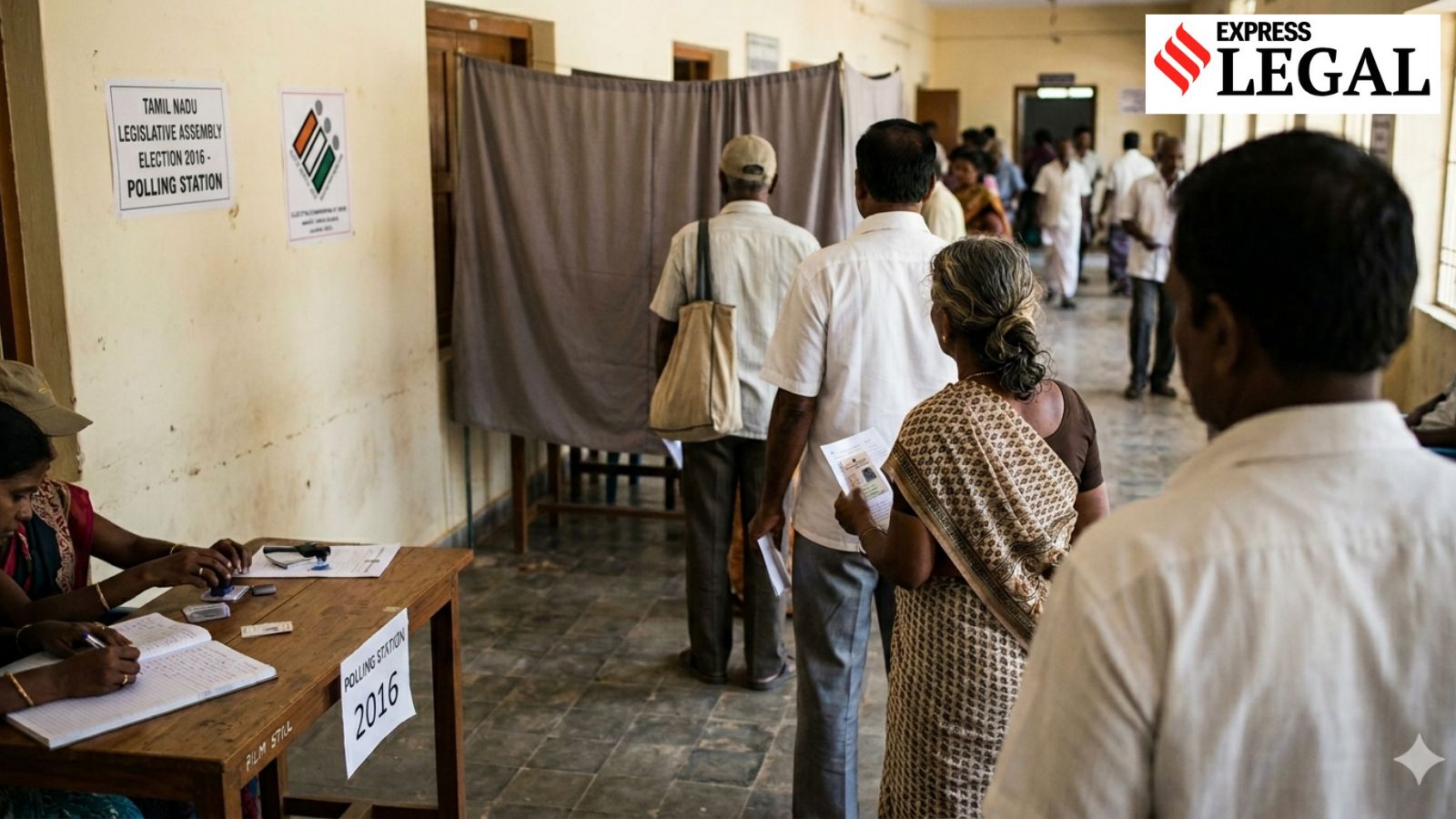
Nearly a decade after he was declared defeated by 49 votes and five years after the Assembly term itself had ended, the Madras High Court ruled that DMK leader and former Tamil Nadu Speaker M Appavu was, in fact, the rightful winner of the 2016 Radhapuram Assembly election, holding that hundreds of postal ballots cast in his favour had been wrongly rejected.
Justice G Jayachandran, who called the prolonged litigation a “grave mockery of justice”, was hearing an election petition filed in 2016 by Appavu, who had challenged the election of AIADMK candidate I S l Inbadurai from the Radhapuram Assembly constituency in Tirunelveli district by a margin of 49 votes.
“The term ‘unfortunate’ may not be an adequate expression to describe the present case since in view of this Court, a grave mockery of justice, under the guise of dispensing justice been committed to the people of India, particularly the voters of Radhapuram Assembly Constituency, Tirunelveli District, who were forced to bear a person as their Assembly representative though he is not duly elected,” the court said on June 3.
Justice G Jayachandran heard the matter on June 3.
Judiciary custodian of Constitution: Court
Unfortunately, in this case, the mandate contained in Section 86(7) of the Representation of the People Act, 1951, has been conveniently ignored.
Judiciary in this Country, being the custodian of the Constitution, should act in tandem with the other organs of the Constitution, to retain the pride of this nation as one of the largest democratic countries in the world.
Non-adherence to the mandate contained in Section 86(7) of the Representation of the People Act, 1951, will undermine democracy and the true spirit of adult franchise.
If courts continue to ignore their own observations made in Mohd Akbar case, this country may also go in the way of other autocratic countries which gained Independence around 75 years ago, along with us.
Verdict came after term ended
The judgment marks the culmination of a legal battle that outlived the very Assembly term it concerned.
Appavu had approached the high court alleging that valid votes cast in his favour had been wrongly rejected during counting and that irregularities had occurred in the counting of votes recorded by electronic voting machines during the final rounds.
He sought a recount of postal ballots and votes recorded in Electronic Voting Machines (EVMs) during the 19th, 20th and 21st rounds of counting. The court noted that after 18 rounds of counting, Appavu had allegedly been leading, but the final declaration showed him losing by 49 votes.
Following a detailed trial, the high court in October 2019 ordered a recount of postal ballots and votes cast in certain EVMs, finding prima facie merit in the challenge.
Postal ballots that changed everything
At the heart of the dispute were 203 postal ballots that election officials had rejected as invalid because they were attested by middle school headmasters rather than gazetted officers.
The high court had held in its 2019 order that middle school headmasters qualified as gazetted officers for the purpose of attesting postal ballot declarations and that the rejection of all 203 ballots was improper.
The recount that followed produced a startling result.
According to the recount report later referred to by both the Supreme Court and the high court, 153 of the disputed postal ballots had been cast in favour of Appavu, while only one vote had been cast in favour of Inbadurai.
44 ballots remained invalid
Justice Jayachandran observed that these figures conclusively established that Appavu had actually won the election by 103 votes.
Story continues below this ad
“Out of 203 postal votes rejected as invalid, the Election Petitioner, Mr M Appavu, had received 153 valid votes in his favour. Whereas, the 1st respondent, M I S Inbadurai… had received only one valid vote,” the court recorded.
SC case stretched for years
The litigation took a dramatic turn when Inbadurai challenged the high court’s recount order before the Supreme Court.
On October 4, 2019, the apex court allowed the counting process to continue but directed that the results should not be declared.
The matter thereafter remained pending for years, passing through multiple hearings and adjournments.
In March 2021, the Supreme Court opened the sealed recount report and noted that if the disputed postal ballots were counted, Inbadurai could not retain victory.
The court observed that the dispute essentially boiled down to one legal question- whether the headmasters who attested the postal ballot declarations could be treated as gazetted officers.
However, by then the political landscape had changed.
The 2016 Assembly term had ended, fresh elections had been held in 2021, and another round of Assembly elections was conducted in 2026.
Finally, on May 21, 2026, the Supreme Court disposed of the appeal, observing that because of the lapse of time and expiry of the term of office, no useful purpose would be served by deciding the legal issue in that appeal.
It left the question open for determination in another case and permitted the high court to pass consequential orders.
The judgment repeatedly stressed that election disputes are required under Section 86(7) of the Representation of the People Act, 1951, to be decided as expeditiously as possible and preferably within six months.
Referring to earlier Supreme Court observations on delays in election litigation, Justice Jayachandran warned that prolonged adjudication of election disputes undermines democracy and weakens public faith in the electoral process.
Election declared void, records to be corrected
Allowing the election petition, the high court declared Inbadurai’s election from the Radhapuram constituency void and formally declared Appavu as the duly elected MLA for the 2016-2021 term.
The court directed the secretary of the Tamil Nadu Legislative Assembly to substitute Appavu’s name in all official records as the representative of the constituency for that period.
At the same time, the court clarified that Inbadurai was not personally responsible for the improper declaration and would not face any disqualification.
Story continues below this ad
However, he would be ineligible to claim pensionary benefits arising from service as MLA during the disputed term.
With that, one of Tamil Nadu’s longest-running election disputes has finally reached its conclusion, nearly a decade after the votes were cast and long after the Assembly term in question had become history.
The verdict may no longer alter who sat in the Assembly between 2016 and 2021, but it has rewritten the official record of who actually won the election.
View original source — Indian Express ↗
More from Politics

The Punch
PoliticsJun 5, 2026 · 1 min
US Senate approves $70bn for Trump immigration crackdown
The Punch

Rio Times
PoliticsJun 5, 2026 · 1 min
U.S. Warns Against Toppling Bolivia President as Crisis Deepens
Rio Times

Lovin Malta
PoliticsJun 5, 2026 · 1 min
New Online Dashboard Measures Malta’s Political Reach Across Social Media
Lovin Malta