BBC
Rare butterfly find drives conservation research
58 minutes ago
Hsin-Yi LoSouth East
A Surrey amateur lepidopterist has shared how his remarkable discovery of a rare butterfly has led to a breakthrough in conservation research.
Gareth Tilley discovered a population of one of the UK's most elusive butterflies, the black hairstreak, which had never before been recorded in the county.
Prior to his discovery, the species was found exclusively in woodlands between Oxford and Peterborough, according to Butterfly Conservation.
Tilley said: "I live in Epsom, and it was during the lockdown in 2020 I started going for walks in the area.
"During one of those walks a butterfly landed in front of me. I was amazed to see it was a black hairstreak."
Since 2002, the species' UK distribution has declined by 33%, largely due to habitat loss, according to Butterfly Conservation.
Tilley said when he told locals, some believed it was a one-off illegal release.
He then worked with Butterfly Conservation, the local council and the University of Sussex to confirm that this butterfly species does live in Surrey.
Tilley said the species is "notoriously difficult" to monitor.
"The caterpillars look like leaves, the chrysalis like bird droppings, and the adults stay high in trees," he explained.
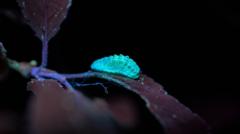
The breakthrough came after he learned that some US caterpillars glow under UV light.
Gareth Tilley bought a UV torch to try and find the caterpillars in May 2022.
"I was sceptical it would work," he said.
"But when I found a caterpillar, it didn't just glow, it was incredibly bright."
He said he ended up finding 46 of them in one evening.
Tilley said the purpose of caterpillar's ability to glow in the dark is still unknown.
"It may help them deter predators, or have no direct function," he said.
Butterfly Conservation says it recognises the significance of the discovery and is now promoting UV surveying for hairstreaks nationwide.
Steven Lofting, the charity's south east conservation manager, said Tilley's work had made a "hugely valuable contribution" to butterfly conservation in the UK.
"We are finding much higher numbers of hairstreaks using UV surveys and it's a new, fun way to engage volunteers," he added.
Tilley is promoting this technique to other conservation groups, including those in Australia.
Related internet links
Related stories

Straits Times
TechnologyJun 14, 2026 · 1 min
Mexican guild chief apologises for racist gesture at World Cup
Straits Times

Philippine Daily Inquirer
TechnologyJun 14, 2026 · 1 min
Cybersecurity review urged after hacking of Senate, House sites
Philippine Daily Inquirer

TechPana
TechnologyJun 14, 2026 · 1 min
Traffic Police to Launch New Online System for Reporting Lost Vehicles
TechPana

The Guardian
TechnologyJun 14, 2026 · 1 min
Russia is losing the war in Ukraine, and Putin is desperate. But that’s when he’s at his most dangerous | Simon Tisdall
The Guardian