Indian Express
Knowledge Nugget: Why Defence Ministry’s Sitapur Solar Project is making headlines
Take a look at the essential events, concepts, terms, quotes, or phenomena every day and brush up your knowledge. Here’s your UPSC Current Affairs knowledge nugget for today on Sitapur Solar Project.
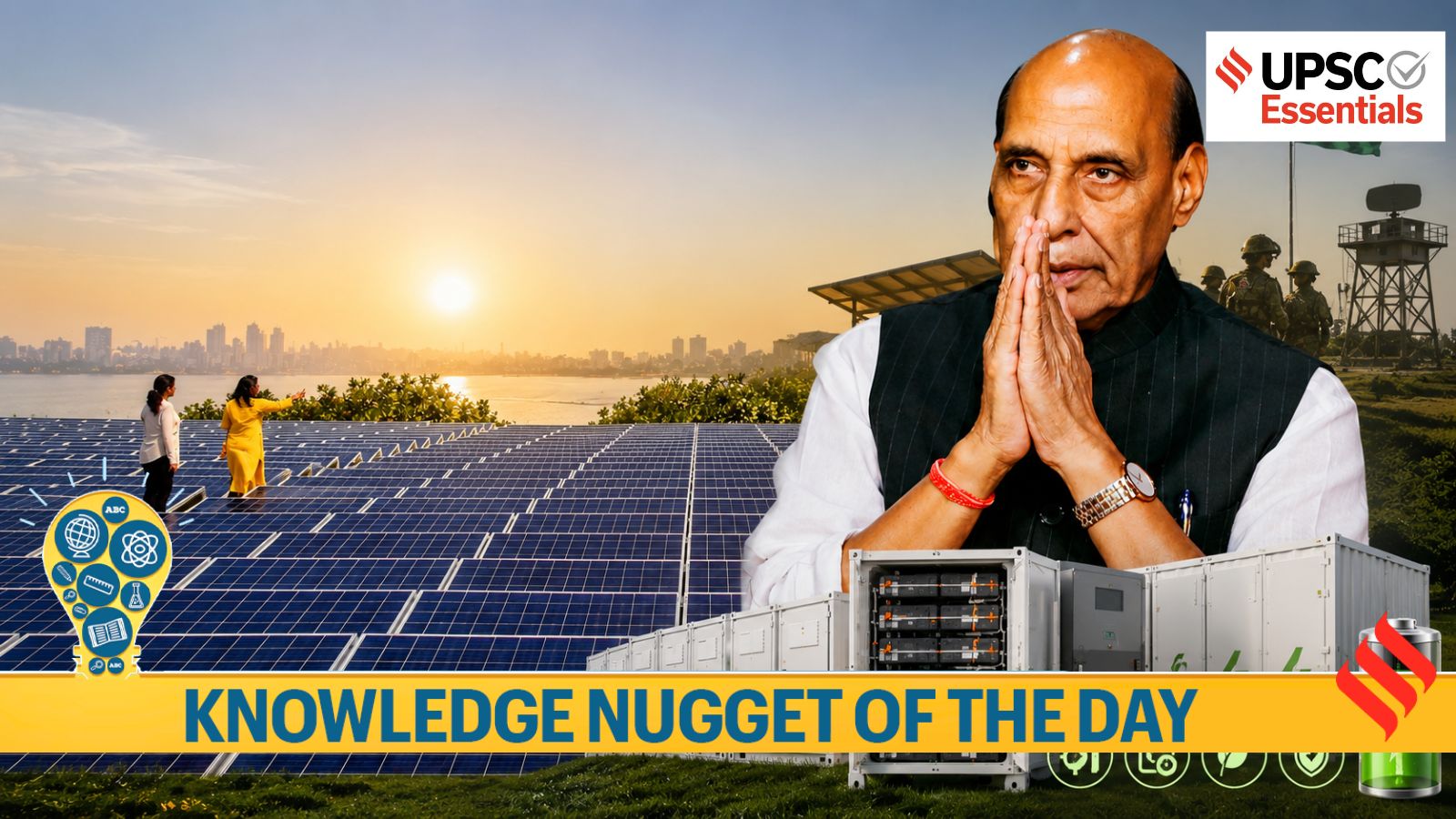
Defence Minister Rajnath Singh has approved the establishment of a 250 MW Solar Power Project in Sitapur, Uttar Pradesh. In this context, let’s know what makes the solar project in Sitapur ‘first of its kind’ and what are the various Energy storage technologies.
1. Defence Minister Rajnath Singh has approved the establishment of a 250 MW Solar Power Project with a Battery Energy Storage System (BESS) in Sitapur, Uttar Pradesh, marking a pioneering effort among several planned projects aimed at utilising thousands of acres of unused defence land across India for various green energy initiatives.
2. “This is the first-of-its-kind project undertaken by the Ministry of Defence (MoD), involving the development of a large-scale solar power generation facility with integrated BESS support on defence land,” the statement from the Ministry noted.
3. The Ministry stated that besides strengthening long-term energy security for the defence forces, the project is expected to substantially reduce expenditure incurred on procurement of conventional grid power for defence establishments, resulting in significant savings to the government exchequer over the life cycle of the project.
4. “The project will be implemented in close coordination with Integrated HQ of MoD (Army) and Directorate General Defence Estates (DGDE),” it said, adding that the project represents a convergence of national security, energy security, technological innovation and environmental sustainability.
5. The solar power project in Sitapur is expected to emerge as one of the country’s most significant renewable energy projects established on defence land and a benchmark for future solar-plus-storage projects in the defence sector, it added.
Story continues below this ad
Energy Storage Technologies
As the approved establishment of a 250 MW solar power project in Sitapur includes a battery energy storage system, let’s know what it is and other energy storage technologies.
1. Energy storage refers to systems that can store excess renewable electricity during periods of high generation and discharge it when demand rises but power generation remains low.
2. At its core, energy storage systems convert electricity from renewable sources such as solar and wind, when it is available, into forms that can be stored. Later, it converts these back into electricity when need arises.
3. A range of energy storage technologies are being deployed globally. Among them, pumped hydro storage (PHS) and battery energy storage systems (BESS) are currently the most widely used.
Story continues below this ad
(i) PHS uses surplus electricity to pump water from a lower reservoir to a higher one. When electricity demand peaks, it releases the stored water downhill through turbines to generate power.
(ii) BESS technology stores electricity chemically and discharges it when needed. Lithium-ion batteries, particularly lithium iron phosphate (LFP) batteries, are currently the dominant technology for grid-scale storage because of their falling costs, high efficiency and long operational life.
The Two Titans of Energy Storage
Pumped Hydro Battery Systems PHS vs BESS All 6 Technologies
HOW IT WORKS
Pumped Hydro Storage (PHS)
Uses surplus electricity to pump water from a lower reservoir to a higher one. When electricity demand peaks, the stored water is released downhill through turbines to generate power — essentially a giant rechargeable battery using gravity and water.
▲
Charging phase
Excess renewable electricity powers pumps that push water uphill to the upper reservoir for storage.
▼
Discharge phase
At peak demand, water flows downhill through turbines connected to generators, producing electricity on demand.
◆
Best suited for
Large-scale, long-duration storage where geography permits two reservoirs at different elevations.
HOW IT WORKS
Battery Energy Storage Systems (BESS)
Stores electricity chemically and discharges it when needed. Lithium iron phosphate (LFP) batteries have become the dominant grid-scale technology, driven by rapidly falling costs, high efficiency, and long operational life.
+
Charging phase
Renewable electricity drives a chemical reaction inside cells, storing energy in electrochemical bonds.
-
Discharge phase
The chemical reaction reverses, releasing stored energy as electricity almost instantaneously when the grid needs it.
★
Why LFP leads
Lithium iron phosphate batteries combine falling costs, high efficiency, thermal stability, and long operational lifespan — making them the top choice for grid-scale BESS.
PHS — Storage medium
Water & gravity
Gravitational potential energy in elevated reservoirs
BESS — Storage medium
Chemical bonds
Electrochemical energy in lithium-ion cells
PHS — Scale
Very large
Requires suitable terrain; ideal for bulk, long-duration storage
BESS — Scale
Flexible
Deployable at any scale; no geographic constraints
PHS — Response
Minutes
Slower ramp-up; best for planned peak demand management
BESS — Response
Milliseconds
Near-instant response; ideal for grid frequency regulation
~
PHS
Pumped Hydro Storage
Pumps water uphill using surplus electricity. Releases it downhill through turbines to generate power at peak demand.
+
BESS
Battery Energy Storage
Stores electricity chemically in lithium iron phosphate (LFP) cells. Discharges near-instantly. Dominant grid-scale technology.
*
CSP-TES
Solar-Thermal Storage
Mirrors focus sunlight onto a receiver that heats molten salt. Stored heat later produces steam to drive a turbine.
>
CAES
Compressed-Air Storage
Compresses air into underground caverns using excess electricity. Released air drives turbines to generate power on demand.
O
FES
Flywheel Storage
Spins a rotor at extreme speed to store rotational energy. Injects power into the grid almost instantly — ideal for short-term stability.
^
GES
Gravity Energy Storage
Lifts heavy weights to higher elevations using surplus power. Lowers them through generators to convert gravitational energy back to electricity.
4. Beyond PHS and BESS, several other energy storage technologies exist globally at smaller scales. Such as:
(i) Concentrating solar-thermal storage systems: This technology uses mirrors that capture and focus sunlight onto a receiver. As the receiver gets heated, materials such as molten salt are circulated inside the receiver to store the heat. The stored heat can later be used to produce steam. This steam is converted into mechanical energy in a turbine, which powers a generator to produce electricity.
Story continues below this ad
(ii) Compressed-air energy storage systems use excess electricity to compress air and store it in underground caverns or tanks. When power demand rises, the compressed air is released to drive turbines and generate electricity.
(iii) Flywheel energy storage systems store electricity as rotational energy by spinning a rotor at extremely high speeds. Because they can inject power into the grid almost instantly, they are particularly useful for maintaining grid stability and managing short-term fluctuations.
(iv) Gravity energy storage systems use electricity to lift heavy weights to higher elevations. When electricity is needed, the weights are lowered, converting gravitational energy back into electricity through generators.
BEYOND THE NUGGET: India’s new domestic solar cell mandate
1. According to a Union government mandate, only locally manufactured solar cells can be used in domestic, commercial and industrial solar projects from June 1.
Story continues below this ad
2. Cells — components that convert sunlight into electricity — are the building blocks of solar modules, the panels used to generate power.
3. This domestic cell sourcing mandate is aimed at reducing India’s dependence on imports and strengthening the domestic solar manufacturing ecosystem.
Post Read Question
Answer Key
(c)
(Sources: Rajnath approves ‘first of its kind’ solar project in Uttar Pradesh’s Sitapur, UPSC Weekly Concepts Snapshot: Energy storage technologies, Bond Yield and ENSO, From June 1, solar projects must use only locally made cells: Why this raises concerns)
Story continues below this ad
🚨 Click Here to read the UPSC Essentials magazine for May 2026. Share your views and suggestions in the comment box or at [email protected]🚨
Subscribe to our UPSC newsletter. Stay updated with the latest UPSC articles by joining our Telegram channel – Indian Express UPSC Hub, and follow us on Instagram and X.
View original source — Indian Express ↗
Related stories

Straits Times
TechnologyJun 14, 2026 · 1 min
Mexican guild chief apologises for racist gesture at World Cup
Straits Times

Philippine Daily Inquirer
TechnologyJun 14, 2026 · 1 min
Cybersecurity review urged after hacking of Senate, House sites
Philippine Daily Inquirer

TechPana
TechnologyJun 14, 2026 · 1 min
Traffic Police to Launch New Online System for Reporting Lost Vehicles
TechPana

The Guardian
TechnologyJun 14, 2026 · 1 min
Russia is losing the war in Ukraine, and Putin is desperate. But that’s when he’s at his most dangerous | Simon Tisdall
The Guardian