Indian Express
China This Week | China holds its ‘highest exam’, and its indirect presence at the FIFA World Cup
The past week saw China’s biggest public examination held, with 12.9 million students sitting for the Gaokao, or the annual college entrance exam. It lasts for two to four days, and sees buses rerouted, restrictions on construction work and other measures to ensure smooth conduct, as state media Xinhua reported.
Yu Jing, an official spokesperson of the Chinese Embassy in India, called it “India’s equivalent of JEE/NEET rolled into one” in a recent X post, drawing comments linking the timing of the post to recent flaws in the NEET and CBSE exams.
China’s Gaokao — the world’s largest exam & India’s equivalent of JEE/NEET rolled into one — was conducted smoothly for 1.3 crore students in just 2 days 🎓
Factories paused. Roads quieted. The entire nation rallied for its students.
चीन की गाओकाओ — दुनिया की सबसे बड़ी परीक्षा,… pic.twitter.com/aSbpL05suN
— Yu Jing (@ChinaSpox_India) June 10, 2026
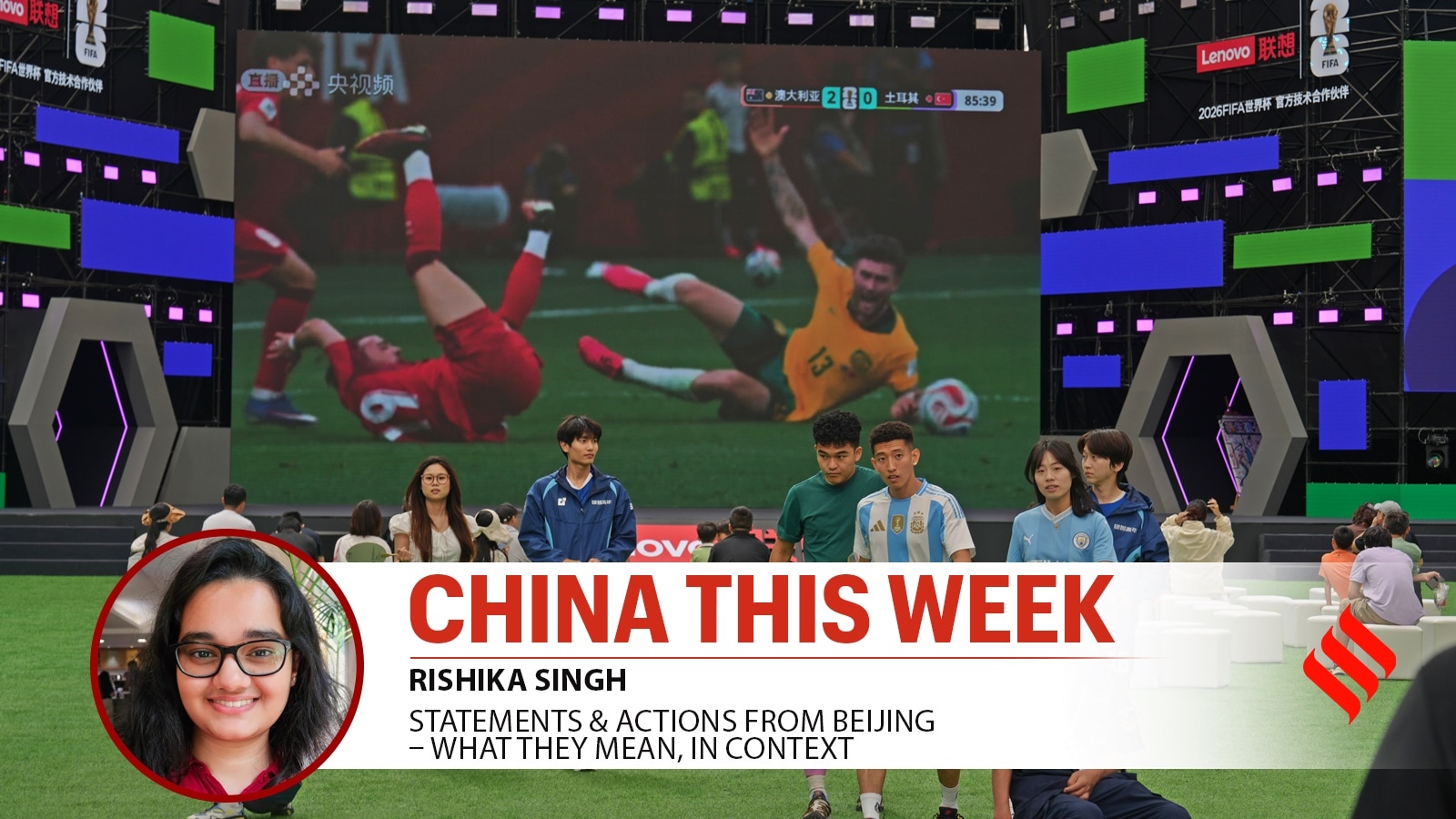
Next, the FIFA World Cup kicked off this week, and while China’s football team did not make the cut, its companies and products — including the mascots dressed up as the Labubu dolls — were hard to miss.
Two Labubu mascots popped up on the pitch for the opening ceremony of World Cup. pic.twitter.com/8LZ7CBAbgi
— Shanghai Daily (@shanghaidaily) June 12, 2026
We also covered the context and significance of Chinese President Xi Jinping’s first foreign visit this year to North Korea this week. Finally, we take a look at the Pentagon’s recent inclusion of major Chinese companies, including BYD and Alibaba, in an official list of “Chinese Military Companies” that led to criticism from the government.
Here is a closer look at these developments:
1. How China conducts the Gaokao
The examination is treated as among the most important parts of a Chinese student’s school life, determining whether they make it to one of the country’s elite colleges.
The South China Morning Post reported that “To ensure fairness, the gaokao is safeguarded by stringent security measures. Teachers who develop the exam questions are reportedly confined for about a month in secure facilities. The papers are often printed by high-security units, including prisons, where waste disposal and drainage systems are closely monitored to prevent leaks.” Satellite tracking and armed convoys are also deployed to track movement.
But that is not to say that errors are unheard of. For instance, it was discovered years later that 242 cases of identity theft took place in Shandong province between 2002 and 2009, where some students took the place of deserving candidates, according to the BBC. In 2018, two senior officials were fired over allegations of grades being manipulated in the exam.
In general, the exam faces charges of being manipulated to an extent by people from privileged families and living in better-off regions. By and large, the process has been well-functioning, but it puts immense pressure on students to perform.
UPSHOT: In China, the gaokao represents a unique opportunity for social mobility. In their book, The Highest Exam: How the Gaokao Shapes China (2025), authors Hongbin Li, Ruixue Jia and Claire Cousineau wrote, “The gaokao marks one of the few opportunities in China to prove your worth to society, and even more consequentially, to the government. In truth, few across China are left untouched by the country’s education system…”
Story continues below this ad
Consequently, the exam has also seen revisions aligned with state priorities. The Xinhua report said, “In 2025, 29 new undergraduate majors, including carbon neutrality science and engineering, low-altitude technology and engineering, and industrial software, were added to the national higher education catalog, while programs such as general marketing and Japanese language studies were phased out in many schools.”
Other new majors include “rare earth science engineering” and additional science and tech subjects.
2. China’s limited presence at FIFA World Cup
Despite being a key force on the global stage for years, with a dominant presence at international sporting events like the Olympics, China has not been conspicuously visible at football’s marquee event.
Its national football team last qualified in 2002, when Japan and South Korea co-hosted the World Cup. But in their absence, there are other Chinese linkages to the beautiful game, which is reported to enjoy a substantial following within the country.
Story continues below this ad
One is the presence of Chinese referee Ma Ning, who enjoys a large social media following and has attracted sponsorships from major Chinese brands, the BBC reported. The other, of course, is the Chinese brands themselves.
Global Times, a mouthpiece of the Chinese Communist Party, reported the imprint of Chinese manufacturing on the event in early June. It ranged from the Beijing-based retail company All Star Partner securing official licensing rights for multiple national teams to the Beijing-based Lenovo, the Official Technology Partner.
Then there is Hisense, whose technology will reproduce “every detail of the on-field action, which will assist Video Assistant Referees in making precise decisions and supporting high-quality event broadcasting.”
UPSHOT: Factors such as time zone have been cited for subdued buzz in China around the World Cup this year. Similar to India, it took a while for China Media Group, the parent organisation of state broadcaster China Central Television (CCTV), to agree to broadcast the event after weeks of uncertainty.
Story continues below this ad
But, as is often the case, China’s economic heft has ensured that even when it lacks a direct presence in any part of the world or a sector it has traditionally not held space in, it can still be a part of the game.
3. US deems BYD, Alibaba ‘Chinese Military Companies’
Earlier this week, the US Department of War added major Chinese companies — including e-commerce giant Alibaba, internet search engine Baidu and EV company BYD — to an official list of “Chinese military companies” operating directly or indirectly in the US.
China’s foreign ministry said the list “unreasonably suppressed” Chinese companies and urged the US to “correct its mistaken practices.” Chinese companies, too, criticised the move, denying such claims.
What is the basis of such inclusions, how does it affect their operations, and what does it say about the state of the larger US-China geopolitical competition? We answered those questions in an explainer earlier this week.
View original source — Indian Express ↗
Related stories

TechCrunch
TechnologyJun 14, 2026 · 1 min
As AI companies race to go public, who else is along for the ride?
TechCrunch

The Verge
TechnologyJun 14, 2026 · 1 min
Conclave is the sound of a NYC summer block party
The Verge

Daily Trust
TechnologyJun 14, 2026 · 1 min
UDUS Hosts International Conference on Media, AI and National Development
Daily Trust
Engadget
TechnologyJun 14, 2026 · 1 min
Anbernic now has a store page where you can buy replacement parts for its handhelds
Engadget