Indian Express
UPSC Essentials daily subject quiz : International Relations MCQs (Week 166) — Check out answers with explanations
UPSC Essentials brings to you its initiative of subject-wise quizzes. These quizzes are designed to help you revise some of the most important topics from the static part of the syllabus. Attempt today’s subject quiz on International Relations to check your progress.
🚨 Click Here to read the UPSC Essentials magazine for May 2026. Share your views and suggestions in the comment box or at [email protected]🚨
1. Two or more countries can file a joint nomination for an inscription in UNESCO’s Intangible Cultural Heritage List.
2. Sangha Trinational (TNS) is a transboundary conservation complex in North America.
3. Only natural sites and biodiversity reserves can be included in UNESCO’s Intangible Cultural Heritage List.
Which one of the following conclusions based on the above statements is correct?
(a) All three statements are correct.
(b) There are two correct statements, that include statement 1.
(c) There is only one correct statement.
(d) There is no correct statement.
Relevance: UNESCO lists—both World Heritage and Intangible Cultural Heritage—are among the most frequently asked international organisation topics in UPSC. Questions often test the distinction between tangible heritage, intangible heritage, biosphere reserves, and World Heritage Sites.
Explanation
Story continues below this ad
— To speed up the process of safeguarding heritage, the BRICS countries are deliberating on filing joint nominations for various UNESCO lists. In this line, India and China are in advanced stages of discussions over a joint nomination for ‘The Great Tang Records on the Western Regions’, a narrative of Chinese Buddhist monk and scholar Xuanzang’s travels through medieval India in the 7th century. Hence, statement 1 is correct.
— The proposal, led by China and to be supported by India, is presently under consideration with the Ministry of External Affairs, as per sources. China had earlier reached out through diplomatic channels to convey an interest in pursuing a joint nomination for an inscription in UNESCO’s Intangible Cultural Heritage List.
— Sangha Trinational (TNS) is a transboundary conservation complex in the North-western Congo Basin where Cameroon, the Central African Republic and the Republic of Congo meet. Hence, statement 2 is not correct.
— The Intangible Cultural Heritage List specifically recognizes living cultural heritage such as traditions, performing arts, rituals, festivals, craftsmanship, and traditional knowledge systems, not natural sites. Natural sites are covered under the UNESCO World Heritage List, which is a separate programme. Hence, statement 3 is not correct.
Therefore, option (c) is the correct answer.
(Other Source: whc.unesco.org)
QUESTION 2
Consider the following statements:
Story continues below this ad
1. The International Labour Organisation (ILO) launched the World Day Against Child Labour in 2002.
2. The Sustainable Development Goals adopted in 2015 do not include a global commitment to ending child labour.
3. The Marrakech Global Framework for Action against Child Labour provides a concrete roadmap and indicators for tackling child labour through integrated responses.
Which one of the following conclusions based on the above statements is correct ?
(a) There are two correct statements, that include statement 2.
Story continues below this ad
(b) There are two correct statements, that are statements 1 and 3.
(c) There is only one correct statement.
(d) All three statements are correct.
Relevance: The issue of child labour remains central to discussions on inclusive growth, human capital development, social justice, and labour reforms, making it an important area for UPSC. Conferences, declarations, and action frameworks adopted at international forums on labour rights are potential sources for statement-based Prelims questions.
Explanation
— The 6th Global Conference on the Elimination of Child Labour, held in Marrakech, emphasised the critical need to speed efforts and turn promises into tangible achievements. The Marrakech Global Framework for Action against Child Labour lays forth a realistic road map and indicators for combating child labour through integrated actions that address fundamental causes and respect every child’s rights. Hence, statement 3 is correct.
— The International Labour Organization (ILO) established World Day Against Child Labour in 2002 to draw attention to the global scope of child labour and the actions and efforts required to abolish it. Every year on June 12, governments, employers and workers organisations, civil society, and millions of individuals worldwide come together to highlight the situation of child labourers and what can be done to aid them. Hence, statement 1 is correct.
Story continues below this ad
— The Sustainable Development Goals (SDGs), which were endorsed by world leaders in 2015, include a renewed commitment to eliminate child labour. Specifically, target 8.7 of the Sustainable Development Goals calls on the global community to: “Take immediate and effective measures to eradicate forced labour, end modern slavery and human trafficking, and secure the prohibition and elimination of the worst forms of child labour, including recruitment and use of child soldiers, and by 2025 end child labour in all its forms.” Hence, statement 2 is not correct.
Therefore, option (b) is the correct answer.
(Source: http://www.un.org)
QUESTION 3
Which of the following countries borders the Gulf of Aden?
1. Yemen
2. Somalia
3. Egypt
4. Djibouti
Select the correct answer using the codes given below:
(a) 1 and 2 only
(b) 2, 3 and 4
(c) 3 and 4 only
(d) 1, 2 and 4
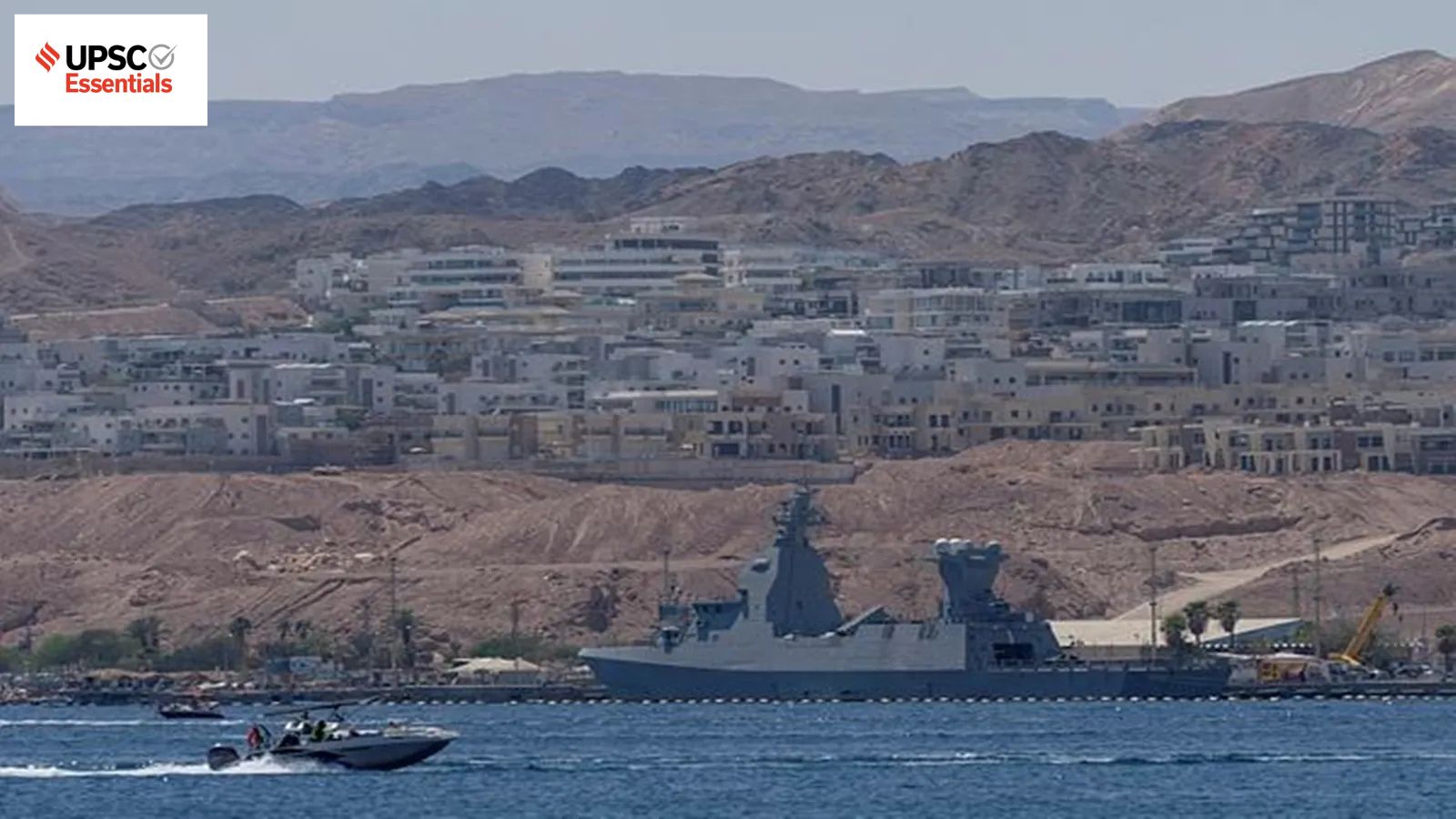
Relevance: It has been repeatedly in the news due to attacks on commercial shipping, naval deployments, anti-piracy operations, and regional conflicts involving West Asia and the Horn of Africa. UPSC can frame map-based questions on strategic chokepoints such as the Bab-el-Mandeb Strait, Strait of Hormuz, Suez Canal, and adjoining water bodies.
Explanation
— The Gulf of Aden is a strategically important sea body that connects the Arabian Sea to the Red Sea via the Bab el-Mandeb Strait.
Story continues below this ad
— Yemen, Somalia, Djibouti, and Eritrea border the Gulf of Aden. Yemen is located on the north coast, Somalia and Djibouti on the south coast, and Eritrea on the west coast.
Therefore, option (d) is the correct answer.
QUESTION 4
Consider the following statements:
1. This Island is located near Iran’s coast, handles more than 90 per cent of the country’s oil exports.
2. The Island hosts major storage facilities, export terminals and pipelines that connect to oilfields across the country.
3. The Island is located in the Persian Gulf.
The above-mentioned statements refer to:
(a) Kharg Island
(b) Qeshm Island
(c) Kish Island
(d) Lavan Island
Relevance: Iran-Israel tensions and concerns over disruption of oil supplies have brought Iran’s energy infrastructure into focus. The location links topics such as the Persian Gulf, Strait of Hormuz, West Asian geopolitics, and international energy trade—areas frequently covered in UPSC current affairs.
Explanation
Story continues below this ad
— Kharg Island, located less than 20 miles off Iran’s coast, handles more than 90 per cent of the country’s oil exports. Because much of Iran’s shoreline is too shallow for large tankers, crude is transported via pipelines to the island before being shipped abroad.
— The island is central to Iran’s economy. It hosts major storage facilities, export terminals and pipelines that connect to oilfields across the country. Much of Iran’s oil shipped from Kharg is believed to go to China.
(File Photo)
— Kharg Island’s proximity to Iran’s mainland puts it within range of missiles, drones and artillery. This would make both an invasion and any long-term occupation difficult.
— Kharg Island’s role in global oil supply means any disruption could have wider economic consequences. Tensions in the Persian Gulf often affect shipping routes, including the Strait of Hormuz, a key passage for global oil trade.
Story continues below this ad
— For countries like India, which imports a significant share of its oil from the region, any instability could lead to higher fuel costs and broader economic impact.
Therefore, option (a) is the correct answer.
QUESTION 5
Which of the following countries has decades-long experience with ethanol-blended fuels?
(a) Indonesia
(b) China
(c) Brazil
(d) Qatar
Relevance: India is expanding its ethanol blending programme to reduce crude oil imports and lower emissions. The country is cited as the most successful example of large-scale ethanol adoption, making it important for comparison with India’s energy transition efforts.
Explanation
— The Union government exempted higher ethanol-petrol blends (22%-30% ethanol) from central excise duty, putting their tax treatment on a par with the 20% ethanol blend (E20) that’s currently the standard at pumps. The government has also proposed amendments to recognise 85% ethanol-blended fuel and 100% ethanol fuel under the Central Motor Vehicles Rules.
— The government is looking to progressively increase ethanol blending in petrol from the current E20 level to E25, before transitioning towards flex-fuel vehicles and E85-E100 fuels.
— Brazil’s decades-long experience with ethanol-blended fuels may offer a template for how India could move forward.
— The South American country has widely adopted flex fuel vehicles, driven by government mandates, price incentives for consumers, clear guidance for automakers and robust public awareness campaigns.
Therefore, option (c) is the correct answer.
Previous Daily Subject-Wise-Quiz
Daily Subject-wise quiz — History, Culture, and Social Issues (Week 157)
Daily subject-wise quiz — Polity and Governance (Week 166)
Daily subject-wise quiz — Science and Technology (Week 166)
Daily subject-wise quiz — Economy (Week 166)
Daily subject-wise quiz — Environment and Geography (Week 166)
Daily subject-wise quiz – International Relations (Week 165)
Subscribe to our UPSC newsletter and stay updated with the news cues from the past week.
Stay updated with the latest UPSC articles by joining our Telegram channel – IndianExpress UPSC Hub, and follow us on Instagram and X.
View original source — Indian Express ↗
Related stories

TechCrunch
TechnologyJun 14, 2026 · 1 min
As AI companies race to go public, who else is along for the ride?
TechCrunch

The Verge
TechnologyJun 14, 2026 · 1 min
Conclave is the sound of a NYC summer block party
The Verge

Daily Trust
TechnologyJun 14, 2026 · 1 min
UDUS Hosts International Conference on Media, AI and National Development
Daily Trust

Engadget
TechnologyJun 14, 2026 · 1 min
Anbernic now has a store page where you can buy replacement parts for its handhelds
Engadget