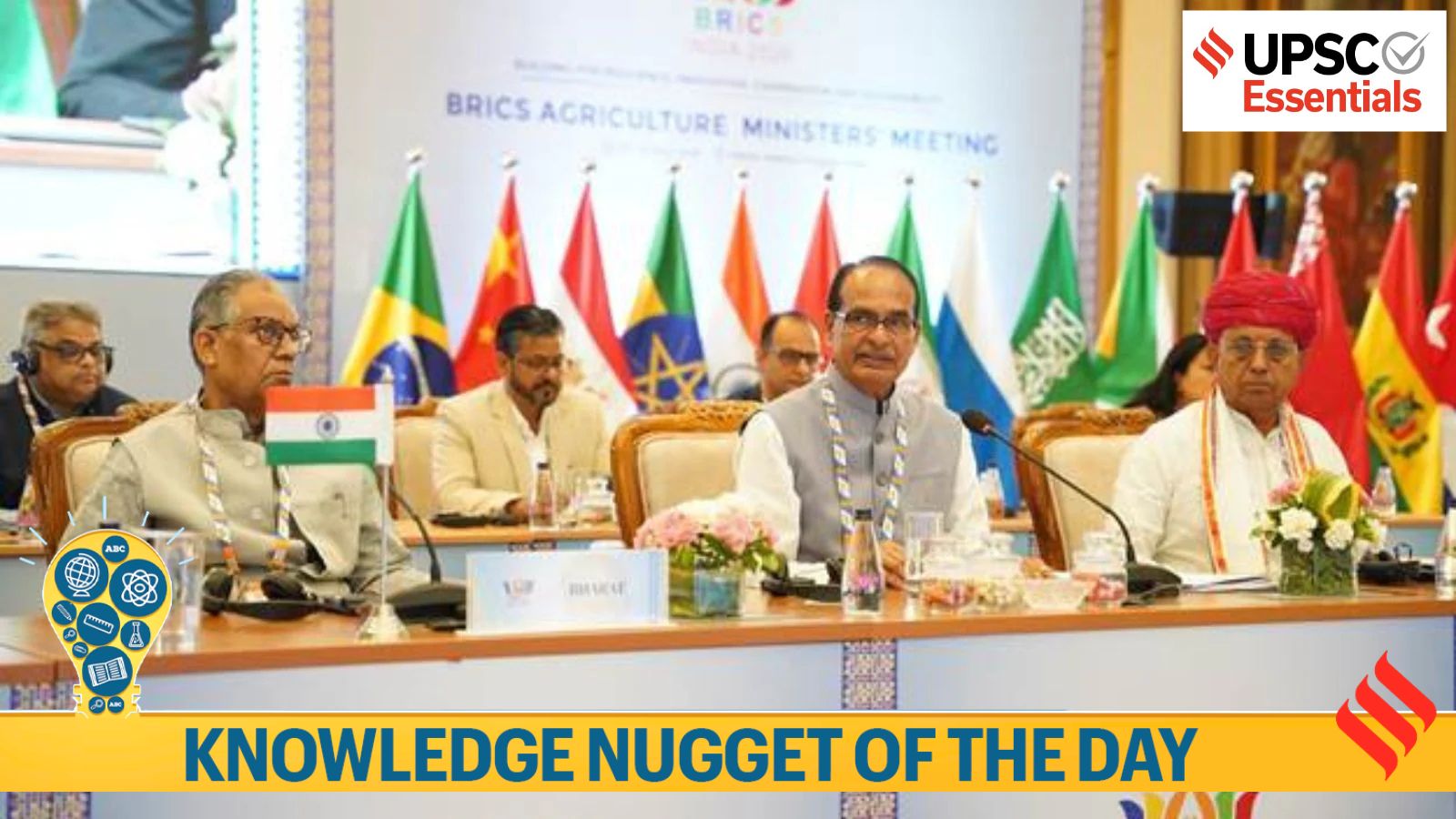
Knowledge Nugget | BRICS adopts Indore Declaration: What are 4 priorities and 4 new initiatives?
Take a look at the essential events, concepts, terms, quotes, or phenomena every day and brush up your knowledge. Here’s your UPSC Current Affairs knowledge nugget for today on the BRICS Indore Declaration.
(Relevance: India assumed the presidency of the BRICS bloc on January 1, 2026, succeeding Brazil. UPSC has asked several questions related to BRICS. In 2016, a question was asked about the New Development Bank initiative, and in 2015, a question focused on the ‘Fortaleza Declaration.’ UPSC Mains has also featured questions on BRICS. Therefore, it is important to know about the new developments around the BRICS.)
With Agriculture Minister Shivraj Singh Chouhan asserting that the farmer was at the centre of all deliberations, the ‘BRICS Indore Declaration’ was unanimously adopted on Sunday (June 15). Meanwhile, the BRICS Urbanisation Forum concluded in Delhi on June 12. Addressing a press conference, Housing and Urban Affairs Minister Manohar Lal said that BRICS countries had accepted India’s proposal to establish a BRICS Urban Research and Knowledge Network.
In this context, let us know the key highlights of the BRICS Indore Declaration and India’s proposed BRICS Urban Research and Knowledge Network.
Key Takeaways:
1. The BRICS Agriculture Ministers and officials-level meetings held in Indore in which the ‘BRICS Indore Declaration’ was unanimously adopted to provide new direction to food security, farmer welfare, climate-resilient farming, agricultural trade and digital agriculture.
2. Union Minister for Agriculture and Farmers’ Welfare, and Rural Development said that the farmer is at centre of this declaration— the shared commitment to advance food security, nutrition, livelihoods, agricultural trade, innovation, investment, climate-resilient farming and sustainable agricultural development by keeping the farmer at the centre has been recorded in this declaration.
3. The Agriculture Minister informed that the focus of the ‘Indore Declaration’ is the farmer; this declaration records a shared commitment to advance food security, nutrition, livelihoods, agricultural trade, innovation, investment, climate-resilient farming, and sustainable agricultural development with the farmer at its centre.
Story continues below this ad
Agriculture Minister Shivraj Singh Chouhan at the BRICS Agriculture Ministers and officials-level meeting in Indore. (Source: PIB)
4. Four priorities: The declaration has been adopted amid ongoing geopolitical tensions and focuses on four main priorities: Farmers, food security, climate and technology.
Do you Know?
BRICS countries represent nearly half of the world’s population, possess about 42 per cent of global agricultural land and contribute nearly 42 per cent to world foodgrain production.
5. Four Institutional initiatives: Separately, four institutional initiatives have also been proposed. It includes:
(i) Centres of Excellence on Agro-Ecology and Regenerative Agriculture: Establishing a BRICS Network of Centres of Excellence on Agro-Ecology and Regenerative Agriculture will birth a platform for joint research, experience sharing and capacity building on natural, organic and regenerative agricultural practices, through which member countries will learn from each other’s best practices and promote climate-resilient and sustainable agricultural systems, Chouhan said.
— Notably, in India, the Indian Institute of Farming Systems Research, Modipuram, has been given an important role as a Centre of Excellence on natural farming under this network, which will make contributions in joint research, knowledge sharing and training.
Story continues below this ad
(ii) BRICS Network on Digital Agriculture: The second major initiative is the BRICS Network on Digital Agriculture, which will give new direction to cooperation in the fields of artificial intelligence, geospatial technology, digital public infrastructure and data-based agricultural solutions. IIT Delhi in India will coordinate this network.
(iii) Global Forum on Farmers’ Rights in Seed Systems: The third announcement is related to the setting up of the Global Forum on Farmers’ Rights in Seed Systems, which will protect farmers’ seed rights, the diversity of indigenous seeds and traditional knowledge.
(iv) BRICS AgriN (Agro Input, Genetic Resources and Information Network): The fourth initiative is the BRICS AgriN. This will strengthen cooperation among member countries in areas of agricultural inputs, seeds and genetic resources.
— Chouhan said this network will promote information exchange, capacity building, technical cooperation and partnerships so that information about best varieties, genetic resources and inputs available in different countries can be shared and practical solutions can be developed.
Story continues below this ad
BRICS Urban Research and Knowledge Network
1. The BRICS Urbanisation Forum concluded in Delhi. The Housing and Urban Affairs Minister Manohar Lal said the BRICS countries had accepted India’s proposal to set up a BRICS Urban Research and Knowledge Network.
2. The Network has been designed as a Chairship-led, institutionally connected platform to provide a practical and sustained mechanism for urban cooperation within BRICS.
3. It will support systematic knowledge-sharing and mutual learning, while helping bridge the gap between policy and implementation through the exchange of practical solutions, city-level experiences and operational lessons.
4. Operating through a virtual, low-cost and flexible model, the Network will be coordinated each year by the lead institution of the BRICS Chair country, with activities and outputs handed over to the next Chairship.
Story continues below this ad
BEYOND THE NUGGET: BRICS and New Development Bank
1. BRICS stands for Brazil, Russia, India, China, and South Africa, the original five members who were large, non-Western economies. In 2025, Indonesia officially joined the BRICS as a full member taking total membership to 10. Egypt, Ethiopia, Iran, and the United Arab Emirates are also part of the bloc. The organisation now represents almost half the world’s population and almost one-quarter of the world’s economy. Saudi Arabia has been invited to join.
2. The acronym BRIC was first used in 2001 by Goldman Sachs in their Global Economics Paper, ‘The World Needs Better Economic BRICs’. The paper projected that Brazil, Russia, India, and China would be among the world’s largest economies in the next 50 years or so.
3. As a formal grouping, BRIC started after the meeting of the leaders of Russia, India and China in St. Petersburg on the margins of the G8 Outreach Summit in 2006. The grouping was formalised during the first meeting of BRIC Foreign Ministers on the margins of the UNGA in New York in 2006.
4. The first BRIC Summit was held in Yekaterinburg, Russia, in 2009. It was decided to include South Africa at the BRIC Foreign Ministers’ meeting in New York in 2010, and accordingly, South Africa attended the 3rd BRICS Summit in Sanya, China, in 2011.
Story continues below this ad
5. The New Development Bank (NDB) is a multilateral development bank established by BRICS countries. The idea of setting up NDB was first conceived in 2012 during the BRICS Summit in New Delhi, India. The agreement to establish it was signed on July 15, 2014, and became operational on July 21, 2015, during the BRICS Summit held in Fortaleza. This is known as the Fortaleza Declaration.
Post Read Question
The ‘Fortaleza Declaration’, recently in the news, is related to the affairs of (UPSC CSE 2015)
(a) ASEAN
(b) BRICS
(c) OECD
(d) WTO
Answer Key
(b)
(Sources: BRICS Indore Declaration adopted keeping ‘farmer at centre’: Agri Minister Shivraj Singh Chouhan, Planning of cities should be for the people: Minister Manohar Lal)
🚨 Click Here to read the UPSC Essentials magazine for May 2026. Share your views and suggestions in the comment box or at [email protected]🚨
Story continues below this ad
Subscribe to our UPSC newsletter. Stay updated with the latest UPSC articles by joining our Telegram channel – Indian Express UPSC Hub, and follow us on Instagram and X.
View original source — Indian Express ↗
Related stories

NTA Cancels Internet License of Simple Media Network Over Failure to Renew on Time
Meta lobbies Congress for protection from child-harm lawsuits

As Malta Tightens The Rules On Short Lets, Owners Need To Level Up Or Be Left Behind