The Next Web
LinkedIn just produced its most unlikely success story: a World Cup footballer
TL;DR
Roberto ‘Pico’ Lopes, a Dublin-born Shamrock Rovers defender, was scouted for Cape Verde’s national team via a LinkedIn message he initially dismissed as a prank. He started in Cape Verde’s first ever World Cup match on 15 June 2026, a 0-0 draw with Spain in Atlanta. The story highlights how a platform built for white-collar networking produced football’s most unlikely international call-up.
Most LinkedIn messages lead to sales pitches, recruiter spam, or polite rejections. Roberto ‘Pico’ Lopes got a World Cup call-up.
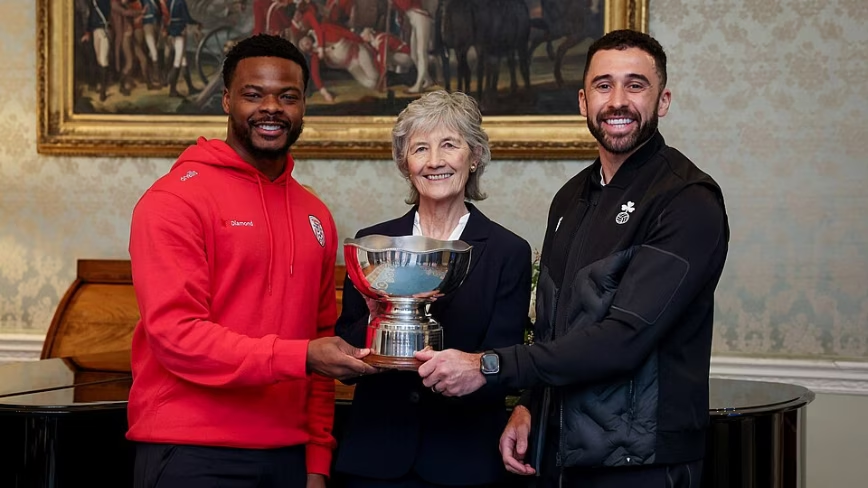
The Dublin-born Shamrock Rovers defender made history on Monday when he started for Cape Verde against Spain in the country’s first ever World Cup match, a Group H clash at Mercedes-Benz Stadium in Atlanta. Cape Verde held the European champions to a stunning 0-0 draw.
The message he almost deleted
In 2019, former Cape Verde coach Rui Aguas discovered that Lopes had a Cape Verdean father and sent him a LinkedIn message in Portuguese. Lopes ignored it, assuming it was spam.
The 💜 of EU tech
The latest rumblings from the EU tech scene, a story from our wise ol' founder Boris, and some questionable AI art. It's free, every week, in your inbox. Sign up now!
Nine months later, Aguas tried again, this time in English. “I grew up in an era of prank phone calls and prank messages so I was always a bit sceptical,” Lopes told the Irish Mirror.
Curiosity eventually won out. Lopes translated the original message and found a genuine international call-up waiting in his inbox.
It is widely believed to be the first time a LinkedIn message has led to a World Cup squad selection. The claim is inherently difficult to verify as a universal first, but no contradicting precedent has surfaced in reporting from the BBC, FIFA, or Sky Sports.
From mortgage desk to centre-back
Before football became his full-time job, Lopes worked as a mortgage adviser at a bank in Blanchardstown, Dublin. He played part-time for Bohemians, a League of Ireland club that could not offer professional contracts.
The turning point came when Glenn Cronin, a former Bohemians teammate who had joined Shamrock Rovers’ coaching staff, invited Lopes for a coffee with head coach Stephen Bradley. Bradley, who had taken charge in 2016, offered Lopes a full-time professional deal, a rarity in Irish football at the time.
“I’ve always wanted to be a professional footballer since I was a young boy,” Lopes said. “This was the opportunity for me.”
The irony is not lost on Lopes. Had he never gone to college, he would never have set up a LinkedIn account, and the Cape Verde call-up would never have reached him.
Social media has reshaped recruitment across industries, but football scouting still relies on agents, academy pipelines, and match footage. LinkedIn sits at the bottom of that list, which is precisely what makes this story so unusual.
A platform built for offices, repurposed for pitches
LinkedIn has more than a billion registered users, and its algorithms are increasingly scrutinised for how they handle user data. The platform was designed for white-collar networking, not for identifying centre-backs in the League of Ireland.
Yet Aguas used it the way any hiring manager would: he searched for a candidate, checked the profile, and sent a cold outreach message. The difference is that the “role” was representing a country at international level, and the candidate thought it was a joke.
The 2026 World Cup is steeped in technology, from Google Gemini-powered fan experiences to biometric ticketing. But the tournament’s most compelling tech story may be the simplest: a cold message on a professional networking site that changed a man’s life.
Cape Verde’s fairytale run
Cape Verde, ranked 67th in the world, qualified for the tournament by winning its qualifying group ahead of Cameroon. The island nation of roughly 600,000 people had never previously appeared at a World Cup.
Lopes, now 33, has become a mainstay of the squad since his 2019 debut. He has represented Cape Verde at two Africa Cup of Nations tournaments, in 2021 and 2023, helping the team reach the quarter-finals in the latter.
His family, including his wife, baby son Diego, his Irish mother, and Cape Verdean father Carlos, travelled to Atlanta for the match. Cape Verde still faces Uruguay and Saudi Arabia in Group H.
“This opportunity to play for the national team gave me the opportunity to learn more about the culture and my identity,” Lopes said. “I’ve loved every minute of it.”
The tech powering this World Cup includes robot dogs, AI-driven sports broadcasting, and hunter drones. But none of that is what fans will remember from Cape Verde’s debut: they will remember the defender from Dublin who got scouted on LinkedIn.
View original source — The Next Web ↗
Related stories
ABC News
TechnologyJun 15, 2026 · 1 min
'Ecosystem engineers' returned to desert decades after local extinction
ABC News

South China Morning Post
TechnologyJun 15, 2026 · 1 min
EU carbon tariff sows havoc in China as steel firms grapple with ‘absurd’ rules
South China Morning Post
TechRadar
TechnologyJun 15, 2026 · 1 min
Quote of the day by Apple CEO Tim Cook: 'If you put a key under the mat for the cops, a burglar can find it, too'
TechRadar
TechRadar
TechnologyJun 15, 2026 · 1 min
'AI will probably most likely lead to the end of the world, but in the meantime, there’ll be great companies'
TechRadar