Times of Israel
Touting ‘Less Oy, More Joy,’ UK Jewish Culture Month celebrates Jewish creators others shun
LONDON — Stepping quietly into the brightly lit hall of the Victoria and Albert Museum’s Photography Centre on an unusually sunny London day, dozens of visitors followed a curator through a display dedicated to American photography — possibly the largest such public collection outside the United States.
The group stopped beside one iconic photo after another, by artists such as Diane Arbus, Alfred Stieglitz, Joel Meyerowitz, Simon Leonard Stein and many others — all of them Jewish.
Like many other British cultural venues, the Victoria and Albert Museum hadn’t created a special display for the UK’s first Jewish Culture Month, but crafted tours and talks around existing exhibits, many of which feature contributions by Jewish creators.
“We were pleasantly surprised by the willingness of prominent establishments to take part in the project; they understood its importance,” said Liat Rosenthal, director of culture, education and communities at the Board of Deputies of British Jews, a cross-communal umbrella body representing the Jewish community in the UK, which is behind the initiative.
The Board of Deputies branded Jewish Culture Month as an attempt to bring “Less Oy, More Joy,” hoping not only to empower the Jewish community and its creatives, but also to expose the wider public to Jewish life, history and cultural contributions beyond the grim themes of the Holocaust and antisemitism.
Get The Times of Israel's Daily Edition
by email and never miss our top stories
By signing up, you agree to the terms
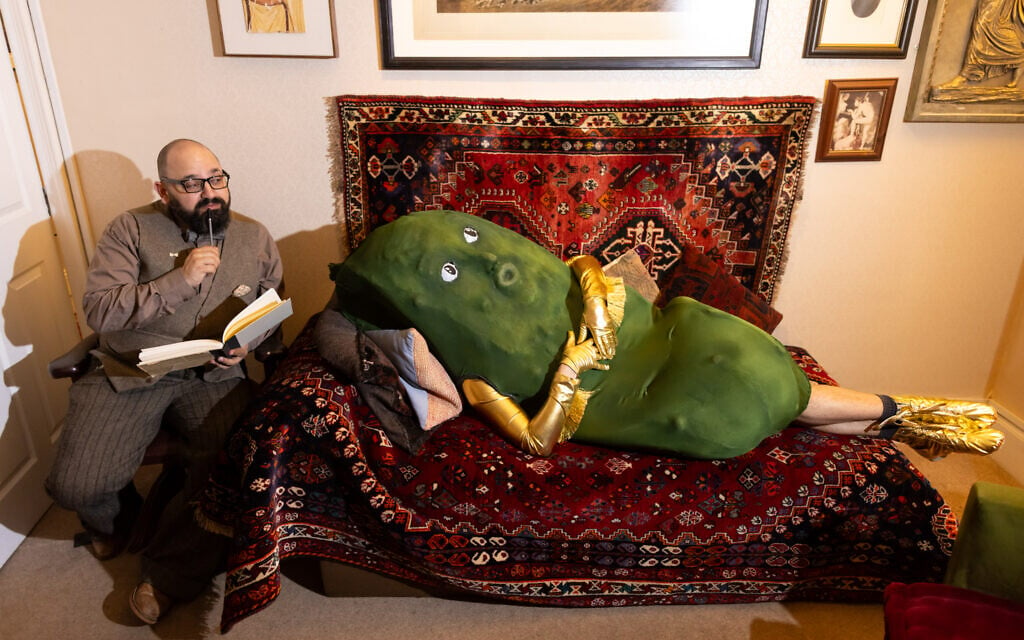
With over 100 events across the UK, ranging from heritage tours, food fairs and music concerts to one giant green gherkin mascot — Mr. Pickle, who roamed major London landmarks — the festival has run from mid-May to mid-June, coinciding with the Hebrew month of Sivan.
“It is a real celebration of British Jewish culture in all its different forms. We think that at this point in time, it is remarkably important that in the UK we show a very proud, open and bold vision of what it means to be Jewish. There is so much pride to take in and so much to celebrate,” Rosenthal said.
But it is impossible to ignore the “oy” in the room, as an unprecedented surge in antisemitism casts a heavy pall over the local Jewish community. Jewish Culture Month events, some under heavy security, have taken place with the community reeling from a recent wave of antisemitic and anti-Israel activity in Britain — including beatings, stabbings, arson and deadly terror attacks, along with increasingly visible hate speech and vandalism.
The nonprofit Community Security Trust reported that 3,700 antisemitic incidents were recorded targeting the community of 290,000 last year.
“Based on the Home Office data from the end of last year, Jews are now 10 times more likely than any other faith group to be victims of a hate crime. I imagine that that figure has deteriorated in recent months, it’s far worse now,” said Stephen Silverman, director of investigations and enforcement at the UK-based nonprofit Campaign Against Antisemitism. “We’re all now waiting for the next terrible thing to happen. We don’t feel that it’s a case of if, it’s a matter of when.”
But, said Rosenthal, there is also a subtler form of antisemitism taking hold in Britain’s cultural sphere in the wake of the bloody October 7, 2023, Hamas invasion of southern Israel and subsequent war in Gaza.
“We wouldn’t have come up with this initiative otherwise; it is our response,” she said.
Rosenthal’s appointment in 2025 as the Board of Deputies’ first-ever director of culture in the organization’s 260-year history perhaps reflects the urgency with which the Jewish community is taking on this cultural battle. Rosenthal, who is known for her former role as a senior creative producer at Tate Modern, also founded Artists Against Antisemitism UK, a public campaign to combat antisemitism in the arts.
“Antisemitism has affected Jewish creative practitioners from all walks of life,” she says.
Singled out and blacklisted
Some of the post-October 7 antisemitic incidents in the art world have made headlines, as performances and exhibitions have openly featured antisemitic and anti-Israel content, while Jewish and Israeli creators have been singled out and blacklisted.
Last spring, in the music industry alone, chants of “Death to the IDF” by the punk-rap duo Bob Vylan shook the Glastonbury Festival and were broadcast live on the BBC, while venues canceled gigs by the British-Jewish klezmer dance band Oi Va Voi after activists protested against them for being a Jewish band with an Israeli singer.
But much of the cultural antisemitism remains behind the scenes. Lucy, who asked that her last name be withheld over fears of repercussions, is a prominent ceramic artist who has exhibited her work in leading venues such as the Royal Academy. She says that post-October 7 antisemitism changed everything.
“I had an agent who showed my work in many places and sold a lot of it; we had a great relationship. In 2024, we planned to present in a huge art fair in Europe,” Lucy said. “But then she called me out of nowhere, asking about Israel-Palestine, and what is to be Jewish at the moment. I thought she might care. But then she said it is a ‘commercial risk’ to present my work, because people might not buy it because I am Jewish.”
Lucy’s art, at the time, wasn’t visibly Jewish. The agent noted that she’d realized Lucy is Jewish because she posted a photo on her social media of her car being vandalized with swastikas a few months earlier.
“I was in shock. This is a racism. Would she say it to a Black artist?” Lucy said. “We had another conversation and she went full on, started to talk about Israel having a disproportionate response, talking about ‘You people, you in the media,’ saying randomly, ‘Ausch, Ausch — how is it called? Auschwitz?’”
Lucy cut ties with that agent, and since then her work has expressed more Jewish themes and explored the struggle with antisemitism. She also notes that Jewish British artists “are looking for each other, going to each other’s exhibitions and creating a different sense of community. People are really reconnected with their Jewish identity.”
Silverman said that Campaign Against Antisemitism advocates for Jewish artists who face discrimination.
“There is a definite effort to drive Jews — not Zionists — out of all manner of spaces. If it continues in this way, eventually you’re going to effectively create ghettos outside of which Jews aren’t safe,” he said.
Silverman said that if artists are not known to be Jewish, “they keep quiet about it because they don’t want to be shunned and excluded, and end up with the kind of treatment that Maureen Lipman gets.”
Lipman, a prominent Jewish-British actress who has been vocal about antisemitism and openly supported Israel, has faced harassment by activists and recently revealed that she had to hire private security for her 2026 stage tour.
Jewish Culture Month has had its challenges, as well. The British Museum had to abruptly cancel a talk titled “Ancient Israel and Judah in the British Museum,” which was designed to look at history and archaeology through the museum’s collection, the day before the lecture. The museum discovered that up to half of registered ticket holders were anti-Israel activists planning to disrupt the event.
But the attempt may have backfired. The story was widely publicized, and the lecture was rescheduled, as well as broadcast online. The lecture became the single most-attended event of the entire Jewish Culture Month, attracting more than 5,000 attendees online alone.
“The success of Jewish Culture Month at the British Museum highlights the enduring power of culture to ignite curiosity and bring people together,” said Rosenthal.
“Audiences embraced the opportunity to delve into stories of ancient kingdoms, peoples and lands, discovering how the history of Jewish communities has shaped our understanding of the world,” she said. “We hope that the Jewish Culture Month will become an annual event.”
View original source — Times of Israel ↗
Related stories
Times of Israel
EntertainmentJun 6, 2026 · 1 min
Despite antisemitic controversy, thousands attend Kanye West concert in Netherlands
Times of Israel
Antara News
NewsJun 5, 2026 · 1 min
Indonesia, Uruguay mark 60 years of ties with "Panoramica" exhibition
Antara News
Times of Israel
EntertainmentJun 9, 2026 · 1 min
Dave Matthews says his criticism of Israel shouldn’t be ‘twisted’ into antisemitism
Times of Israel
Times of Israel
PoliticsJun 8, 2026 · 1 min
John Lithgow wins Tony for portraying antisemitic author Roald Dahl in ‘Giant’
Times of Israel