Indian Express
UPSC Key: G7 summit in France, Telegram ban and Mohenjo-daro ‘Dancing Girl’
Preliminary Examination: Current events of national and international importance
Mains Examination: General Studies-II: Bilateral, regional and global groupings and agreements involving India and/or affecting India’s interests
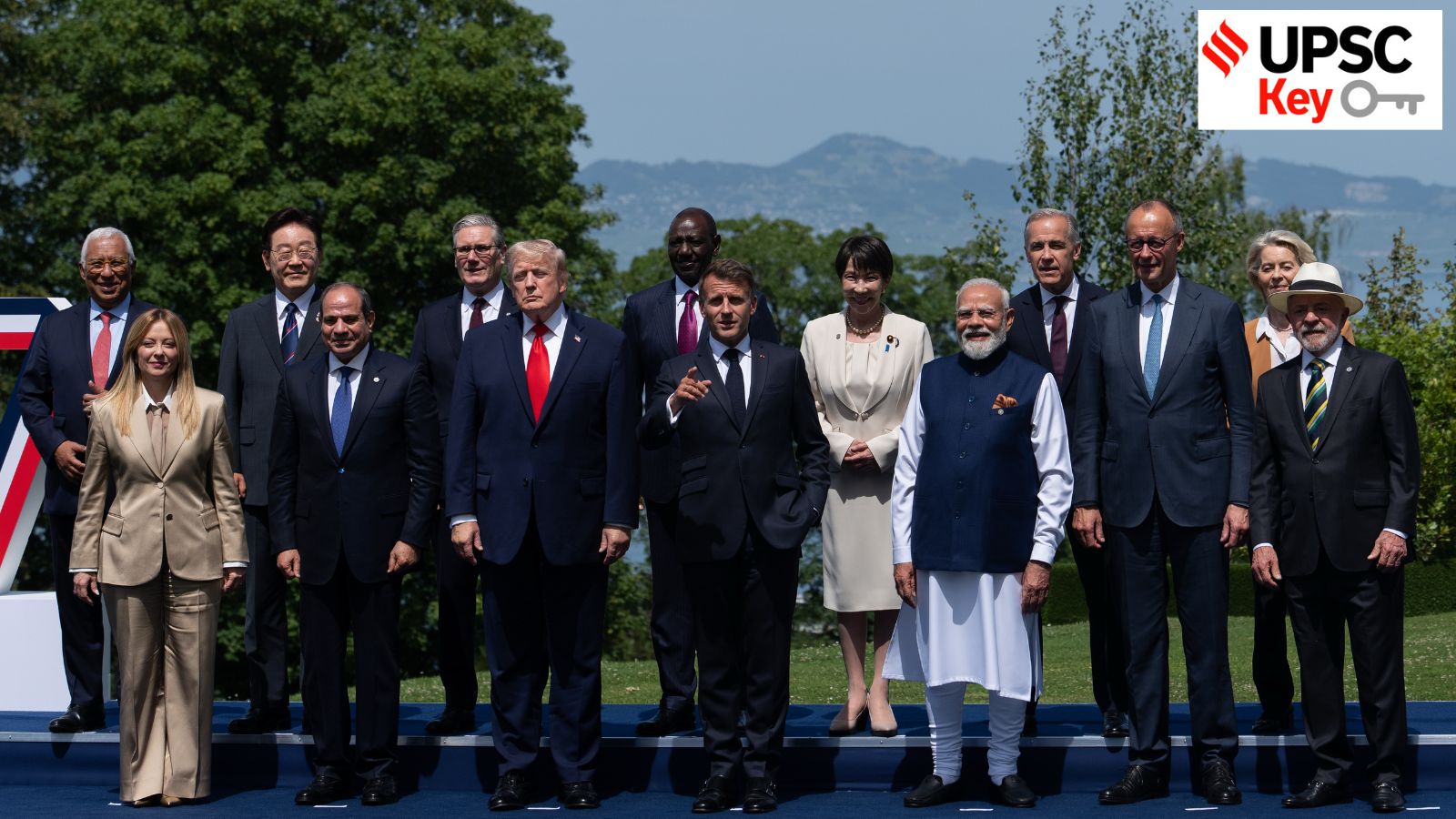
What’s the ongoing story: Underlining that “mutual trust is the most important strategic asset today” and that the world “suffers from a shortage of trust”, Prime Minister Narendra Modi Tuesday told leaders of the G7, including US President Donald Trump, that the “future of our partnerships depends on rebuilding this trust”.
Key Points to Ponder:
— Know about the G7 summit and its history
— Which countries are members of the G7?
— What is India’s status with G7 countries?
— What is the significance of G7 for India?
— What are the challenges faced by Indian seafarers? What is the recent issue?
— What is rule-based international order?
— What is the Indian Ocean Rim Association (IORA)?
Key Takeaways:
— Welcoming efforts to end the crisis in West Asia, Modi, while addressing the leaders at the summit in Evian-les-Bains in eastern France, flagged the issue of the Strait of Hormuz and the death of Indians, including seafarers, in the conflict.
— At least 13 Indians, including three seafarers, have died in separate incidents over the last three and half months.
— “International partnerships and global solidarity become meaningful only when we address shared challenges together. India firmly believes that lasting solutions to the tensions and conflicts unfolding in various parts of the world can only be achieved through dialogue, diplomacy, and international cooperation,” Modi said.
— He made these remarks at the summit where he met Trump, their first face-to-face encounter since their meeting at the White House in February 2025 – the two leaders have spoken several times over the phone in the last 16 months.
— The G7 meeting is taking place at a time when the US and Iran have agreed on a deal to end the war in West Asia – the crisis and the near-closure of the Strait of Hormuz has impacted global energy supplies and economy.
From the Nation page: At G7 meet, Carney invites Modi to visit Canada; both vow to strengthen relations
— A year after they began the reset of ties at the G7 Summit in Canada, Prime Minister Narendra Modi met Canadian Prime Minister Mark Carney on the sidelines of the G7 Summit in Evian, France, on Tuesday. They agreed to strengthen cooperation in defence, information security and energy.
— Carney also invited Modi to visit Canada by the end of the year, as the two sides are working on signing the Comprehensive Economic Partnership Agreement (CEPA).
— Modi expressed India’s support for Canada becoming a Dialogue Partner of the Indian Ocean Rim Association (IORA), it said. They announced the establishment of Raisina Americas as a platform to further strengthen dialogue, exchanges and cooperation.
From the Editorial Page: India’s challenge lies in navigating not between West and rest, but within West
— C. Raja Mohan writes: Narendra Modi’s participation in the G7 summit at Évian this week marks India’s 13th appearance at the forum and the Prime Minister’s seventh in a row since 2019.
— That India is a regular invitee reflects a deepening mutual engagement, rooted in the country’s economic transformation since the 1990s and its growing salience in the international system.
— Today, the G7 is the principal destination of Indian exports, absorbing nearly a third of the country’s merchandise shipments. Most of India’s service exports also go to the G7.
— It is also the main destination for the outward flow of Indian professionals and students; a more restrictive America since Donald Trump’s re-election as president has merely redirected some of those flows to Europe.
— Despite the rhetoric about building a new global economic order with Russia and China, India’s economic diplomacy in recent years has been less about BRICS than about deepening ties with the developed West through trade liberalisation.
— India’s quest for diversification is now less between the West and BRICS than within the West — it is marked by a new determination to deepen ties with Europe, the UK and Canada in the G7.
— India’s real challenge today comes from rapid and unexpected change within the West itself. Three trends stand out. The first is the rise of American unilateralism under Trump.
— Contrary to the popular notion of American decline, the US has grown stronger relative to its Western allies over three decades.
— Third, Trump is recasting not only the internal balance of the West but the terms of its engagement with Russia and China. In pursuit of a grand bargain with Tehran, he has strained the alliance with Israel; in South Asia, he is talking up Pakistan.
— The task of Indian diplomacy is to manage these changes with patience and calm. The answers are only partly external; most lie at home — in restructuring the economy, modernising the defence industrial base, revitalising the technological ecosystem.
— China’s leaders are no longer invited to the G7, yet they loom large over it: A central question at Évian is how to manage the global imbalances produced by China’s export juggernaut.
— Where many in Delhi’s foreign policy community see an irreconcilable contradiction between the pursuit of strategic autonomy and partnership with the West, China demonstrated the art of transcending it — and against far steeper odds.
— The Korean War of 1950-53 cost hundreds of thousands of Chinese lives, yet within two decades, Mao Zedong was befriending Washington. It is that cold realism that separates China’s hard-headed strategy from the perpetually prickly and anxious Indian foreign policy discourse.
Do You Know:
— The Maritime Labour Convention (MLC) defines a seafarer as “any person who is employed or engaged or works in any capacity on board a ship to which this Convention applies”.
— The Group of 7 (G7) is an informal group of seven countries that consists of the United States, Canada, France, Germany, Italy, Japan, and the United Kingdom. Together these countries represent 40% of global GDP and 10% of the world’s population.
— It has no legal existence, permanent secretariat or official members. There is no binding impact on policy, and all decisions and commitments made at G7 meetings need to be ratified independently by the governing bodies of member states.
— The international order based on the rules enshrined in the United Nations Charter of 1945 is referred to as the rules-based international order. It was established to overcome the gravest consequences of traditional power politics, evident in the devastation of the Second World War, and is based on principles like sovereignty, self-determination, multilateralism, and international law.
Other Important Articles Covering the same topic:
📍Who protects seafarers at sea? Understanding maritime governance and international laws
📍Knowledge Nugget: G7 summit in Canada — Historical evolution and importance for UPSC
UPSC Prelims Practice Question Covering similar theme:
(1) With reference to the G7, consider the following statements:
1. It is a formal grouping of advanced democracies that meets annually to coordinate global economic policy and address other transnational issues.
2. The presidency of G7 meetings is held by each of the seven countries in turn, along with the European Union.
Which of the statements given above is/are correct?
(a) 1 only
(b) 2 only
(c) Both 1 and 2
(d) Neither 1 nor 2
Govt bans Telegram until June 22 in bid to ‘secure’ NEET retest
Syllabus:
Preliminary Examination: Current events of national importance.
Mains Examination: General Studies-II, III: Government policies and interventions, Awareness in the fields of IT.
What’s the ongoing story: The Government Tuesday temporarily blocked Telegram, a popular messaging application, until June 22, after the platform’s “non-responsiveness” in aiding the ongoing probe into the May 3 NEET-UG paper leak and for curbing the spread of fraudulent claims of access to the June 21 re-examination paper by handles on the platform, The Indian Express has learnt.
Key Points to Ponder:
— Know about the Telegram app.
— What are the key benefits of social media?
— What are the perils of social media use?
— How is social media regulated in India?
— What is Section 69A of the Information Technology Act, 2000?
— How can the Government block apps and websites in India?
— What are Virtual Private Networks (VPNs)?
— What are the content blocking mechanisms in India?
— What are the challenges associated with imposing age-based restrictions on social media?
— What measures can be adopted to ensure effective and balanced regulation of social media in India?
Key Takeaways:
— Telegram is among the most popular personal messaging applications in the country, with an estimated 150 million users, behind only Meta’s WhatsApp, which has over 500 million users.
— Pavel Durov, founder of the Telegram messaging app, said that by temporarily banning Telegram in the country, the Indian authorities have “punished” over 150 million ordinary users in India.
— The Ministry of Electronics and IT (MeitY) carried out the action under Section 69A of the IT Act at the behest of the National Testing Agency. It also directed the company to disable, in India, its message-editing feature in respect of messages already posted on the platform until June 30, to address “the specific structural feature through which the platform has been used to fabricate after-the-event ‘paper leak’ evidence in respect of national examinations”.
— The Telegram app can, however, be used through a connection over a virtual private network (VPN).
— On why action was necessitated against only Telegram, NTA Director General Abhishek Singh told The Indian Express that the platform was not taking any “proactive action” to deal with channels claiming to provide access to the question paper. “We were playing cat-and-mouse,” he said about the NTA’s efforts to report channels claiming to have access to the NEET-UG question paper.
— In a statement, the NTA said over the last few weeks, Telegram channels operating openly on the platform demanded sums ranging from a few thousand to several lakhs of rupees from candidates and their families, in exchange for purported access to the re-examination paper.
— As per the NTA, some of these channels were openly advertising their purpose through their names: “PAPER LEAKED NEET”, “Re-NEET 2026”, “Private Mafia”, and “REE NEET MAFIAA”. It clarified that no such papers were available “outside the secured examination chain,” it added.
— According to the testing agency, the message-editing feature on Telegram, in its present form, permits a channel administrator to edit the content of a previously posted message – including the substitution of attached files such as PDFs – while the original send-time stamp is retained.
Do You Know:
— Currently, there are two parallel content blocking mechanisms in India. One is under Section 69 (A) of the IT Act, through which content that violates national security, or threatens India’s foreign policy, is taken down.
— Various ministries and state governments have nodal officers who gather such content and send it to officials at the IT Ministry, which is the final signing-off agency responsible for issuing the blocking order.
— The other mechanism works under Section 79 (3)(b) of the IT Act, under which various ministries have been directly empowered to issue blocking orders to online platforms, most commonly through the Home Ministry-led Sahyog portal.
Other Important Articles Covering the same topic:
📍Knowledge Nugget | Telegram app Banned in India: How Government can block apps and social media platforms?
📍Telegram ban: Why the app is under scanner for paper leaks
Previous year UPSC Prelims Question Covering similar theme:
(2) In India, it is legally mandatory for which of the following to report on cyber security incidents? (UPSC CSE 2017)
1. Service providers
2. Data centres
3. Body corporate
Select the correct answer using the code given below:
(a) 1 only
(b) 1 and 2 only
(c) 3 only
(d) 1, 2 and 3
Previous year UPSC Mains Question Covering similar theme:
What are social networking sites and what security implications do these sites present? (UPSC CSE 2013)
India seeks $900-mn steel quota to end UK trade deal logjam
Syllabus:
Preliminary Examination: Current events of national importance, Economic development.
Mains Examination: General Studies-II: Bilateral, regional and global groupings and agreements involving India and/or affecting India’s interests. Effect of policies and politics of developed and developing countries on India’s interests
What’s the ongoing story: India is pushing for a steel quota in the UK market worth nearly $900 million under the bilateral free trade agreement (FTA) signed in July 2025 in a bid to resolve the ongoing row over steel curbs announced by the UK, The Indian Express has learned.
Key Points to Ponder:
— Know about the India-UK Free Trade Agreement.
— What are non-tariff barriers? How do they affect international trade?
— What are tariff-rate quotas (TRQs)?
— What is Carbon Border Adjustment Mechanism (CBAM)?
— What are India’s reservations against CBAM?
Key Takeaways:
— This has delayed implementation of the trade deal even though negotiations were concluded a year ago.
— The move comes after the Indian steel industry flagged that the quotas announced by the UK would end up limiting even the current levels of Indian steel and products exports despite the FTA, and asked the government to at least ensure a quota equivalent to the three-year average of India’s steel and steel products exports to the UK.
— Government officials have said that India will move to curb Scotch whisky as a retaliatory measure if Indian interests are hurt.
— “Our quota needs to be at least the average of the last three years’ exports. The quota announced by the UK, which is set to come into effect from July 1, is far below that level, and the steel industry will end up suffering despite the FTA. The industry would end up taking a large hit in at least 6 categories where we have a significant export interest. Our exports are far higher than their proposed quota,” a source told The Indian Express.
— Industrial exports to the UK are facing two major regulatory impediments, even after concluding the trade negotiations. Officials said the immediate worry is the steel quota because it comes into effect on July 1. It will be followed by the UK’s Carbon Border Adjustment Mechanism (CBAM) set to come into effect on January 1, 2027.
— Under the CBAM regulation, the UK will place a carbon price on some of the most emissions-intensive industrial goods imported to the UK – covering the aluminium, cement, fertiliser, hydrogen, and iron & steel sectors – which are considered at risk of carbon leakage. But the scope will increase going forward.
— India’s exports of iron and steel and their products to the UK stood at $893.4 million in 2025-26, accounting for a significant share of $13.4 billion in total merchandise exports to the UK.
— Maintaining that overcapacity was hurting the country’s steel manufacturing industry, the UK in March lowered the tariff-free quota on imported steel and doubled the tariff on imports exceeding that quota from 25% to 50%.
— Trade experts said such measures are typically announced to curb trade diversion from other countries, particularly the EU and the US. Both the EU and the US have also raised tariffs on steel outside quotas to 50%. However, experts pointed out that the UK has limited steel manufacturing capacity
Other Important Articles Covering the same topic:
📍Knowledge Nugget: What is Carbon Tax and why is it important for UPSC exam?
UPSC Prelims Practice Question Covering similar theme:
(3) Consider the following statements: (UPSC CSE 2023)
Statement-I: Carbon markets are likely to be one of the most widespread tools in the fight against climate change.
Statement-II: Carbon markets transfer resources from the private sector to the State.
Which one of the following is correct in respect of the above statements?
(a) Both Statement-I and Statement-II are correct and Statement-II is the correct explanation for Statement-I
(b) Both Statement-I and Statement-II are correct and Statement-II is not the correct explanation for Statement-I
(c) Statement-I is correct but Statement-II is incorrect
(d) Statement-I is incorrect but Statement-II is correct
NATION
Road ministry plans e-passes for residents in 20-km radius of toll plazas by next month
Syllabus:
Preliminary Examination: Current events of national and international importance.
Mains Examination: General Studies-II: Government policies and interventions for development in various sectors and issues arising out of their design and implementation.
What’s the ongoing story: In a push for barrier-less tolling system under which commuters do not have to stop to pay the toll fee, the Union Ministry of Road Transport and Highways will issue new digital monthly and annual passes by next month for residents in the 20-km radius of toll plazas, said an official with knowledge of the development.
Key Points to Ponder:
— What is a barrier-less tolling system?
— What are its benefits?
— What is the mechanism of FASTag?
— What is the Global Navigation Satellite System (GNSS) for toll collection?
— Know about Automatic Number Plate Recognition (ANPR), Radio Frequency Identification (RFID), and Multi-Lane Free Flow (MLFF)
Key Takeaways:
— The amount to be paid to acquire the passes, which will be linked to FASTag, however, is under discussion, the official said. Under the new system, the vehicle owners who live in the 20-km radius of the toll plazas will be verified through their Aadhaar numbers, the official said.
— MLFF is currently operational at two toll plazas of the country — Choryasi in Gujarat and Mundka-Bakkarwala toll plaza on Urban Extension Road (UER)-II in New Delhi.
— Locals around the 20-km radius of a toll plaza constitute a significant share of unpaid user fee violations recorded so far, said the official.
— The movement of armed forces is another issue that has been flagged in the MLFF tolling system. Sources said the Ministry is deliberating the matter with the department of Military affairs to issue a FASTag exempt from toll charges.
— The toll exemptions and discounts on National Highways are governed by the National Highways Fee (Determination of Rates and Collection) Rules, 2008.
— Currently, defence personnel get the exemption after identification of their vehicle or production of the pass as specified in the Indian Toll (Army and Air Force) Rules, 1942.
— The boom barrier-less toll plazas have very minimum human intervention and it immediately issues an e-notice against the vehicle or vehicle owner, if the passage is recorded and user fee is not paid.
— In MLFF, high-performance Radio Frequency Identification (RFID) readers and Automatic Number Plate Recognition (ANPR) cameras read the FASTag and Vehicle Registration Number (VRN) to deduct the toll amount.
— Indian Highways Management Company Ltd (IHMCL) — NHAI’s tolling implementation agency — has awarded the MLFF contract for more toll plazas.
Do You Know:
— The National Highway Authority of India (NHAI) on May 1 operationalised India’s first MLFF barrier-less tolling system at the Choryasi toll plaza on the Surat–Bharuch section of NH-48 in Gujarat.
— The MLFF system removes the need for boom barriers and vehicles to stop for toll collection. Instead, high-performance Radio Frequency Identification (RFID) readers and Automatic Number Plate Recognition (ANPR) cameras read the FASTag and Vehicle Registration Number (VRN).
— According to the Economic Survey 2025-26, the MLFF is projected to be implemented across all four-lane and above national highways and expressways by March 2029.
— FASTag is an electronic toll collection system managed by the National Payments Corporation of India (NPCI) and the National Highways Authority of India (NHAI).
— FASTag sticker is usually pasted on the windscreen of a car. It was launched in 2014 as a pilot project and made mandatory at every toll plaza in the country in 2021.
— It uses Radio Frequency Identification (RFID) technology to communicate with scanners installed at toll plazas. Once the car crosses a toll plaza, the requisite toll amount is automatically deducted from a bank account or a prepaid wallet linked to the FASTag.
Other Important Articles Covering the same topic:
📍Knowledge Nugget: What is RFID technology in FASTag? Key concept for your UPSC exam
Previous year UPSC Mains Question Covering similar theme:
What is the technology being employed for electronic toll collection on highways? What are its advantages and limitations? What are the proposed changes that will make this process seamless? Would this transition carry any potential hazards? (UPSC CSE 2024)
EXPLAINED
How a Mohenjo-daro figurine became a ‘dancer’ — and a challenge to ‘modesty
Syllabus:
Preliminary Examination: Current events of national and international importance
Mains Examination: General Studies-III: Indian Economy and issues relating to planning, mobilisation of resources, growth, development and employment.
What’s the ongoing story: A Class 9 textbook shaded over the nude torso of the iconic “Dancing Girl” of Mohenjo-daro before the NCERT (National Council of Educational Research and Training) decided to restore its original image.
Key Points to Ponder:
— What is the cultural significance of “Dancing girl” of Mohenjo-daro?
— What is the location of Mohenjo-daro?
— What are the major Harappan sites?
— Know about society, economy, and town planning
— What is the significance of Harappan Civilization?
— What is the Lost-wax technique?
— Which metals were found during the Harappan civilization?
Key Takeaways:
— This was not the first time an attempt had been made to cover up the Harappan-era bronze figurine. In 2023, a fully clothed “contemporized version” of the ‘Dancing Girl’ was unveiled as the mascot of the International Museum Expo.
— The story of “vulgarity” being attached to the bronze statue found at Mohenjo-daro, however, dates back several decades. It is largely associated with archaeologist John Marshall choosing to interpret it as the image of a “nautch girl” or “dancing girl” — an act some scholars believe was done without compelling evidence.
The Dancing Girl, bronze sculpture from Mohenjodaro
(Source: Wikimedia Commons)
— The government of Pakistan also had similar reservations when it was trying to acquire Harappan artefacts from India in the 1950s, arguing that Mohenjo-daro and Harappa were both in Pakistan. India, however, contended that the legacy of the Harappan civilisation belonged to South Asia and not Pakistan alone.
— Finally, India and Pakistan agreed to a 50:50 division of the Harappan artifacts “found at Mohenjodaro and Chanhu-daro with the help of Mortimer Wheeler”.
— While Pakistan wanted both the “Dancing Girl” and the “Priest King”, India was willing to hand over just one of the two.
— “The Pakistani officials chose the priest king to avoid any backlash at home that a figure of a naked teenager could have invoked from religious quarters,” Kumar writes.
— Significantly, even the identification of the statue as that of a dancing girl by John Marshall is contested.
— However, Gregory L Possehl, in his book The Indus Civilisation, expressed doubt whether the statue represents a female dancer. Historian Upinder Singh also said in A History of Ancient and Early Medieval India: “The dancing girl may not have been dancing at all, and even if she was, she may not represent a professional dancer.”
— Significantly, while many nude terracotta representations of the female body were found from Harappan sites, these were identified as a marker of the Mother Goddess cult, while the bronze statue was identified as a nautch girl.
Do You Know:
— The announcement of the discovery of Indus Valley civilization was made by Sir John Marshall, the English archaeologist and director-general of the Archaeological Survey of India (ASI), on 20 September 1924.
— He wrote in The Illustrated London News “Not often has it been to archaeologists…to light upon the remains of a long forgotten civilisation,”. “It looks, however, at this moment, as if we were on the threshold of such a discovery in the plains of Indus.”
— However, in the decades preceding Marshall’s announcement in The Illustrated London News, several Indus sites apart from Harappa had already been explored. In 1921-22, Harappa came to be excavated by Daya Ram Sahni, while Mohenjodaro was dug up by Rakhal Das Banerji in 1922-23.
— Both Sahni and Banerji discovered seals of the kind found by Cunningham decades earlier. But given that they were excavating two very different-looking places far away from each other, they were both unaware of the other’s find.
— In June 1924, Marshall called for a special conference at the headquarters of the ASI in Simla, where the archaeologists of Harappa and Mohenjodaro assembled all the artifacts found by them in these two places. It was soon evident that both these sites belonged to the same culture and civilisation, and Marshall announced his dramatic discovery to the world.
— The Dancing Girl belongs to the Harappan civilisation, which dates back to approximately circa 2600-1900 BCE. Discovered in 1926 inside a small house at the Harappan site of Mohenjo-daro (in present-day Pakistan), the figurine represents a 10.8 cm-high bronze figure of a woman, with her head tilted backwards and slightly bent knees.
Other Important Articles Covering the same topic:
📍100 years of the discovery of the Indus Civilisation: The stories you haven’t heard yet
📍‘Dancing Girl’ controversy: Revisiting Harappa’s iconic artefact, its many meanings
Previous year UPSC Prelims Question Covering similar theme:
(4) Which of the following characterizes / characterizes the people of the Indus Valley Civilisation? (UPSC CSE 2013)
1. They possessed great palaces and temples
2. They worshipped both male and female deities.
3. They employed horse-drawn chariots in warfare.
Select the correct statement/statements using the codes given below.
(a) 1 and 2 only
(b) 2 only
(c) 1, 2, and 3
(d) None of the above
(5) Which one of the following is not a Harappan site? (UPSC CSE 2019)
(a) Chanhudarp
(b) Kot Djii
(c) Sohgaura
(d) Desalpur
Previous year UPSC Mains Question Covering similar theme:
To what extent has the urban planning and culture of the Indus Valley Civilization provided inputs to the present day urbanization? Discuss. (UPSC CSE 2014)
You always needed cough syrup prescription: What’s changed & why
Syllabus:
Preliminary Examination: Current events of national importance.
Mains Examination: General Studies II: Government policies and interventions, Issues relating to development and management of Social Sector/Services relating to Health, Education, Human Resources.
What’s the ongoing story: The Union government has removed cough syrups from the list of medicines that receive certain exemptions in manufacturing and sale, such as availability in general stores in smaller villages. This comes after a spate of recent incidents where children have died after consuming contaminated syrups.
Key Points to Ponder:
— What is the Schedule K of the Drug Rules?
— Why are cough syrups removed from Schedule K?
— How is cough syrup manufactured?
— What are diethylene glycol and ethylene glycol?
— What does the removal of cough syrups from Schedule K mean?
— What are the challenges in ensuring drug safety in India?
— What measures should be taken to prevent contamination of medicines?
Key Takeaways:
— The Union Health Ministry, in a gazette notification, removed the word “syrup” from Schedule K of the Drug Rules.
— Even before this notification, a doctor’s prescription was required for almost all cough syrup formulations. The removal from Schedule K removes just one exemption that allowed general stores in smaller villages with a population of less than 1,000 to sell these syrups.
— In other areas, cough syrups can only be sold at licensed medical stores with a pharmacist on site.
— This step comes after several incidents of children dying because of contaminants in cough syrups. The oversight measure was first discussed in a meeting of the apex drug regulator’s Drug Consultative Committee (DCC) last November, after the deaths of at least 22 children in Madhya Pradesh’s Chhindwara.
— The step, however, has been described as “too little, too late” by experts in drug regulation. “This exemption was meant only for cough syrups that do not contain any Schedule H or X drugs (which are to be sold on the prescription of a Registered Medical Practitioner only). But almost all cough syrups contain at least one component that is regulated. This meant that they should not have been sold without a prescription anyway, but, in practice, they are widely available over the counter,” said a former drug regulator, on condition of anonymity.
— They added: “The only cough syrups that do not contain any of the regulated substances are herbal remedies, and they are not governed by these norms… despite some of them using propylene glycol (PEG), which is usually the source of the contaminant.”
— Contamination with diethylene glycol and ethylene glycol usually happens in syrups when non-pharmaceutical grade PEG is used as a solvent in its manufacturing, without appropriate testing.
— Experts advise that people should only buy cough syrups from established brands to reduce the chances of contamination.Every cough needs to be treated differently, and patients do not need to take cough syrups for most of them.
Other Important Articles Covering the same topic:
📍UPSC Ethics Simplified | What can a doctor’s story teach future public servants? Revisiting medical ethics after the cough syrup tragedy
📍No cough syrups without a doctor’s prescription – New rules announced
ALSO IN NEWS
• Great Nicobar project: Zoological Survey to soon seek nod for translocating corals
— The Zoological Survey of India (ZSI) will soon seek a nod from the Department of Environment and Forest, Andaman and Nicobar Islands, for the translocation of over 16,000 coral colonies that will be impacted around the Galathea Bay transhipment port site under the Great Nicobar Island (GNI) project, senior officials told The Indian Express.
— Translocation of coral colonies to mitigate potential impacts of port construction activities, such as capital dredging, is one of the key conditions laid down in the environmental clearance granted for the Rs 81,000 crore mega project. Capital dredging is undertaken to create deep, navigable channels for large vessels and alters marine ecology.
— Coral colonies, made up of many individual coral animals called polyps, need light to remain healthy, and a rise in sediment load from dredging activities can increase turbidity (cloudiness) and coral smothering, leading to their death.
Read more about Coral reefs and their translocation here.
• ‘Like real life, kids need rules for social media use’
— Six months after Australia banned social media for those under 16, the UK became the latest country to tighten online safety for children. On June 15, UK Prime Minister Keir Starmer announced that under-16s would be banned from social media by spring 2027.
— The Indian Express spoke to Ravi Iyer, Managing Director of the University of Southern California’s Marshall Neely Center, and a social psychologist who has worked on the societal impacts of technology and social media. During his earlier stint at Meta (then Facebook), Iyer led data science, research and product teams and worked on issues ranging from algorithms and comment ranking to bullying and harassment on social media.
• Kerala records spike in Shigella cases, 4 deaths this month
— Kerala has seen a spike in cases of the highly contagious Shigella bacterial infection, with the state reporting 146 confirmed cases — 70 of them in the first two weeks of this month. Five deaths, including four this month, have also been reported this year. Kozhikode and Wayanad have been the worst-hit districts, reporting 74 and 16 confirmed cases, respectively.
— Health Department sources said the quality of water is a major factor behind the contagious diseases like Shigella in Kerala. “Water in open wells in households is not chlorinated. The same compound would have toilet pits, and the chances of water getting contaminated are very high. Water supplied in hotels and restaurants is also contaminated in many cases,” an official said.
PRELIMS ANSWER KEY
1. (d) 2. (d) 3. (b) 4. (b) 5. (c)
Subscribe to our UPSC newsletter. Stay updated with the latest UPSC articles by joining our Telegram channel – IndianExpress UPSC Hub, and follow us on Instagram and X.
🚨 Click Here to read the UPSC Essentials magazine for June 2026. Share your views and suggestions in the comment box or at [email protected]🚨
View original source — Indian Express ↗
Related stories

TASS
PoliticsJun 17, 2026 · 1 min
East Timor’s PM arrives in Kazan to attend Russia-ASEAN summit
TASS

Al Jazeera
NewsJun 16, 2026 · 1 min
Iran, Ukraine dominate G7 summit
Al Jazeera

TASS
NewsJun 3, 2026 · 1 min
Trump confirms attendance of G7 summit in France
TASS

Euronews
PoliticsJun 16, 2026 · 1 min
G7 summit: Zelenskyy joins leaders to discuss revival of peace talks
Euronews